Aplysina muricyana Pinheiro, Hajdu & Custódio, 2007
Description
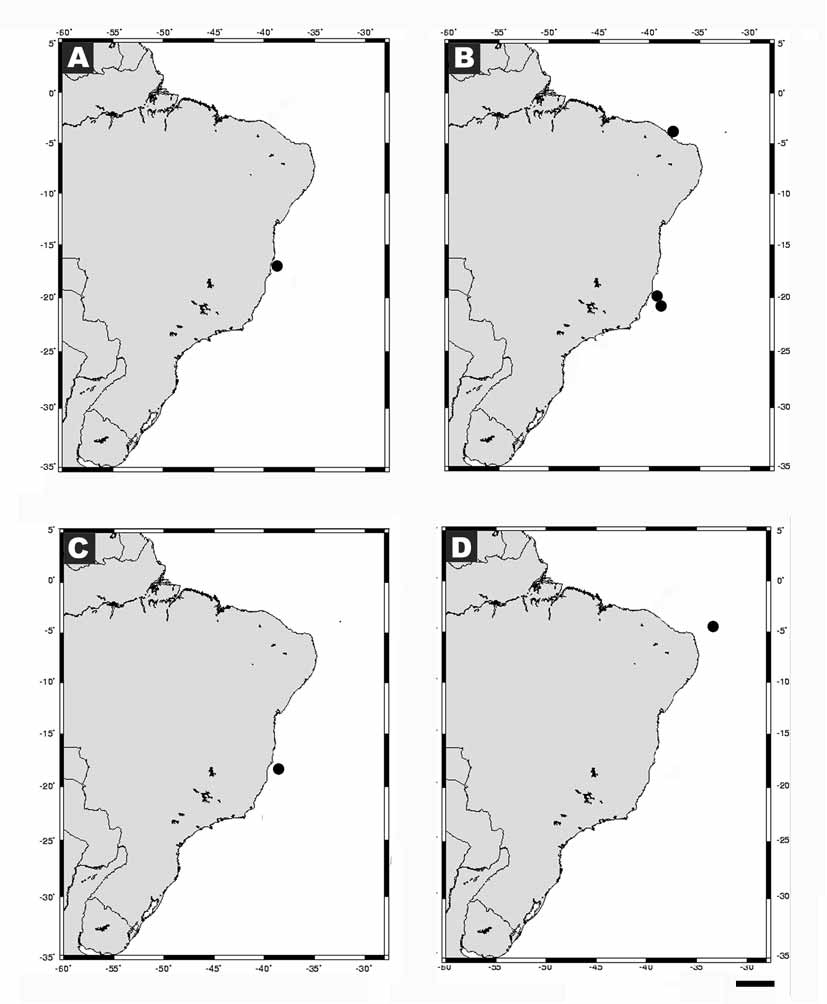
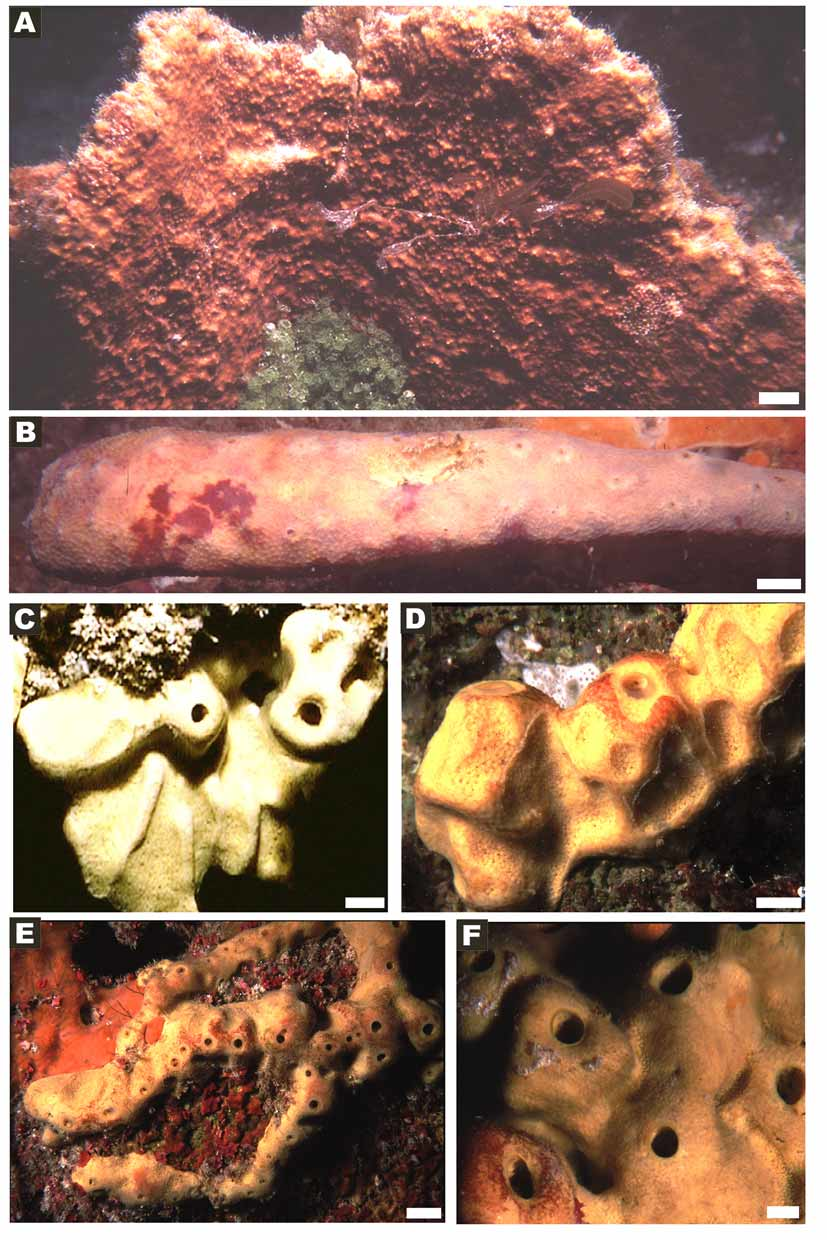
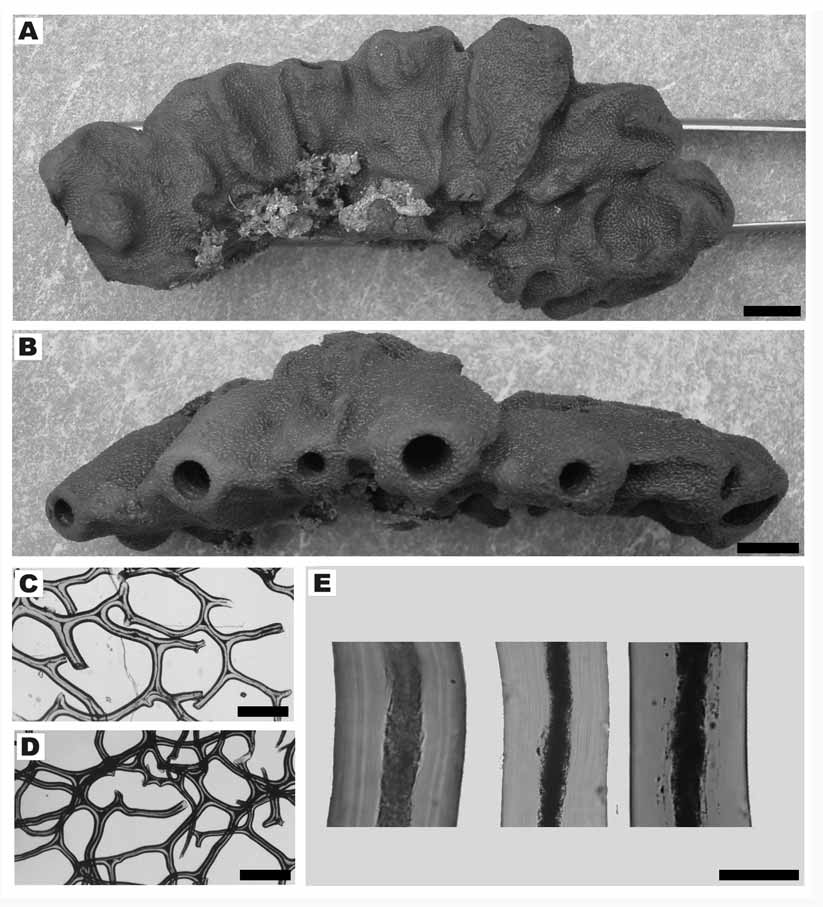
Description of the species: Specimens are composed of laterally anastomosed tubes with an irregular polygonal outline, in creeping groups of up to 45 tubes, with clusters having a maximum of 36 cm in length and 3 cm in width. The polygonal outline results from discrete edges extending upwards from the base of the sponge on its free sides (Figs. 17 C – F, 20 A – B). Some short tubes are projected from the base in varied directions. The surface is finely conulose. The sponge possesses large pseudoscula, frequently apical or pseudo-apical (eccentric), varying from 0.5 cm to 1 cm in diameter, small oscula on the tubes’ outer sides being also visible. In specimen MNRJ 2139, oscula have an iris-type diaphragm. The predominant colour in vivo is beige, specimens with green, brown, brownish-beige and red tinges being also common. After preservation in ethanol specimens vary from beige to brown. Consistency is soft. Skeleton: Choanosome with a delicate and irregular network of spongin fibers (Figs. 20 C – D) with amber colour bark 38 – 126 Μm thick (average 72 Μm) and a thick pith that can be black or amber 8 to 50 Μm (average 29 Μm; Fig. 20 E). The presence of spongin fibers wrapped and excavated by filamentous structures, possibly fungi, was observed in some specimens as in Aplysina pseudolacunosa sp. n. TABLE X: Spongin fibres’ measurement data for Aplysina muricyana sp. n. (in micrometers; S. D. = Standard Deviation and N = 30). Specimens Locality * Fibers Piths Thinnest Mean Thickest S. D. Thin- Mean Thickest S. D. nest Holotype Atol das Rocas, RN 51.3 75.2 117.3 12.3 11.3 17.4 27.6 3.4 MNRJ 6196 Paratype Atol das Rocas, RN 50.0 84.2 126.3 18.6 12.5 16.4 22.5 3.0 MNRJ 2139 Paratype Atol das Rocas, RN 52.5 73.8 91.3 9.0 12.5 19.3 28.8 3.8 MNRJ 2168 Paratype Atol das Rocas, RN 41.3 74.5 105.0 16.7 10.0 14.9 28.8 4.1 MNRJ 2173 MNRJ 4493 Atol das Rocas, RN 42.5 65.3 83.8 9.8 12.5 18.2 25.0 4.2 Distribution: Provisionally known only from the type locality, Atol das Rocas (RN, Brazil; Fig. 16 D). Ecology: All specimens were collected in shallow-waters at Atol das Rocas, inside large crevices, and the species is thus considered to be sciaphilous. Inside the atoll, depth of occurrence was limited to 5 m, but outside the atoll ring, specimens were seen down to 15 m. Specimens in darker areas were completely beige, and those more exposed to light, more intensely pigmented with darker colours, as a likely consequence of association with cyanobacteria.
Common Names
No common names available.
Taxonomic Hierarchy
Kingdom: Animalia
Phylum: Porifera
Class: Demospongiae
Order: Verongiida
Family: Aplysinidae
Genus: Aplysina
Species: Aplysina muricyana Pinheiro, Hajdu & Custódio, 2007
Aplysina muricyana Pinheiro, Hajdu & Custódio, 2007