Aplysina caissara Pinheiro & Hajdu, 2001
Description
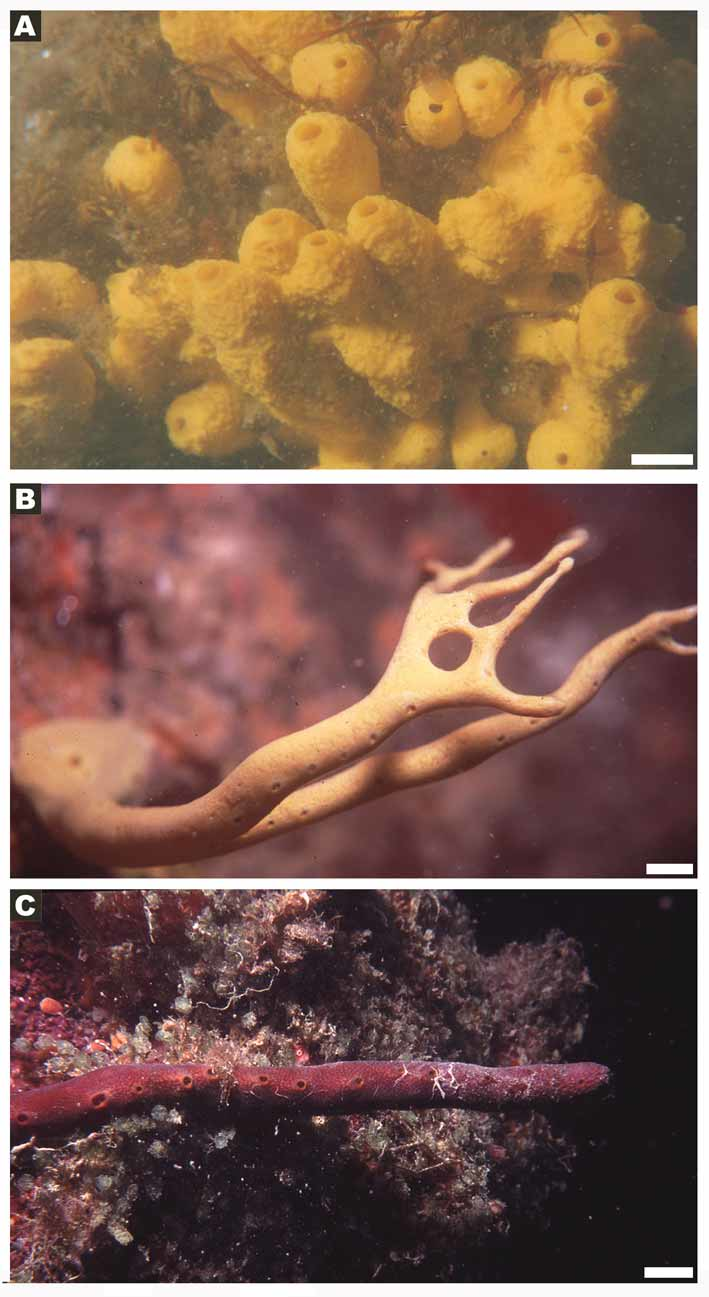
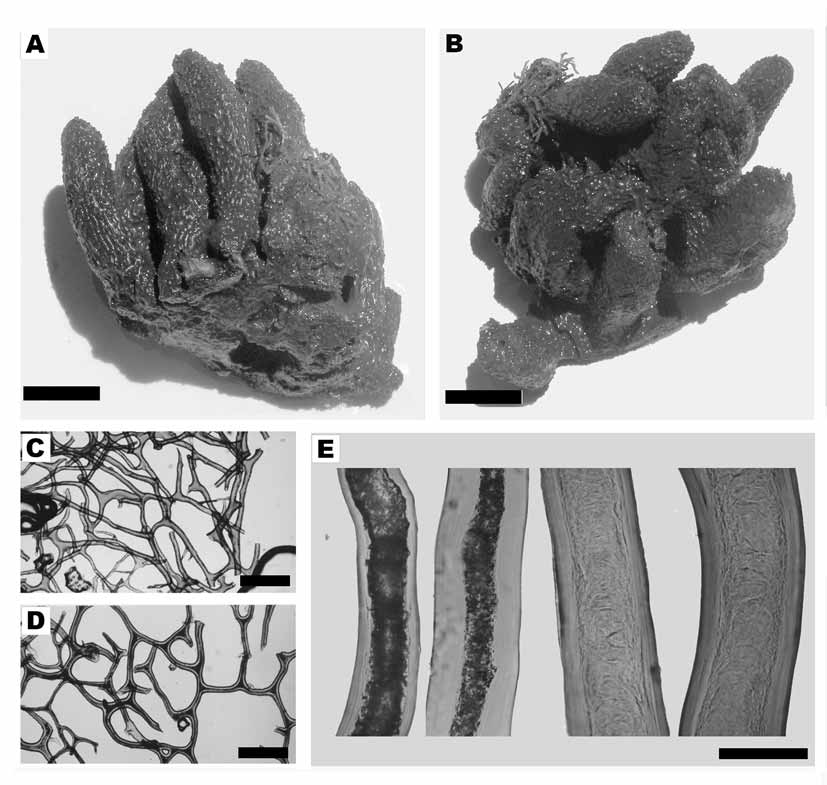
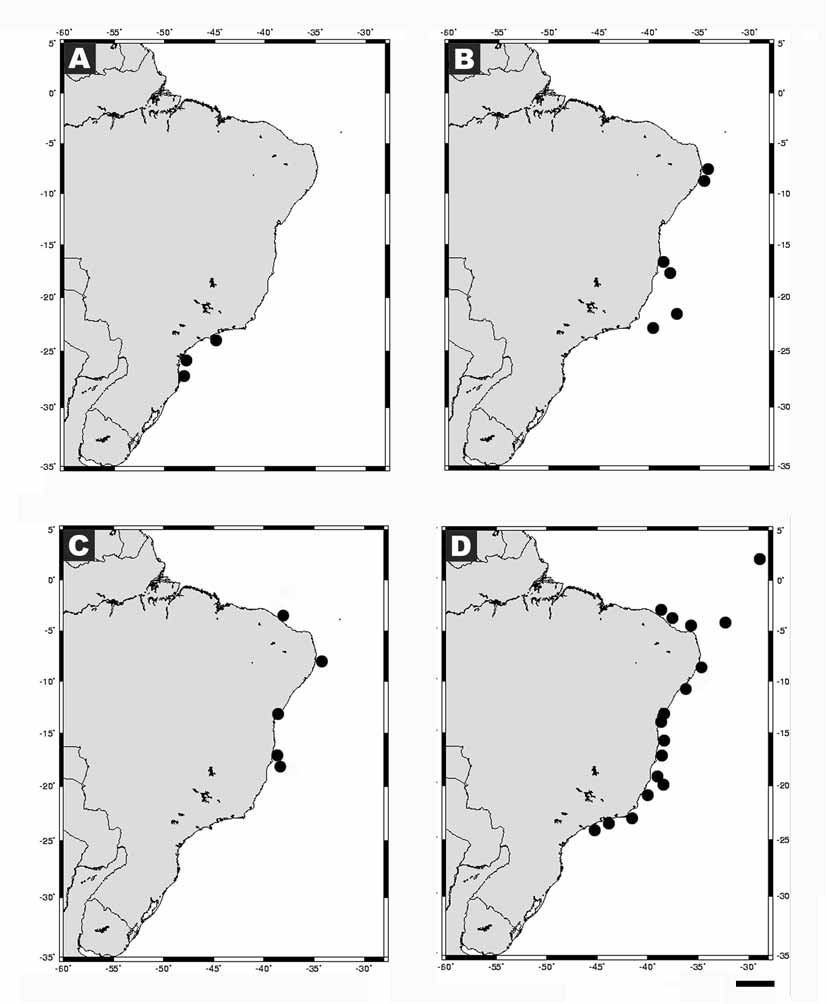
Description: Specimens can have few (3 – 4) or many digits (60 – 80), which are mostly erect. Digits can be single or anastomosed, cylindrical (fusiform or straight) or slightly volcaniform (rare), 1 – 6 cm high and 0.6 – 1.5 cm wide (Figs. 1 A, 2 A – B). Area coverage can be as large as 25 x 15 cm, but more often about 6 x 6 cm. Surface is finely conulose. Oscula are mostly apical (1.5 – 4 mm in diameters), but few lateral and smaller (ca. 1 mm in diameter) can occur. The colour is bright yellow in vivo, which turns into deep purple after preservation in alcohol. Consistency is soft and flexible Skeleton: Choanosome with a delicate and irregular network of spongin fibers. They have a bark with amber colour and thickness of 25 – 100 Μm (average 44 Μm), and black or amber pith with thickness varying between 11 and 81 Μm (average 16 Μm) (Figs. 2 C – E, Tab. I). TABLE I: Spongin fibres’ measurement data for Aplysina caissara Pinheiro & Hajdu, 2001 (in micrometers; S. D. = Standard Deviation and N = 30). Specimens Locality * Fibers Piths Distribution: Provisionally endemic from southern and southeastern Brazil (24 – 28 º S, Fig. 3 A). This area is known as the Paulista Biogeographic Province. Ecology: The species has a typically patchy distribution, being often very rare, but reaching considerable densities at a few spots, where specimens can be found every couple of meters. Its known depth distribution is from 0.5 to 12 m. Few specimens are found at very shallow depths (0.5 – 3 m) in places of somewhat restricted water flow, where temperatures may reach 28 º C. However, most are located in areas of large water circulation and intermittently exposed to the Central South Atlantic waters, with temperatures reaching a minimum around 13 º C (Pinheiro & Hajdu, 2001).
Common Names
No common names available.
Taxonomic Hierarchy
Kingdom: Animalia
Phylum: Porifera
Class: Demospongiae
Order: Verongiida
Family: Aplysinidae
Genus: Aplysina
Species: Aplysina caissara Pinheiro & Hajdu, 2001
Aplysina caissara Pinheiro & Hajdu, 2001