Coregonus clupeaformis (Mitchill, 1818)
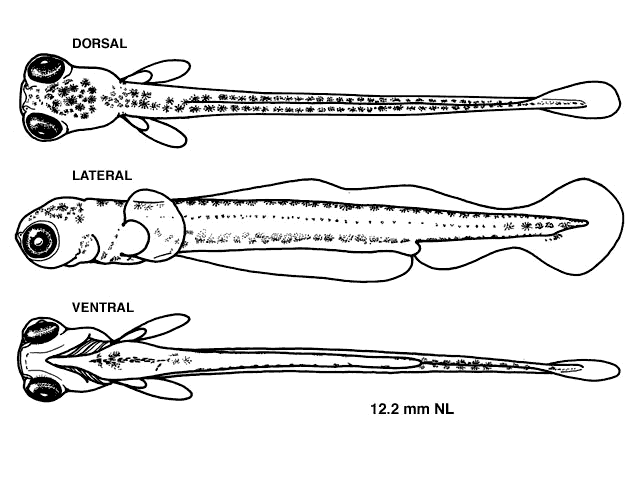
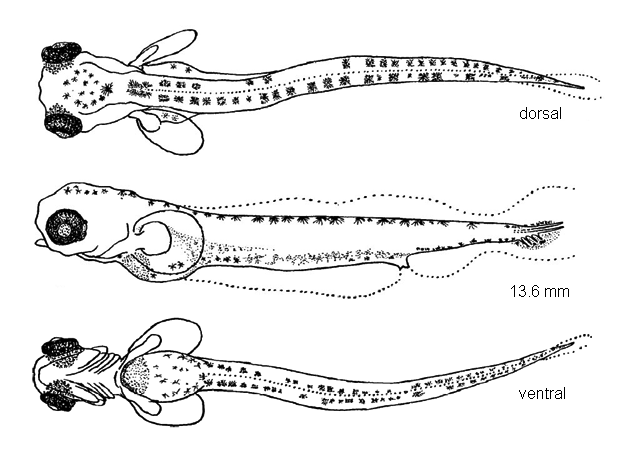
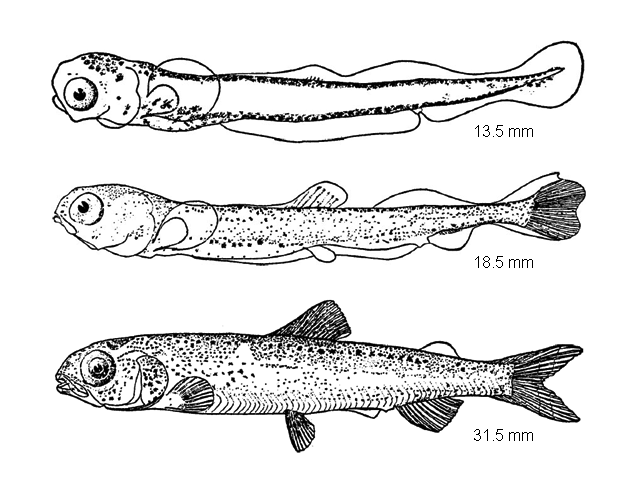
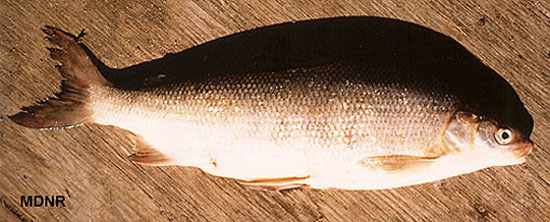
Description
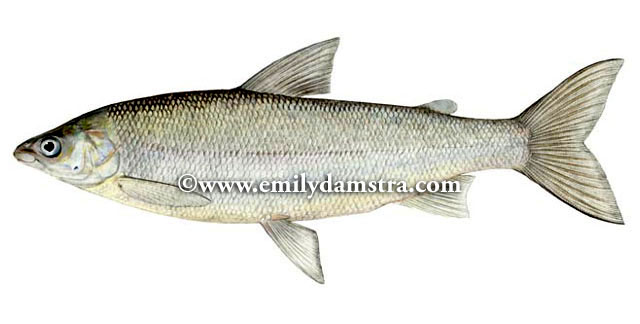
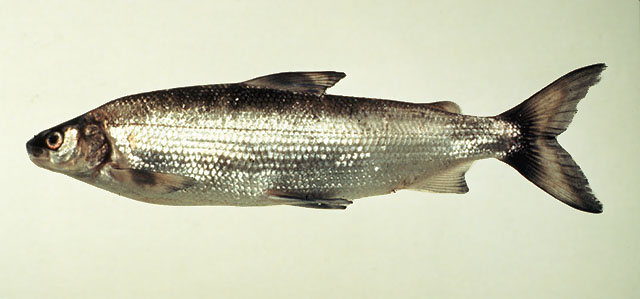
Dorsal spines (total): 0; Dorsal soft rays (total): 11 - 13; Anal spines: 0; Anal soft rays: 10 - 14; Vertebrae: 55 - 64. Adipose fin well developed, often larger in males; axillary process present in pelvic fins (Ref. 27547). Dark brown to midnight blue above fading to silver on sides and wide beneath; no parr marks in young (Ref. 27547).
Common Names
Taxonomic Hierarchy
Kingdom: Animalia
Phylum: Chordata
Class: Teleostei
Order: Salmoniformes
Family: Salmonidae
Genus: Coregonus
Species: Coregonus clupeaformis (Mitchill, 1818)
Climate Zone
Location
- North America: Atlantic, Arctic and Pacific basins throughout most of Canada south into New England, the Great Lakes basin, and central Minnesota, USA; Copper and Susitna river drainages in Alaska. Introduced in northwestern USA (Ref. 86798). This species was stocked into high Andean lakes in two countries in southern Latin America (Ref. 1739). Probably conspecific with Coregonus lavaretus (Ref. 7506). Belongs to Coregonus clupeaformis complex (Ref. 27547).
Biology
Inhabits large lakes and large rivers and enters brackish water (Ref. 86798). Primarily a lake dweller (Ref. 27547). Nerito-pelagic (Ref. 58426). Appears to be rather sedentary, at least in the Great Lakes (Ref. 27547). Movement in large lakes generally consists of 4 stages: movement from deep to shallow water in the spring; movement back to deep water in the summer as the shoal water warms; migration to shallow-water spawning areas in the fall and early winter; and post-spawning movement back to deeper water (Ref. 27547). Forms separate populations in large lakes (Ref. 27547). Adults feed mainly on aquatic insect larvae, mollusks and amphipods (Ref. 1091, 3849); also other fishes and fish eggs, including their own (Ref. 1998). Extensive hatchery programs for the propagation have been carried out on the Great Lakes and other areas for years (Ref. 3746, 3849). Valued for its meat as well as for its roe, which is made into an excellent caviar; utilized fresh, smoked, and frozen; eaten steamed, fried, broiled, boiled, microwaved, and baked (Ref. 9988).
Habitat
brackish
Conservation Status
Not Evaluated
Threat to Humans
Harmless
Coregonus clupeaformis (Mitchill, 1818)