Paguristes haigae Ayón Parente & Hendrickx, 2007
Description
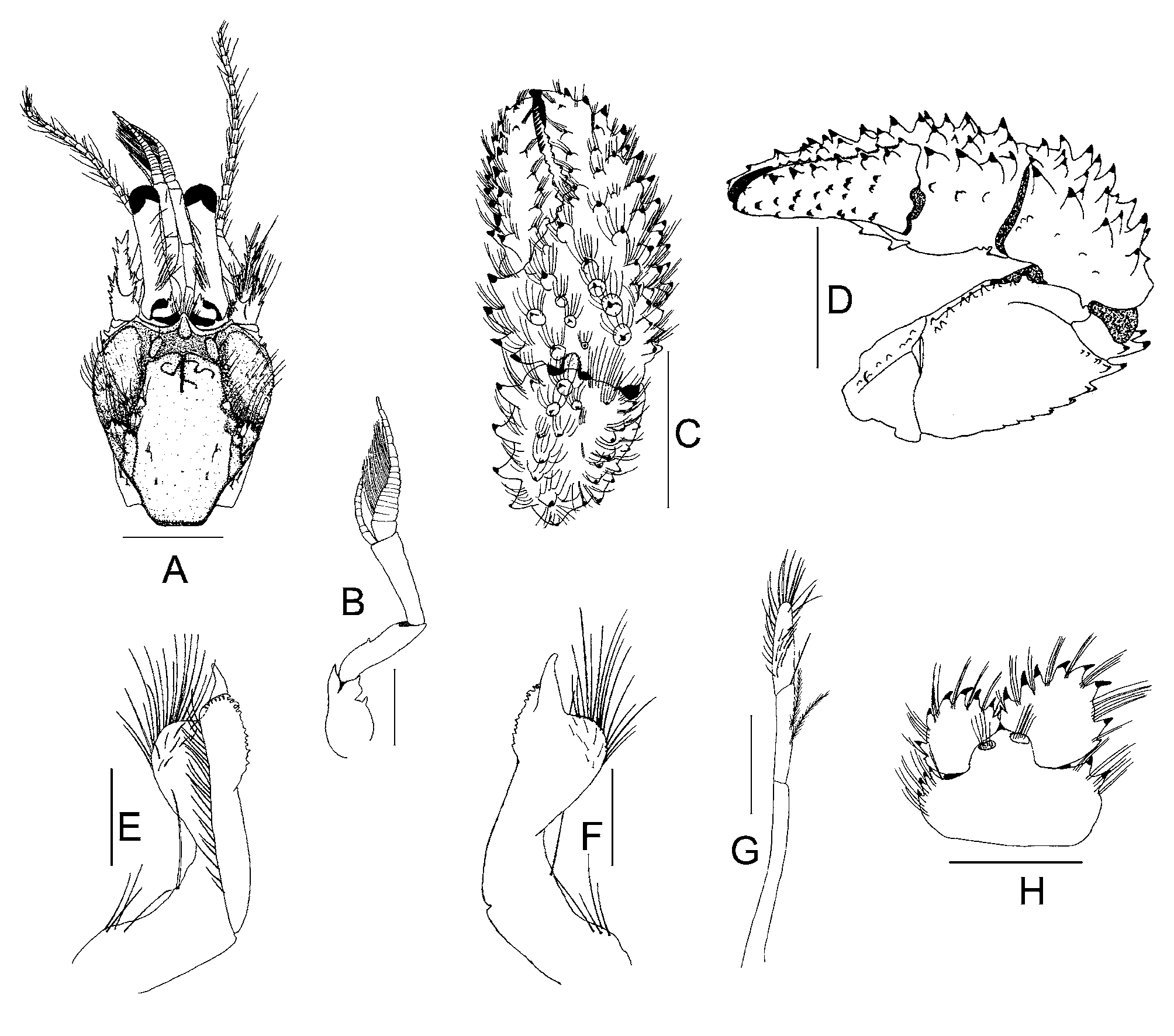
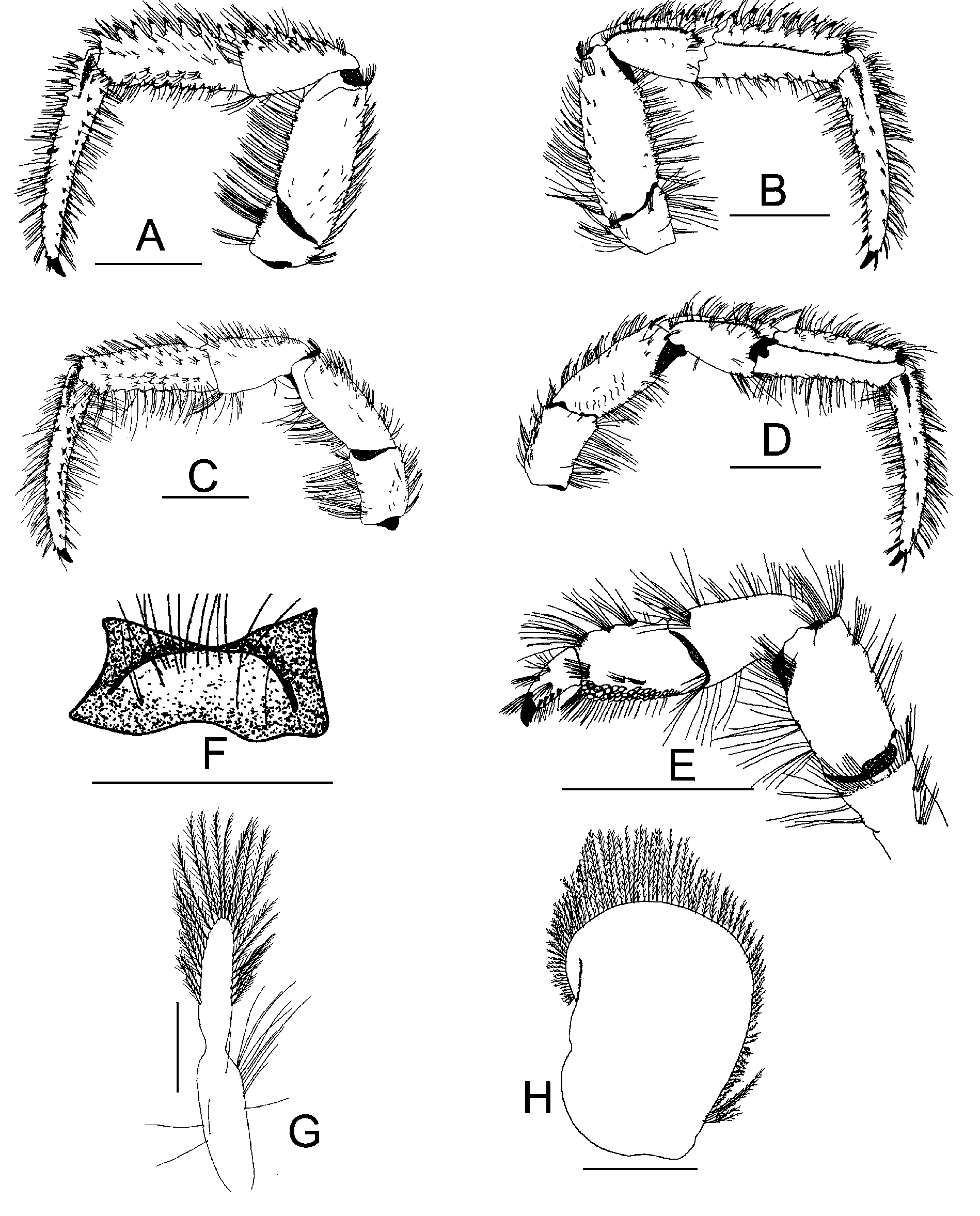
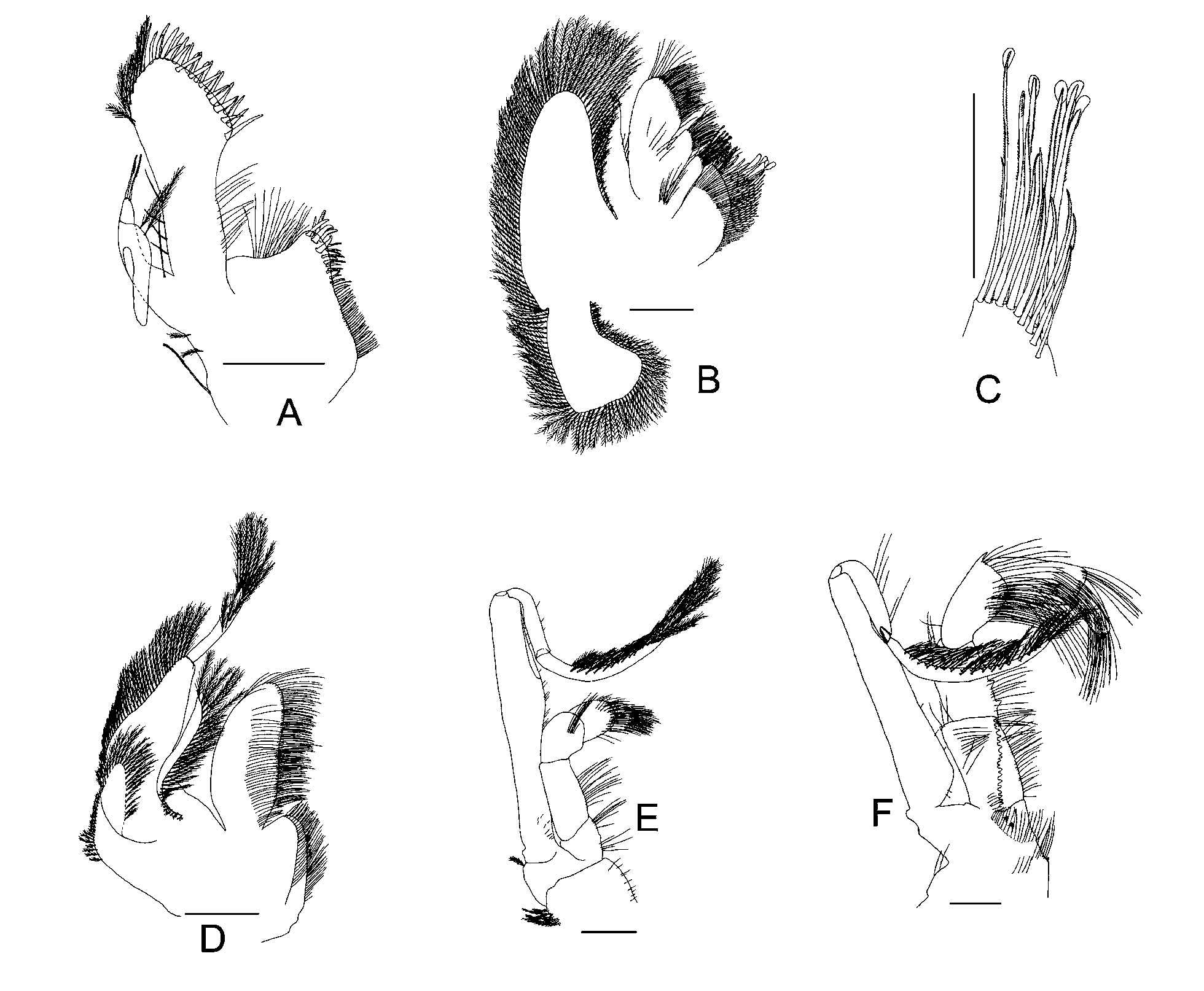
Description. Thirteen pairs of biserial gills; branchiostegites each with few spinules on distal margin and dorsal margin, concealed by moderately dense long setae. Shield (Fig. 1 A) longer than broad; dorsal surface almost smooth with some spines and spinules on lateral surface and scattered tufts of long setae. Rostrum terminally blunt, tip with marginal setae, reaching beyond base of ocular acicles and slightly overreaching lateral projections. Lateral projections triangular, each with small terminal spine. Ocular peduncle 0.63 – 0.67 length of shield, slender, dorsomesial surface with row of short setae; corneal diameter 0.20 – 0.23 peduncular length. Ocular acicle wide basally, subtriangular or subquadrate, ending in simple or bifid spine, lateral margin unarmed, acicles separated by space approximately 0.50 – 0.70 basal width of one acicle. Antennular peduncle (Fig. 1 A, B) moderately long, when fully extended equal to ocular peduncle or exceeding by 0.25 length of ultimate segment. Ultimate segment unarmed; penultimate segment with small spine on ventromesial margin in proximal half; basal segment with moderately strong spine on ventrodistal margin, mesial and lateral surfaces each with strong spine on distal margin, small spine on lateral face of statocyst lobe. Antennal peduncle moderately long, reaching 0.67 – 0.70 length of ocular peduncle; fifth segment with few scattered tufts of setae; fourth segment with strong spine dorsodistal; third segment with ventral margin strongly produced, ending in strong spine; second segment with dorsolateral distal angle produced, ending in bifid spine, lateral margin with 2 or 3 strong spines, 1 smaller spine on distal third of dorsolateral surface, dorsomesial angle with 1 strong spine, mesial margin with 1 or 2 moderately strong spines and tufts of setae; first segment with 1 laterodistal spine, ventral margin strongly produced, rounded. Antennal acicle moderately long, reaching to distal margin of fifth peduncular segment, terminating in prominent bifid spine; ventrolateral margin with 1 small spine, 1 or 3 spines on dorsolateral margin, 3 to 4 spines on mesial margin and tufts of setae concealing partially armature. Antennal flagellum as long as shield; articles each with short setae (shorter than 1 article length) on proximal half, distal half with 2 long setae (longer than 2 articles length) and several setae (shorter than 1 article length). Mandible without distinguishing characters. Maxillule (Fig. 3 A) with proximal (coxal) endite subquadrate, distal (basial) endite subrectangular, enlarged distally, with rigid setae on internal margin; endopod with 1 proximal seta and 2 to 4 terminal bristles on weakly produced internal lobule, external lobule well developed, recurved, approximately 0.67 length of endopod, outer angle with 2 long plumose setae. Maxilla (Fig. 3 B, C) with endopod moderately long, proximal half somewhat inflated, slightly exceeding scaphognathite in distal extension; proximal and distal lobes of coxal endite with setae. First maxilliped (Fig. 3 D) with endopod shorter than basial segment of exopod, epipod well developed. Second maxilliped (Fig. 3 E) with basis-ischium fusion incomplete. Third maxilliped (Fig. 3 F) with basis-ischium fusion incomplete; basis with 2 to 4 small spines on ventral margin; ischium with crista dentata well developed, with 13 to 20 corneous denticles, without accessory tooth, with 1 small spine at dorsodistal and ventrodistal angles; merus with 3 to 4 spines on ventral margin, dorsodistal margin with 1 small spine; carpus with 1 small spine at dorsodistal and ventrolaterodistal margins. Chelipeds equal, similar, short and tomentose (Fig. 1 C, D). Dactyl 1.50 longer than palm, ending in moderately strong, spoon-shaped claw; dorsomesial margin with row of strong, corneous-tipped spines, decreasing in size distally, and tufts of stiff plumose setae; lateral margin with row of moderately strong, corneoustipped spines accompanied with tufts of setae; dorsal surface with 2 rows of small tipped spines accompanied with tufts of setae; mesial face (Fig. 1 D) and ventromesial margin with moderately strong granules or corneous-tipped spines accompanied with tufts of stiff setae or bristles; ventral face each with few tufts of stiff setae or bristles; cutting edge with row of calcareous (proximally) and corneous (distally) teeth. Palm moderately long, about 0.50 length of carpus; dorsomesial margin each with 4 strong, corneous-tipped spines, the 2 proximal closely set; dorsolateral margins each with row of corneous-tipped spines decreasing in size proximally and distally; dorsal surface with 4 irregular rows of corneous-tipped spines accompanied with moderately long plumose setae; mesial, lateral and ventral faces with few moderately strong, corneous-tipped spines accompanied with tufts of long stiff setae. Fixed finger ending in moderately strong spoon-shape claw; a few corneous-tipped spines and tufts of stiff setae on dorsal face; inner proximal edge with some small corneous teeth; cutting edge with moderately strong calcareous teeth proximally and corneous teeth distally. Carpus moderately short, approximately 0.70 length of merus; dorsomesial margin with 4 strong, corneous-tipped spines accompanied with tufts of long rigid setae; dorsolateral margin with 6 or 7 strong or moderately strong, corneous-tipped spines; dorsal face with few strong or moderately strong spines and tufts of setae; mesial and outer faces with few small granules ending in spines or corneous-tipped spines, and tufts of stiff setae; ventrolateral angle with one small tipped spine; ventral surface unarmed. Merus subtriangular; dorsal face with 1 row of small tipped spines increasing in size distally and forming transversal rows of strong or moderately strong tipped spines accompanied with tufts of long plumose setae, subdistal and distal margins each with strong or moderately strong corneous-tipped spines extending on lateral and mesial margins; mesial face smooth; outer face with spinules or small spines; ventromesial and ventrolateral margins each with row of small spines increasing in size distally; ventral face with scattered spinules distally. Ischium with row of small spines on ventromesial margin. Coxa with 1 small spine at ventrodistal margin, concealed by tufts of long, plumose setae. Pereopods 2 and 3 similar (Fig. 2 A – D), left slightly longer than right, differing somewhat in armature, tomentose ventrally and dorsally. Dactyl 1.50 – 1.62 longer than propodus; dorsal surface with tufts of moderately long plumose setae on proximal fourth, remainder with tufts of long, moderately stiff setae; dorsomesial margin with row of prominent, corneous-tipped conical or tubular spines proximally, forming row of corneous spines distally, partially concealed by dense tufts of long plumose setae; lateral and mesial faces each with tufts of moderately long setae; ventromesial and ventrolateral margins each with row of small corneous-tipped spines and long plumose setae; ventral margin with 15 – 17 corneous spines, concealed by long, plumose setae. Propodus moderately short, 1.08 – 1.12 length of carpus; dorsal surface with row of prominent corneous-tipped spines (pereopod 2) and smaller spines (pereopod 3), partially obscured by tufts of moderately stiff long setae; mesial, lateral and ventral faces each with rows of small, corneous-tipped spines partially obscured by tufts of plumose setae (pereopod 2); mesial and ventral faces of pereopod 3 each with rows of small corneous-tipped spines partially obscured by tufts of plumose setae; lateral face with longitudinal row of tufts of plumose setae (pereopod 3). Carpus moderately long, 0.75 – 0.78 (pereopod 2) and 0.85 – 0.90 (pereopod 3) length of merus; dorsal surface with 2 longitudinal irregular rows of moderately strong or strong spines, mesial spines longer than lateral (pereopod 2), or with one row of spines increasing in size distally (pereopod 3); mesial face smooth; lateral face with few spinules and tufts of setae, 1 moderately strong spine on the middle laterodistal margin (pereopod 2); ventral face with tufts of long plumose setae on distal margin (pereopod 2); lateral face with 1 longitudinal sulcus flanked by tufts of plumose setae (pereopod 3); lateroventral margin and ventral surface each with tufts of plumose setae (pereopod 3). Merus compressed laterally; dorsal face with row of spinules or small spines obscured partially by tufts of long plumose setae (pereopod 2) and 1 moderately strong spine distally (pereopod 3); mesial face smooth with scattered tufts of very short setae; lateral face with few spinules and tufts of short setae, ventrolateral angle with 1 moderately strong spine and tufts of long plumose setae; ventral surface with double row (pereopod 2) or simple row (pereopod 3) of small corneoustipped spines and tufts of long plumose setae. Ischium with row of small spines on ventromesial margin (pereopod 2); dorsodistal margin with 2 small spines partially obscured by tufts of plumose setae (pereopod 2); dorsal face and laterodistal margin with small spines or spinules and tufts of long plumose setae (pereopod 3). Pereopod 4 (Fig. 2 E) with propodal rasp well developed, with 3 or 4 rows of ovate scales; dactyl moderately long, with 4 or 5 corneous spines posterior to claw; preungual process present; 1 dorsodistal spine on carpus. Sternite XII (pereopods 3) (Fig. 2 F) subrectangular; a middle lobule with tufts of long setae. Male gonopod 1 (Fig. 1 E, F) with tuft of setae on superior mesial angle of basal lobe, mesial margin of basal lobe with 1 seta; single row of small hook-like corneous spines on distal margin of inferior lamella; external lobe conical, overreaching inferior lamella, internal lobe short, rounded, with marginal setae and some few short setae on inner and external surfaces. Gonopod 2 (Fig. 1 G) with basal segment usually naked; endopod with 2 moderately long, plumose setae on mesial margin, distal angle with 1 (small male paratype) or tuft of stiff setae (large male paratype); appendix masculina with long setae on distal margin and inferior surface. Left pleopods 3 – 5 with exopod well developed; endopod rudimentary. Female pleopod 1 (Fig. 2 G) basial segment with few moderately long marginal setae; distal segment with long marginal setae. Brood pouch (Fig. 2 H) subrectangular, large and provided with fringe of plumose setae. Telson (Fig. 1 H) with posterior lobes subcircular, asymmetrical, left larger than right; separated by small, median, shallow cleft; posterior margin of lobes armed with 5 or 6 (right) or 5 – 7 (left) strong, corneous-tipped spines; lateral margins each with 2 or 3 corneous-tipped spines (left stronger than right) and tufts of long setae; anterior lobes with 2 – 4 strong or moderately strong, marginal corneous-tipped spines and tufts of long setae. Color. Specimens fixed over a long period of time. Anterior portion of carapace, ocular peduncles, chelipeds and pereopods showing an orange-reddish coloration; cornea dark-brown or black; antennal acicle, antennal peduncle, antenal flagella and antennular peduncle transparent. Habitat. The three specimens were collected on fine sand sediment in empty shells of Chicoreus erythrostomus (Swainson, 1831) (paratypes) and Haustellum elenensis (Dall, 1909) (holotype).
Common Names
No common names available.
Taxonomic Hierarchy
Kingdom: Animalia
Phylum: Arthropoda
Class: Malacostraca
Order: Decapoda
Family: Diogenidae
Genus: Paguristes
Species: Paguristes haigae Ayón Parente & Hendrickx, 2007
Paguristes haigae Ayón Parente & Hendrickx, 2007