Areopaguristes praedator (Glassell, 1937)
Description
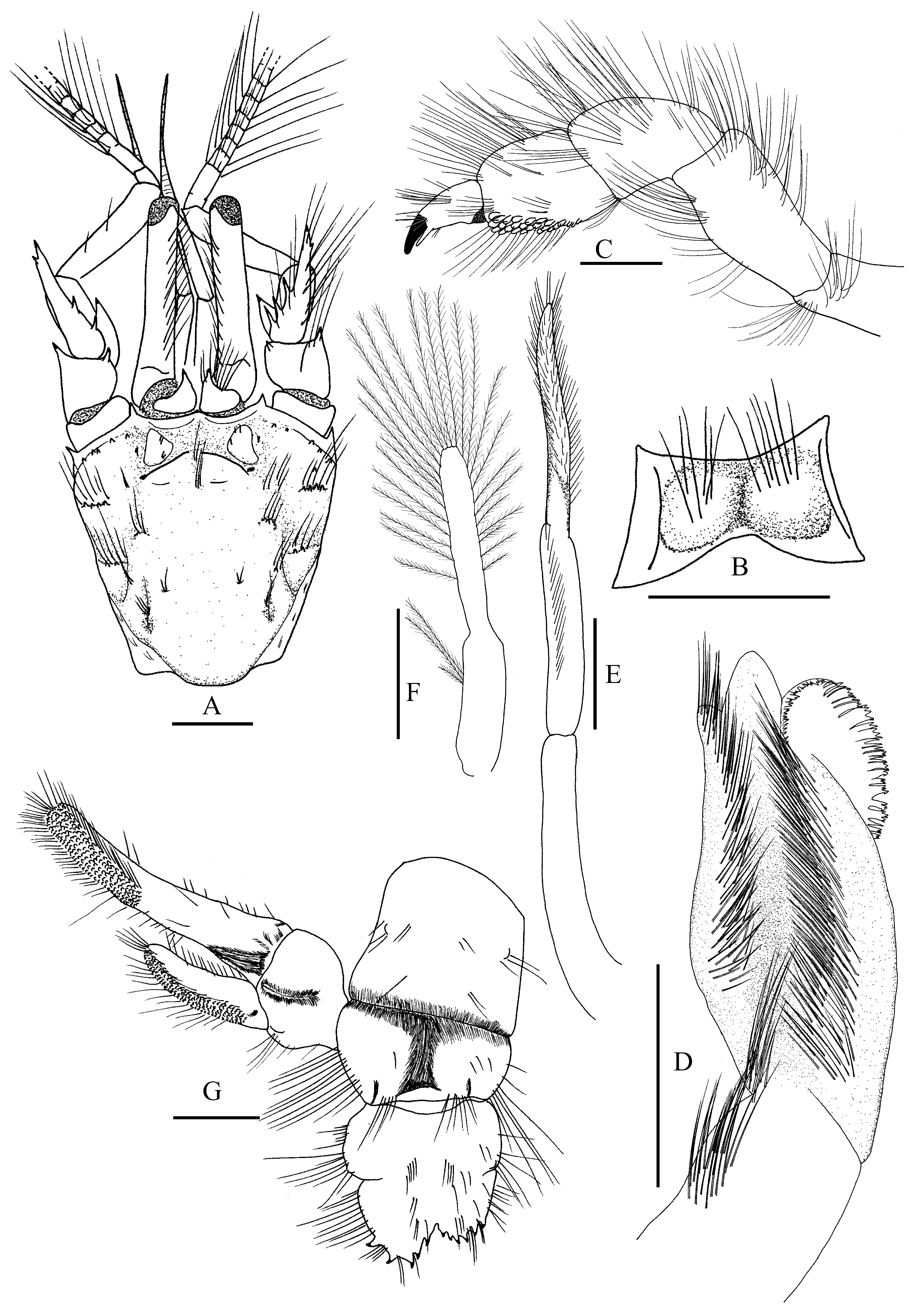
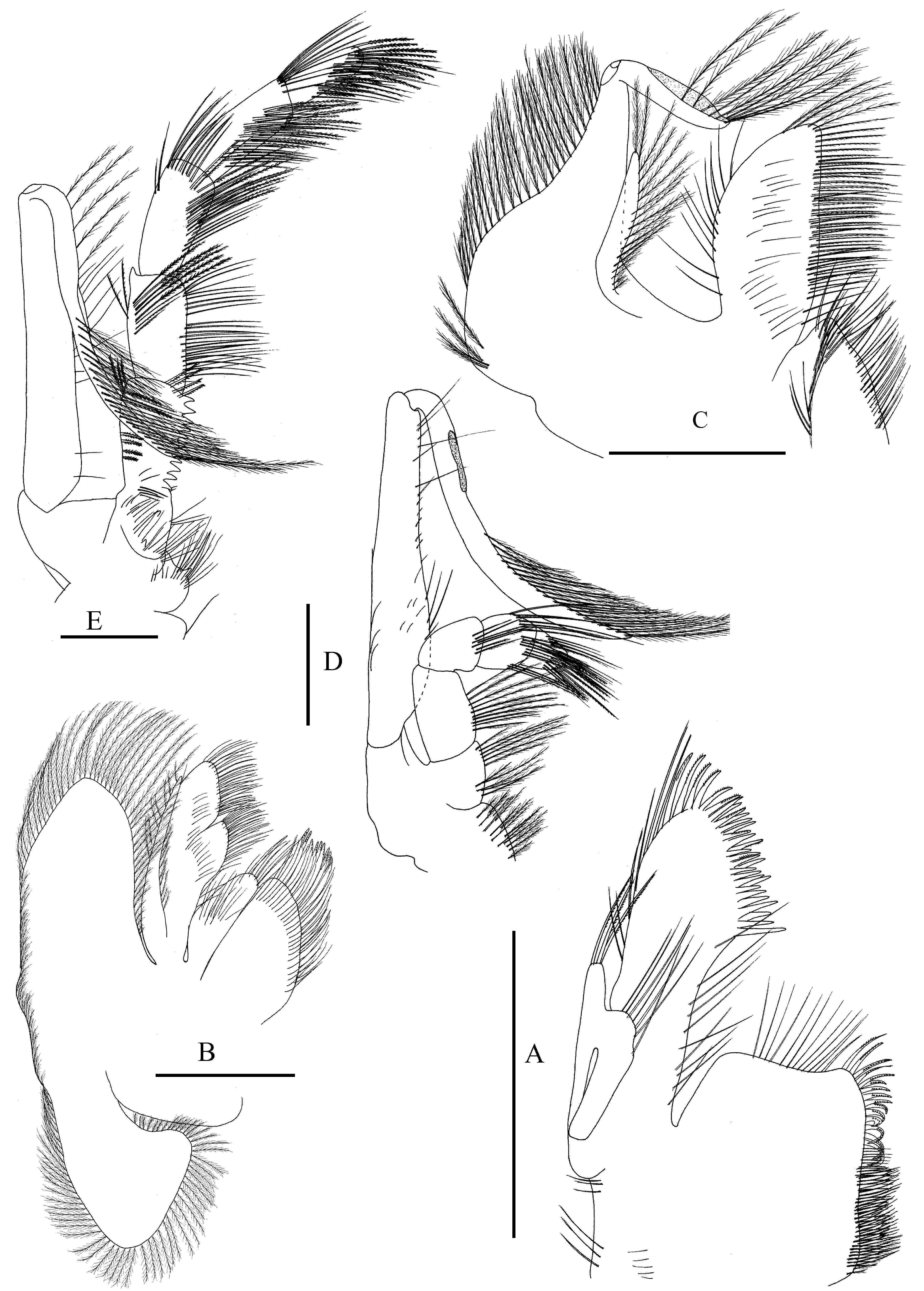
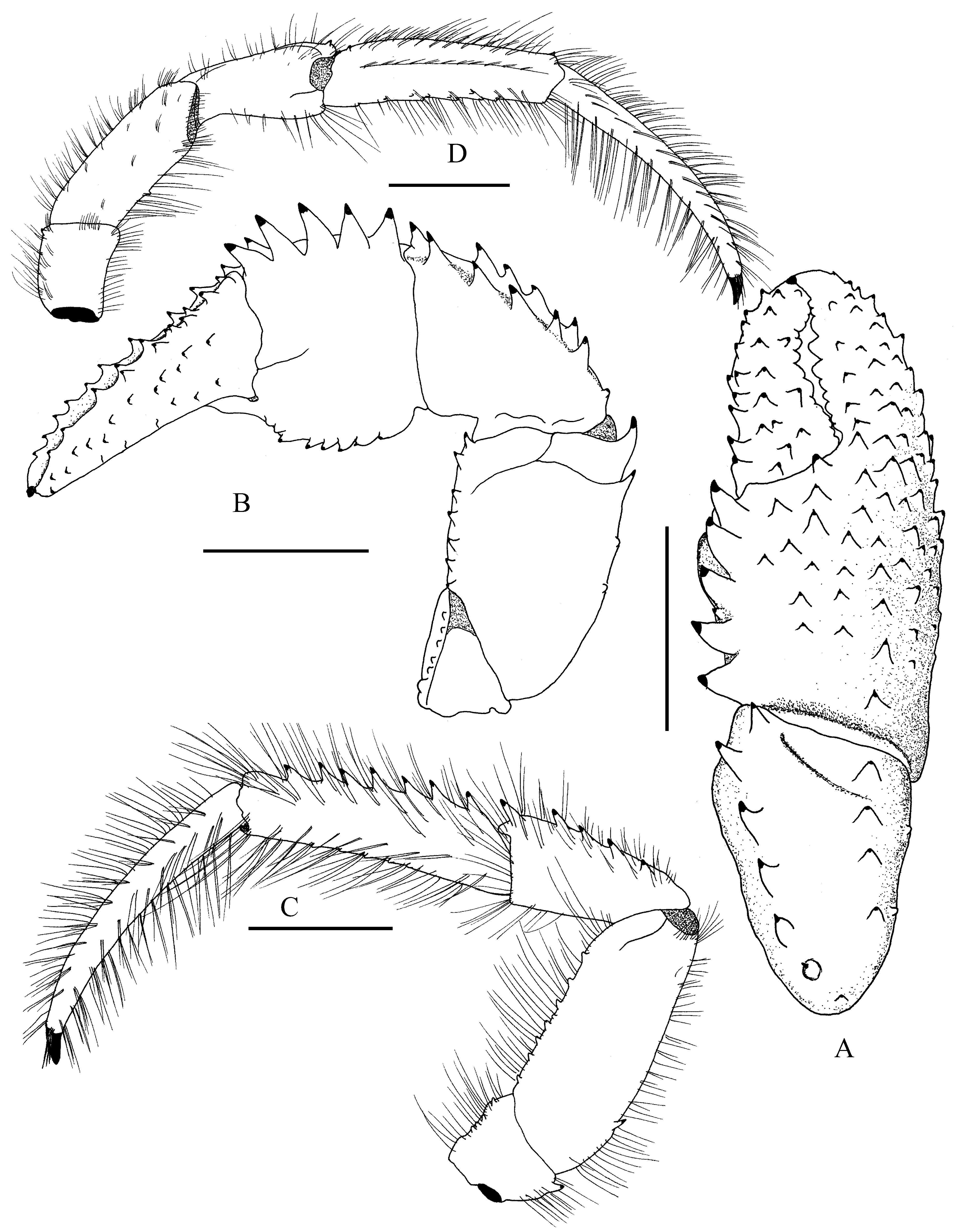
Redescription. Shield (Fig. 1 A) about as long as broad, dorsal surface with few small spines anteriorly, short transverse rows of small spines mostly near anterolateral margins, and scattered tufts of short setae; rostrum blunt, broadly subtriangular, not reaching tip level of lateral projections or basis of ocular acicles, upper surface somewhat concave; lateral projections obtuse, exceeding rostrum in distal extension, ending in marginal spine. Posterior margin rounded. Anterolateral angles each with 1 moderately strong spine. Branchiostegites each with row of spinules on dorsomesial and distal margins, concealed partially by tufts of long setae. Ocular peduncles (Fig. 1 A) long, slender, slightly compressed medially, about 0.90 length of shield. Ocular acicles subtriangular, terminating in strong spine, separated by approximately 0.33 basal width of 1 acicle. Antennular peduncles (Fig. 1 A) long, distal segment overreaching ocular peduncles by 0.50 length of ultimate segment. Ultimate and penultimate segments unarmed, with some tufts of setae on ventral and dorsal margins. Basal segment with 1 small spine on distal ventromesial margin, 1 small spine on laterodistal margin, and 1 moderately strong subdistal spine on lateral margin. Antennal peduncles (Fig. 1 A) with supernumerary segments, overreaching distal margin of corneas by about 0.33 of fifth segment. Fifth segment unarmed, with few short setae on ventrolateral margin and dorsal surface. Fourth segment with small dorsodistal spine. Third segment with 1 strong or moderately strong spine on ventromesiodistal angle and tufts of long setae. Second segment with dorsolateral distal angle moderately to strongly produced, ending in single spine; lateral margin unarmed; dorsomesial distal angle ending in strong spine, mesial margin with tufts of setae. First segment with ventrodistal margin produced, with 1 moderately strong laterodistal spine. Antennal acicle nearly straight, approximately 0.25 length of antennal peduncle, mesial margin armed with 2 – 4 spines, lateral margin with 2 small spines or spinules subdistally, ending in bifid spine. Antennal flagella long, approximately 1.50 length of shield, consisting of about 21 articles and reaching to tip of cheliped fingers when totally extended, ventrally with rows of long setae 3 – 6 flagellar articles in length. Mandible without distinguishing characters. Maxillule (Fig. 2 A) with proximal endite subquadrate, distal endite subrectangular, enlarged distally; endopod with 1 proximal seta, 3 – 5 stout setae or bristles on weakly produced internal lobe, external lobe well developed, recurved, approximately 0.75 length of endopod, external angle with 7 long setae. Maxilla (Fig. 2 B) with endopod moderately long, extending to distal margin of scaphognathite, somewhat inflated basally. First maxilliped (Fig. 2 C) with endopod elongate, approximately 0.70 length of basal segment of exopod, strongly twisted; flagellum short, unsegmented, with long, marginal plumose setae distally; epipod absent. Second maxilliped (Fig. 2 D) with basis-ischium fusion incomplete. Third maxilliped (Fig. 2 E) with joint of endopod and exopod moderately separated; basis-ischium fusion incomplete; coxa with 3 or 4 small spines distally concealed partially by long setae; basis usually with 2 or 3 small spines; ischium with crista dentata well developed, with 10 – 12 teeth, without accessory tooth, usually with 1 small spine on dorsodistal margin; merus with 1 or 2 spines on ventrolateral margin, dorsodistal margin with 1 small spine; carpus, propodus and dactyl unarmed. Chelipeds subequal, right slightly longer than left, similar in armature (Fig. 3 A, B). Dactyls each about 1.75 times longer than palms; dorsomesial margin with row of strong, corneous-tipped spines decreasing in size distally and accompanied with tufts of long setae; dorsal surface with 2 irregular longitudinal rows of corneous-tipped spines accompanied by tufts of long setae; mesial surface with 2 irregular longitudinal rows of spines, upper largest; ventral surface with scattered tufts of long setae; cutting edge with small calcareous denticles interspaced with small corneous spines; terminating in an acute corneous claw overlapped by fixed finger. Palms each about 0.80 length of carpi; dorsomesial margin armed with 5 prominent, corneous-tipped conical spines accompanied with tufts of long setae; dorsolateral margin armed with small, corneous-tipped spines or tubercles, more numerous on fixed finger; dorsal surface with 4 or 5 irregular longitudinal rows of corneous-tipped spines smaller than on dorsomesial margin, each accompanied by tufts of long setae; mesial surface nearly straight, with scattered granules or tubercles, larger near dorsal margin and accompanied by long setae; lateral surface slightly convex, with few small spines accompanied by tufts of long setae; ventral surface with few spines or tubercles extending on fixed finger. Fixed finger ending in small corneous claw; dorsal surface with 2 or 3 irregular longitudinal rows of corneous-tipped spines accompanied by tufts of long setae. Carpi short, each about 0.80 length of meri, subquadrate in cross-section; dorsomesial margin with 5 or 6 strong, corneous-tipped spines increasing in size distally; dorsolateral margin with 4 or 5 small spines; dorsal surface flat, with few tufts of long setae; mesial and lateral surfaces with few flattened granules or tubercles accompanied by tufts of long setae; ventrolateral distal angle with 1 or 2 moderately strong spines. Meri triangular in cross-section; dorsal surface with small granules partially concealed by tufts of long setae; distal and subdistal margins each armed with 1 large corneous-tipped spine; ventromesial and ventrolateral margins spinose, with larger spines on mesial margin; mesial surface smooth; external surface with few small granules and tufts of long setae. Ischia each with row of small spines on ventromesial margin; ventrolateral distal angle with 1 moderately strong spine. Second (Fig. 3 C) and third (Fig. 3 D) pereopods slender, similar right from left except slightly in armature, exceeding to chelipeds by approximately 0.50 of dactyls length when totally extended. Dactyls each 1.30 – 1.40 times length of propodi; dorsal surface with double row of tufts of long setae; mesial and lateral surfaces each with median longitudinal row of setae, longer on mesial surface; ventromesial and ventrolateral margins and ventral surface each with row of tufts of long setae. Propodi 1.28 – 1.30 times length of carpi; dorsal surface with row of 5 – 7 moderately strong spines (second, spines weakly developed and less in number in specimens SL ≤ 2.0 mm), or 1 anterior and 1 posterior (third) and tufts of long setae; mesial surface usually with 2 longitudinal rows of long setae; lateral surface with shallow longitudinal sulcus and usually 2 rows of long setae; ventral surface with 1 irregular (second) or 2 rows (third) of small, spiniform granules accompanied by tufts of short setae. Carpi each 0.77 – 0.88 times length of meri; dorsal surface with 1 row of spines (second), or 1 or 2 small spines (third), 1 distal and 1 posterior, and tufts of long setae; mesial, lateral and ventral surfaces with tufts of long setae. Meri compressed laterally; dorsal surface of each usually with 1 or 2 small spines concealed partially by tufts of long setae; ventral surface with row of spinules on ventromesial margin (second), or with 1 or 2 denticles (third); mesial and lateral surfaces with few tufts of short setae. Ischia each with few small spines on ventromesial margin concealed partially by tufts of long setae; dorsodistal margin with 1 spine (longer on second pereopods). Coxa of second pereopods each with 1 small ventrodistal spine, third pereopods unarmed. Sternite XII (between third pereopods; Fig. 1 B) with anterior lobe subdivided in 2, with tufts of long setae. Fourth pereopods (Fig. 1 C) subchelate; dactyl 0.80 times length of propodus, ventrolateral margin unarmed, preungual process long, slender; propodi each with 3 rows of ovate scales on propodal rasp, and 1 spine on dorsolateral proximal margin. Carpi and meri unarmed. Fifth pereopods chelate; dactyls each with 2 or 3 rows of small corneous spines; propodi each with well developed propodal rasp bearing several rows of small corneous spines. Male first and second pleopods modified as gonopods. First gonopod (Fig. 1 D) with tuft of long setae on mesial margin of basal lobe and superior mesial angle, lateral margin of basal lobe naked; inferior lamella with several rows of long setae on lateral margin, distal margin with row of simple, bifid or trifid, curved corneous spines extending on mesial face; external lobe subtriangular, exceeding inferior lamella in distal extension, naked; inner lobe subtriangular, with setae on mesial margin and inner margin. Second gonopod (Fig. 1 E) with distal segment longer than basal segment, slightly twisted, with long simple setae on laterobasal margin and distally on lateral and mesial margins; basal segment naked. Pleopods 3 – 5 unpaired, exopod well developed, endopod vestigial or absent. Female first pleopods (gonopods, Fig. 1 F) with submedian constriction incompletely dividing basal and distal segments; distal segment with long plumose setae on lateral and distal margins; basal segment naked or with some setae. Pleopods 2 – 5 lacking brood pouch, with dense long setae. Uropods and telson (Fig. 1 G) asymmetrical; protopod with pair of granules or denticles distally. Telson with distinct, deep lateral incisions dividing anterior and posterior portions; posterior portion separated in 2 unequal lobes by moderately deep median cleft, terminal margins of lobes each armed with 5 or 6 corneous-tipped spines, 2 of which on left lobe are largest and on lateral margin of lobe; anterior portions unarmed except for tufts of long setae laterally. Color. According to Glassell (1937: 246), specimens fixed in ethanol: " the ground color is an iridescent cream with dashes and splotches of crimson, this extends to the chelipeds and legs, the former are more highly colored on the inside, while the latter appear to be banded. The setae are a straw colored yellow ". Habitat and ecology. This is an abundant species which occurs rarely in less than 40 m, and frequently in 60 m or deeper (Haig et al. 1970, Ayón-Parente & Hendrickx 2010 a). The material collected by Glassell (1937) was found on sandy substrate with rocks, between 55 – 155 m. Material collected during the SIPCO and CORTES cruises was obtained in 20 – 110 m. The organisms were found on mixed substrate, including sandy substrate mixed with varying proportions of clay and silt, and sand substrates mixed with silt and clay. Epibenthic temperature ranged from 14.5 – 29.4 ° C and oxygen concentration from 1.47 to 4.00 ml / l. Occasionally Areopaguristes praedator nov. comb. can tolerate a range of slight to severe hypoxia (0.39 to <1.00 ml / l). Specimens were mostly found in shells of Phos veraguensis Hinds, 1843, P. articulatus Hinds, 1844, Fusinus panamensis Dall, 1908, Conus sp., Bursa sonorana Berry, 1960, Terebra sp., Hindsiclava militaris Reeve, 1843, Turritela nodulosa King & Broderip, 1832, and Trajana perideris (Dall, 1910). Ovigerous females were observed during the months of February, May, June and August. One female (SL 2.80 mm) was carrying 315 eggs with a diameter range of 0.55 – 0.60 mm.
Common Names
No common names available.
Taxonomic Hierarchy
Kingdom: Animalia
Phylum: Arthropoda
Class: Malacostraca
Order: Decapoda
Family: Diogenidae
Genus: Areopaguristes
Species: Areopaguristes praedator (Glassell, 1937)
Areopaguristes praedator (Glassell, 1937)