Channichthys panticapaei Shandikov, 1995
Description
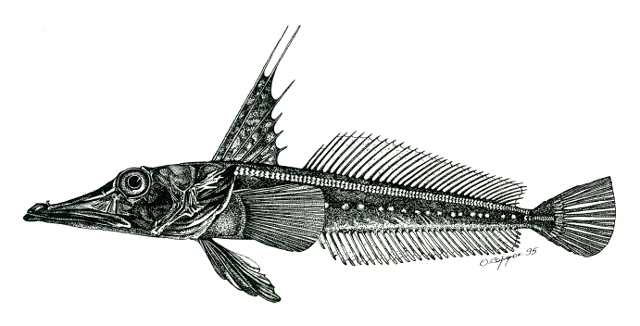
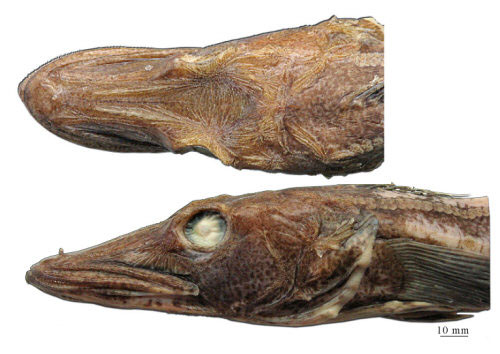
Dorsal spines (total): 6 - 8; Dorsal soft rays (total): 32 - 34; Anal soft rays: 29 - 32; Vertebrae: 55 - 57. This species is characterized by the following: D VI-VIII,32-34 (total); A 29-32; pectoral-fin rays 20-22; vertebrae: 55-57. It is distinguished by the following characters: interorbital width wide, 4.4-5.4 times in HL, wider than horizontal orbit diameter; eyes moderate in size, orbit 5.4-6.5 times in HL, and 2.6-3.1 in snout length and 1.1-1/4 in interorbital width; posterior edge of maxilla extending below 1/2 of the orbit diameter; two rows of rakers on the lower part of 1st gill arch on ceratobranchial and hypobranchial: 11-17 rakers in anterior row, 6-15 in posterior row, 18-31 total; first dorsal fin high, 3.2-5.1 times in SL, with 1st to 3rd spine longest; fin membrane of D1 not reaching tips of longest spines; well separated dorsal fins, posterior edge of D1 fin membrane not reaching 1st ray base of D2; very developed thick rounded bony plates in anterior part of median lateral line; strong bony tuberculation on frontals, dorsal spines, branchiostegals, pelvic rays, maxilla and dentary. Coloration dark-gray to uniformly blackish. (Ref. 90860, 90861, 90862).
Taxonomic Hierarchy
Kingdom: Animalia
Phylum: Chordata
Class: Teleostei
Order: Perciformes/Notothenioidei
Family: Channichthyidae
Genus: Channichthys
Species: Channichthys panticapaei Shandikov, 1995
Climate Zone
Location
- Southern Ocean, Sub-Antarctic: Kerguelen Islands.
Biology
A thalassobathyal, and planktivorous species. Stomach contents contain macroplankton, Parathemisto gaudichaudi and Thysanoessa macrura. It matures at about 30 cm TL (27 cm SL) and spawning probably takes place in June-July. Caught by bottom trawls. (Ref. 90860).
Habitat
demersal
Conservation Status
Not Evaluated
Threat to Humans
Harmless
Channichthys panticapaei Shandikov, 1995