Paragorgia johnsoni Gray, 1862
Description
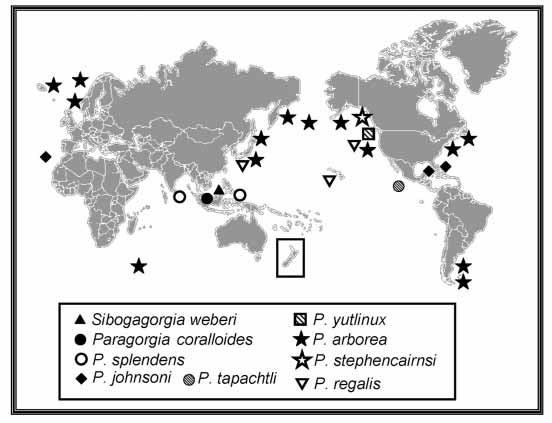
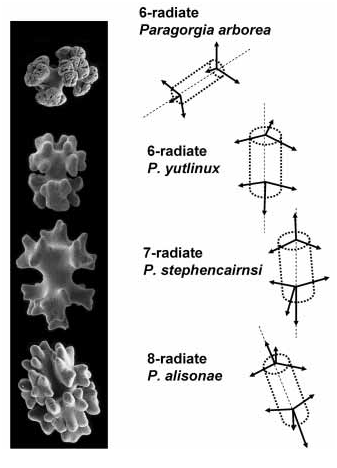
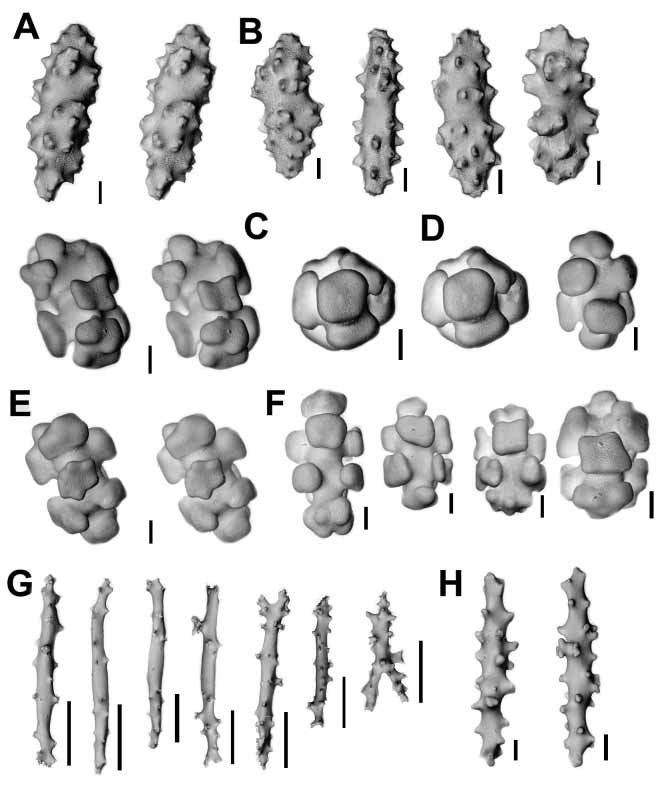
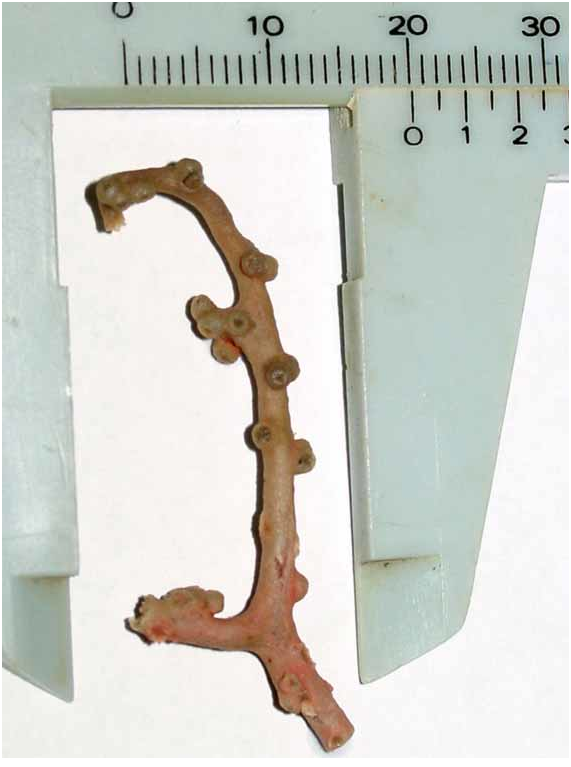
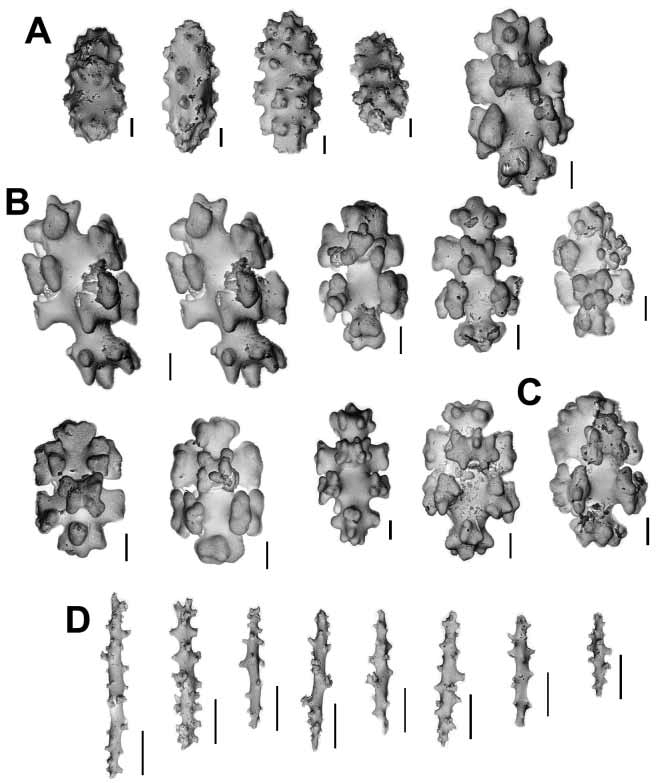
Description. Profusely branched colonies up to 900 mm in length (Grasshoff 1979: Fig. 1) with terminal branches down to 2 – 4 mm in diameter (Grasshoff 1979: Figs. 2 – 3). Numerous short, lateral branches arise from the main branches with an irregular but clavate appearance (Grasshoff 1979: Fig. 1). Autozooid and siphonozooid polyps located towards one side of the colony (Grasshoff 1979: Figs. 2 – 3). Autozooids clustered in distinct nodules (Bayer 1964: 527). Autozooid polyp tentacles with blunt spindles, slightly thicker than in most Paragorgia spp., up to 0.08 mm in length, irregularly ornate with conical rays (Fig. 10 A – B). Surface cortex, including autozooid aperture, with 6 , 7 and 8 radiate (predominant 8 radiates) sclerites up to 0.06 mm averaging 0.05 mm in length (0.003 SD, n = 10) (Fig. 10 C – F). Rays nearly symmetrical with smooth surfaces. Surface radiates about 1.57 times longer than wider, averaging 0.03 mm in width (0.002 SD, n = 10). Medulla with ornate (oftentimes ramified or forked) spindles up to 0.38 mm in length (Fig. 10 G; see also Bayer 1964: 531) with smaller forms in the subsurface / outer medulla (Fig. 10 H). Morphological variation. P. johnsoni exhibits a great deal of variation mostly in the radiate sclerites from the surface cortex. The presence of 6 , 7 , and 8 radiates in this species is also equaled by P. a r b o re a, though including quite different forms and size ranges in each species. In addition, P. johnsoni and P. a r b o re a are the species with the largest geographical and bathymetrical distributions within the group.
Common Names
Taxonomic Hierarchy
Kingdom: Animalia
Phylum: Cnidaria
Class: Anthozoa
Order: Scleralcyonacea
Family: Coralliidae
Genus: Paragorgia
Species: Paragorgia johnsoni Gray, 1862
Paragorgia johnsoni Gray, 1862