Paragorgia whero Sánchez, 2005
Description
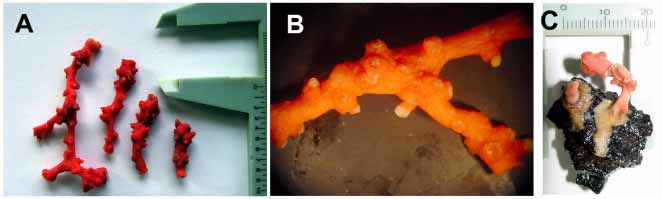
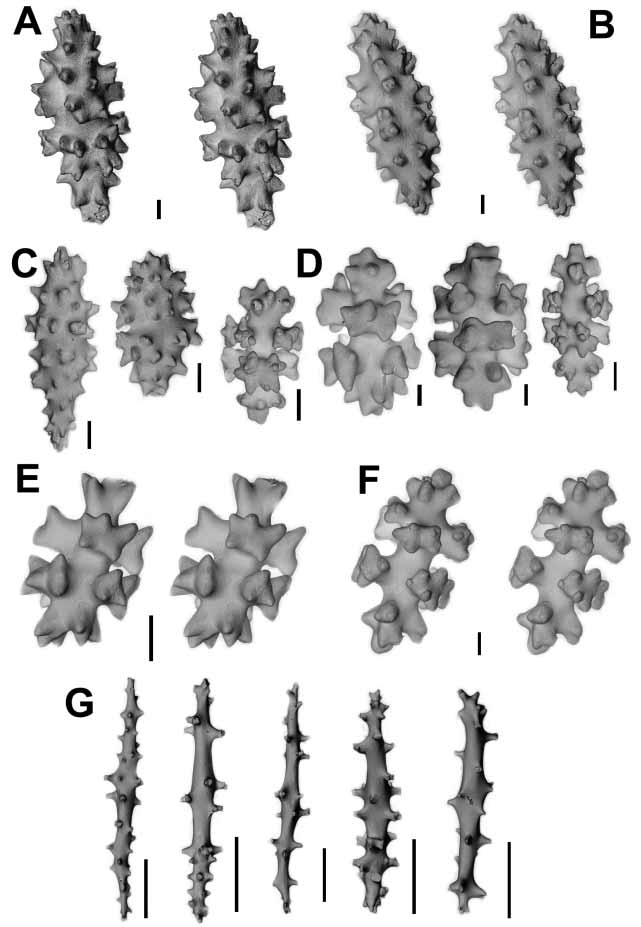
Description. Fragile, slim colonies with branches 3 – 4 mm in diameter at the portions without autozooids (Fig. 32). Autozooids with gregarious tendency in the branches with clusters up to 7 mm in diameter, but also isolated on slimmer portions of the branches (Fig. 32). Autozooid polyps extended in alcoholpreserved specimens; sweeper tentacles, pale yellow. Autozooid polyp apertures conical, semiclosed, projecting up to 2 mm from the branch. Colony easily breakable, larger fragments 63 mm in length (holotype: Fig. 32 A). Color bright red (NIWA 3436) to pink (NIWA 3439), with a white medulla. Medulla at the terminal branches visibly perforated by 2 – 5 large circular internal canals. Polyps with blunt spindles in the tentacles, up to 0.1 mm in length, with radially ornate belts of multiple acute cones (Fig. 33 A – C). Surface sclerites highly ornate, 8 radiatederived, capstanlike sclerites (Fig. 33 D – E), averaging 0.089 mm (0.005 SD, n = 10, NIWA 3436; 0.008 SD, n = 10, NIWA 3439). Surface sclerites 1.65 – 1.74 times longer than wide, averaging 0.05 mm in width (0.004 SD, n = 10, NIWA 3436; 0.006 SD, n = 10, NIWA 3439). Subsurface with forms intermediate to longer spindlelike sclerites (Fig. 33 D). Medulla with long, slim, mostly straight, moderately ornate, spindles up to 0.5 mm in length (Fig. 33 G). Morphological variation. Owing to the small and fragmented nature of the studied material the full range of sizes for P. w h e ro sp. nov. is unknown. In any case, the branches are so fragile it is unlikely that the species attains a large size.
Common Names
No common names available.
Taxonomic Hierarchy
Kingdom: Animalia
Phylum: Cnidaria
Class: Anthozoa
Order: Scleralcyonacea
Family: Coralliidae
Genus: Paragorgia
Species: Paragorgia whero Sánchez, 2005
Paragorgia whero Sánchez, 2005