Paragorgia maunga Sánchez, 2005
Description
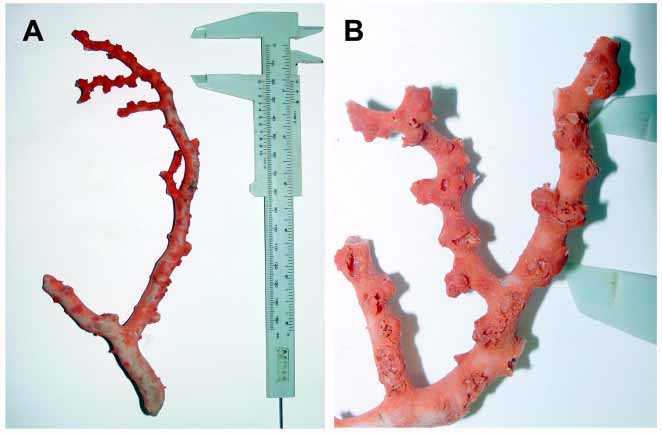
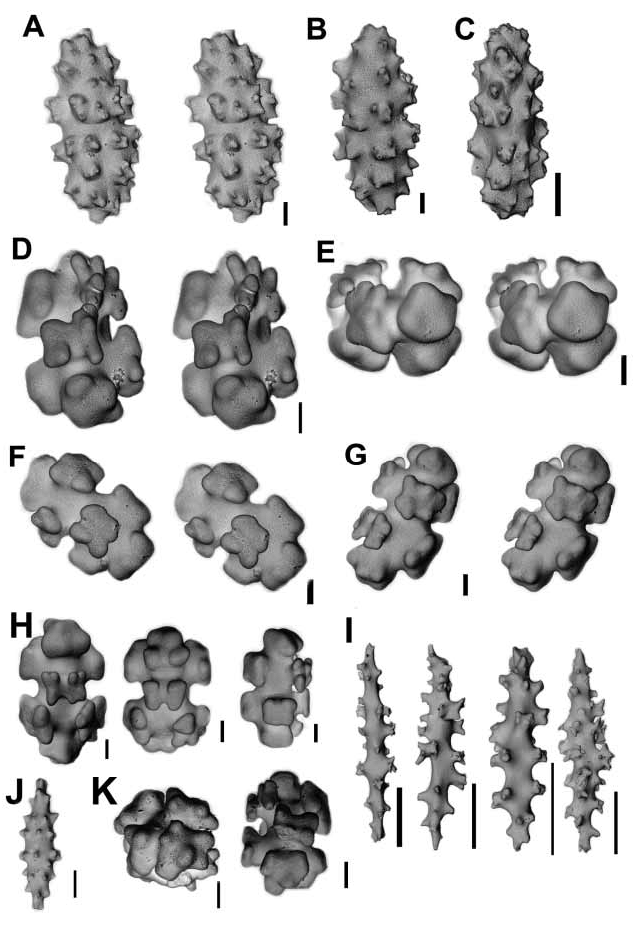
Description. Colonies with a delicate, thin, soft, red cortex; all examined material partially eroded exhibiting the white medulla on surface. The holotype is a fragmented colony 210 mm in length (Fig. 26); the paratypes are broken fragments less than 120 mm long. Branching possibly pseudodichotomous in one plane (no complete specimens available), with autozooid polyps towards one face. Autozooids forming irregular clumps of 3 – 5 polyps (Fig. 26 B). Slimmer parts of branches down to 2 – 3 mm width. Medulla perforated by only 2 – 3 main small canals, tending central, and numerous even smaller canals in both the medulla and subsurface / outer medulla. Center of the medulla, around the main canals, with red sclerites, otherwise colorless with occasional red ones. Autozooid tentacles exhibiting the common red Paragorgia sclerites: ornate ovals up to 0.1 mm in length with conical ornaments throughout (Fig. 27 A – C, J). Surface of the cortex, including autozooid aperture, with small, radiate sclerites up to 0.08 mm in length averaging 0.06 – 0.07 mm (0.006 SD, n = 10, NIWA 3322 = 3324) (Fig. 27 D – H, K). Surface radiates between 1.7 – 1.8 times longer than wide, averaging 0.04 mm in width (0.004 SD, n = 10, NIWA 3322 = 3324). Asymmetrical enlargement of most radial ornaments generating smoothly lobulated subornaments in all rays (Fig. 27 D – H, K). Medulla with long, straight, ornamented (occasional large, irregular projections) spindles up to 0.35 mm in length (Fig. 27 I). Morphological variation. There were some small (<0.01 mm) but significant differences in the size of surface sclerites of two specimens (t = 5.5, df = 19, P <0.001, only 10 sclerites measured in each specimen) although no variance differences were found among the specimens (F = 0.8, df = 9, P> 0.4). Since there is an expected variation in the surface sclerites, i. e., progressively larger towards the subsurface, and the examined specimens were highly eroded during the collection, the differences among specimens could be due to differential sampling in relation to the surfacesubsurface. Nonetheless, all examined specimens clearly exhibit the species diagnostic characteristics (e. g., Fig. 27 A – I vs. J – K).
Common Names
No common names available.
Taxonomic Hierarchy
Kingdom: Animalia
Phylum: Cnidaria
Class: Anthozoa
Order: Scleralcyonacea
Family: Coralliidae
Genus: Paragorgia
Species: Paragorgia maunga Sánchez, 2005
Paragorgia maunga Sánchez, 2005