Paragorgia alisonae Sánchez, 2005
Description
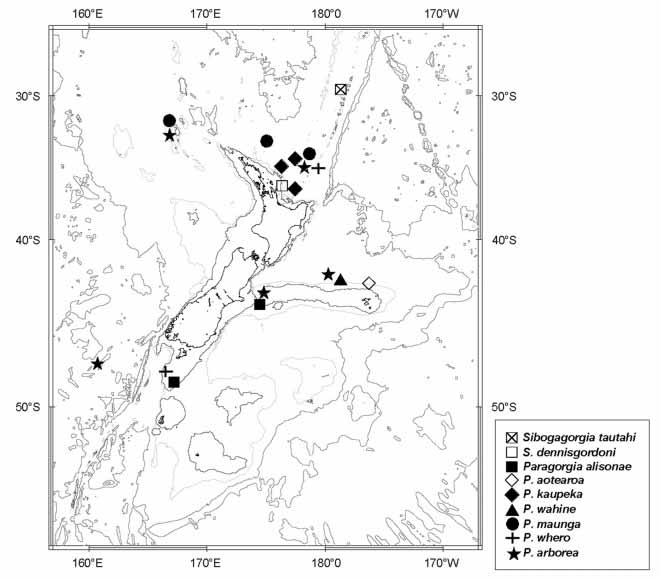
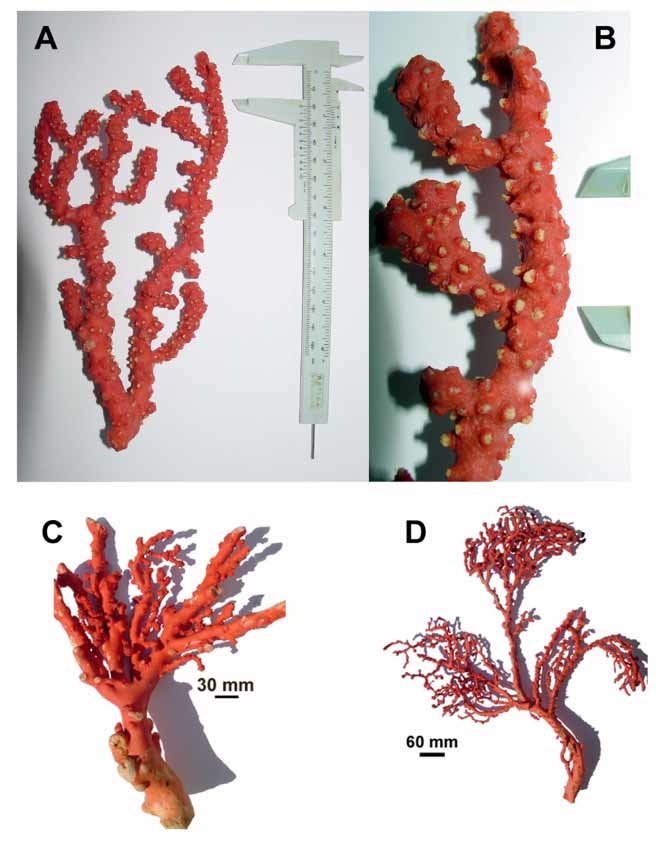
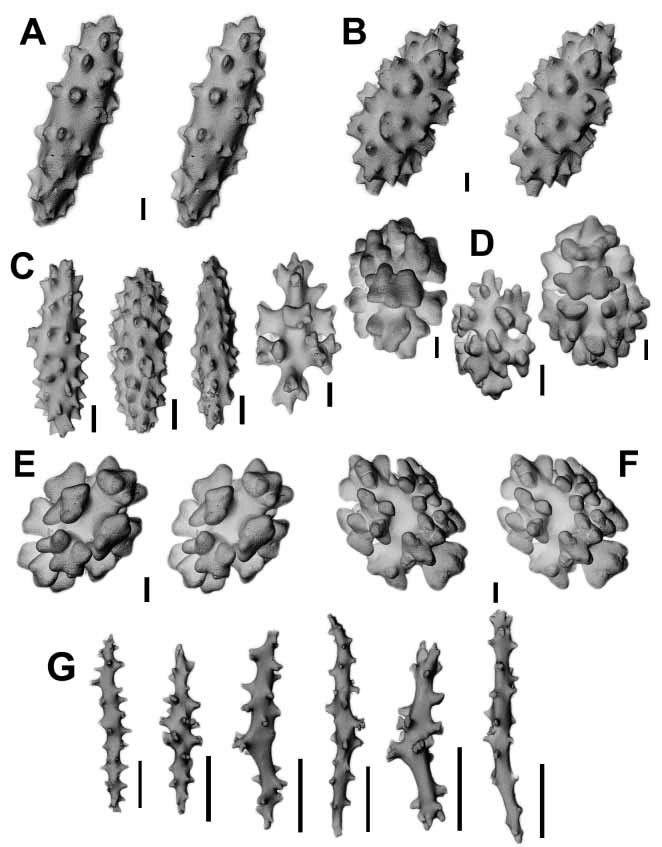
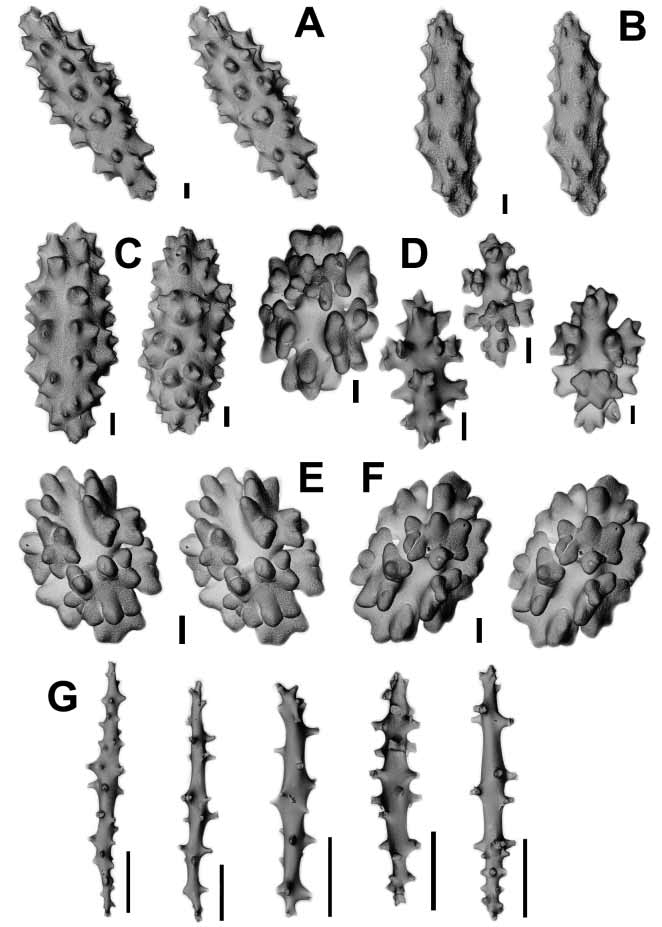
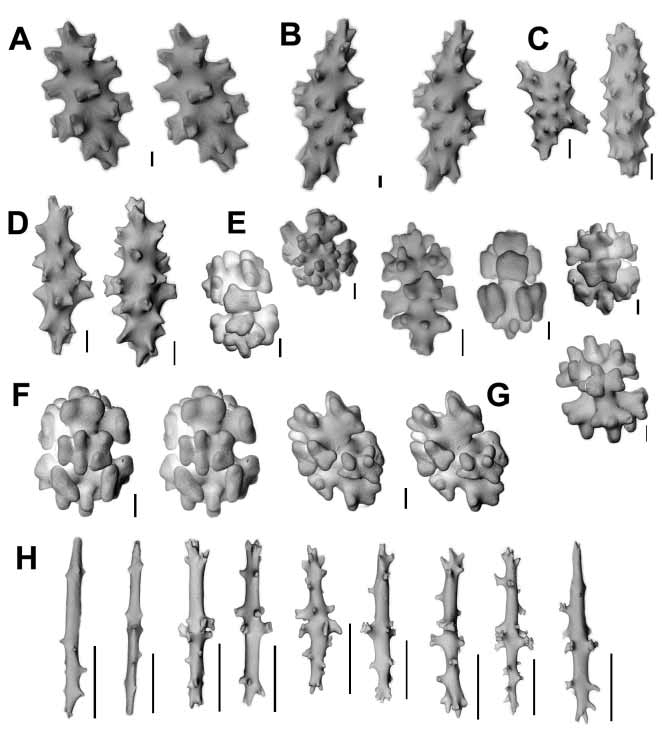
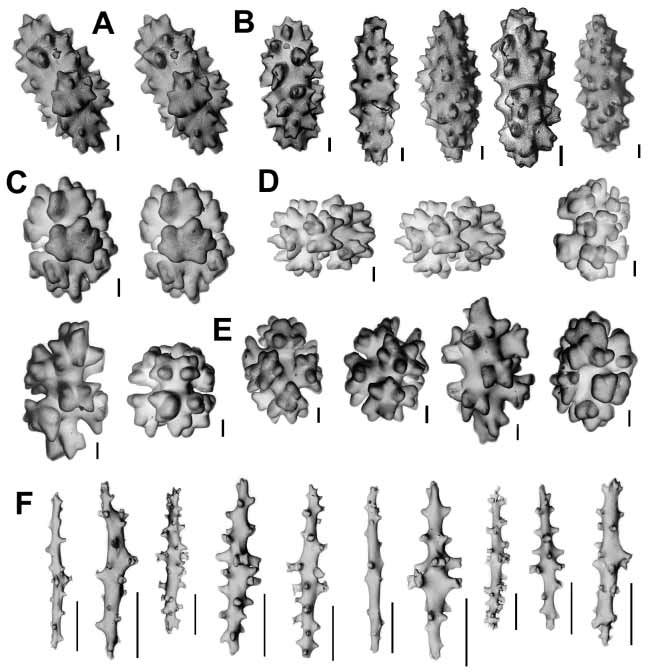
Description. Large colonies, holotype and paratypes composed of multiple fragments <200 mm in maximum length (Fig. 17 A – B). Some colonies (paratypes) up to a meter in height and 43 mm in diameter (e. g., Fig. 17 C – D). Robust branches down to 3 – 5 mm at the slimmer parts (Fig. 17 B). Colonies with simple lateral branching; every major branch carrying multiple short lateral branches, as observed in most octocorals (e. g., Sánchez et al. 2004), tending upward and in oneplane, with branch tips usually ending in a bulb. Colony surface in high relief, though some colonies (paratypes) have autozooids toward one side of colony. Numerous conical, semiclosed, autozooid polyp apertures up to 4 mm in diameter with the tendency to irregularly aggregate as nodules (Fig. 17). Bright red color, white / red mixed medulla, extended polyps pale yellow. Medulla in the terminal branches with 3 – 8 major canals plus numerous smaller canals; subsurface also with small canals. Autozooid polyp tentacles with ovals, similar to other Paragorgia spp., up to 0.13 mm long, regularly but not profusely ornate with smooth conical rays (Figs. 18 A – C, 19 A – C) and sometimes shorter and profusely ornate (e. g., Fig. 18 B). Surface sclerites oval, highly ornate, radiatederived, capstanlike sclerites (Fig. 18 D – E, 19 D – E), averaging 0.078 mm in length (0.005 SD, n = 10, NIWA 3312; 0.006 SD, n = 10, NIWA 3315). Oval surface sclerites 1.5 times longer than wide, averaging 0.05 mm in width (0.002 SD, n = 10, NIWA 3312 = 3315). Subsurface with intermediate forms to longer spindlelike sclerites (Figs. 18 D, 19 D). Medulla with long and slim, slightly bent but mostly straight, moderately ornate, spindles up to 0.4 mm in length (Figs. 18 H, 19 G). Morphological variation. The two specimens used for the description, NIWA 3312 and 3315, are nearly identical in all characters with overall low variation probably because they came from the same locality. However, specimens NIWA 3316 – 17 from different locations comprised larger and thicker specimens, almost resembling P. arborea colonies, Fig. (17 C – D), and with autozooid mostly located towards one side. The sclerites, although not identical to those from the specimens from the type locality, fall within the overall forms and characters for P. alisonae sp. nov. (Figs. 20 – 21). m); D – F, radiate sclerites from the colony surface (scales 10 m) (E and F are stereo pairs); G, sclerites from the colony medulla (scales 100 m). m); E – G, radiate sclerites from the colony surface (scales 10 m) (F and G are stereo pairs); H, sclerites from the colony medulla (scales 100 m).
Common Names
No common names available.
Taxonomic Hierarchy
Kingdom: Animalia
Phylum: Cnidaria
Class: Anthozoa
Order: Scleralcyonacea
Family: Coralliidae
Genus: Paragorgia
Species: Paragorgia alisonae Sánchez, 2005
Paragorgia alisonae Sánchez, 2005