Paragorgia kaupeka Sánchez, 2005
Description
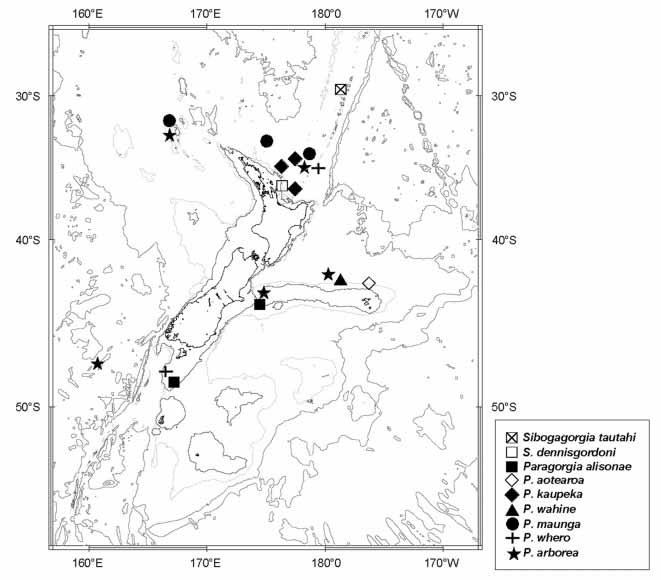
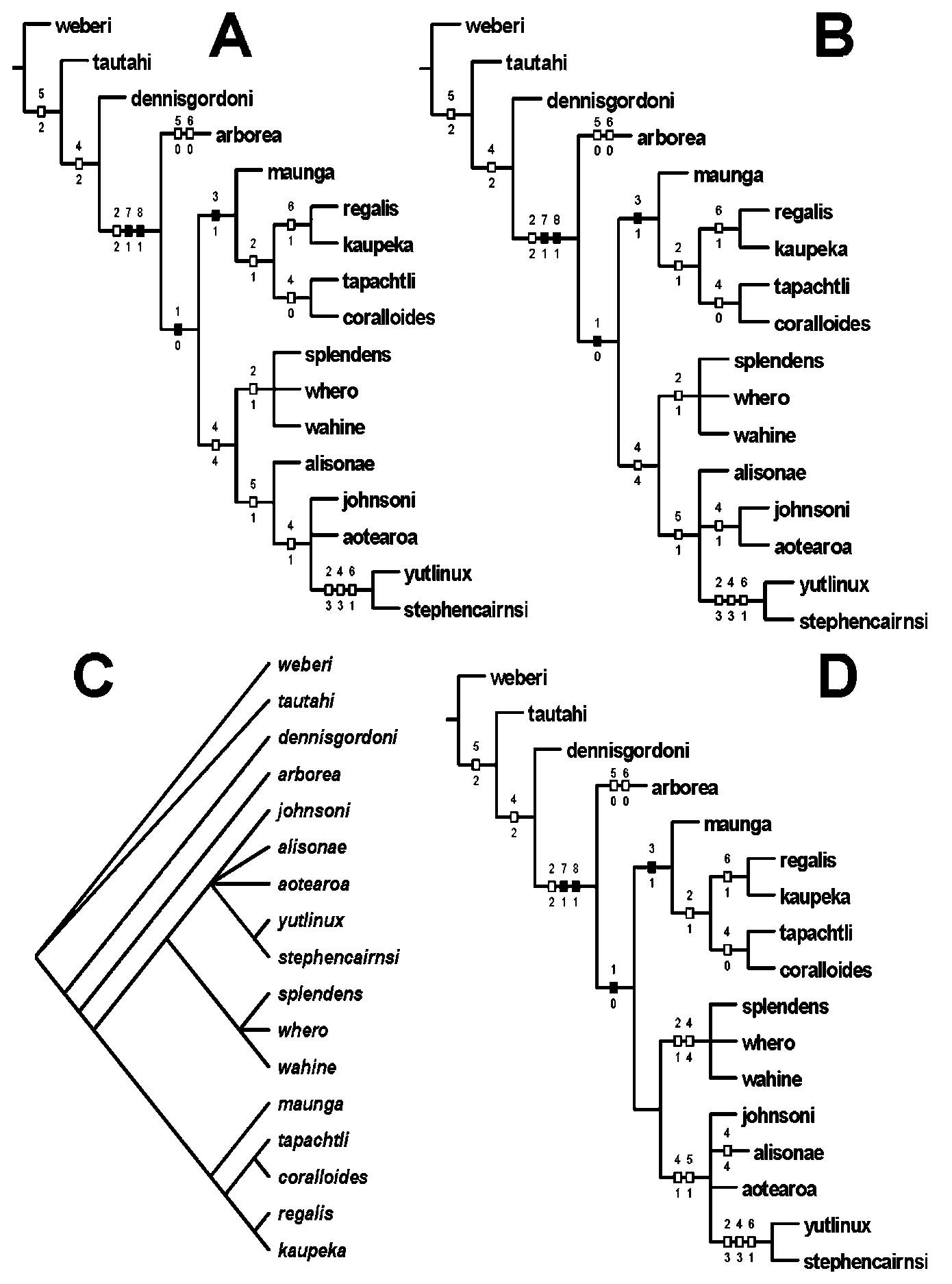
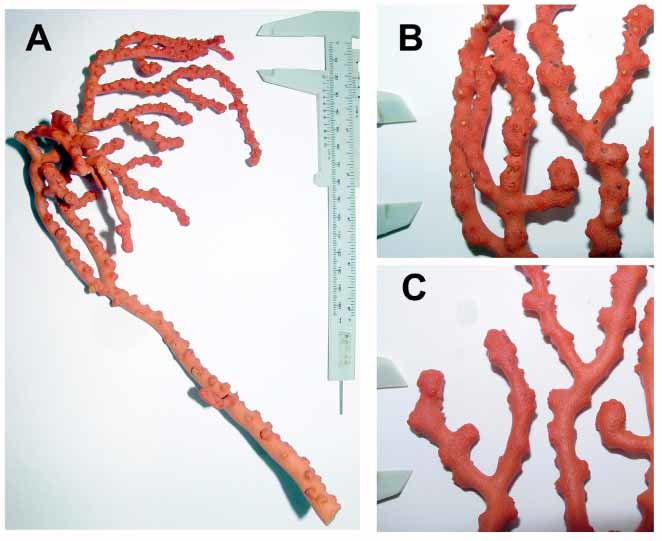
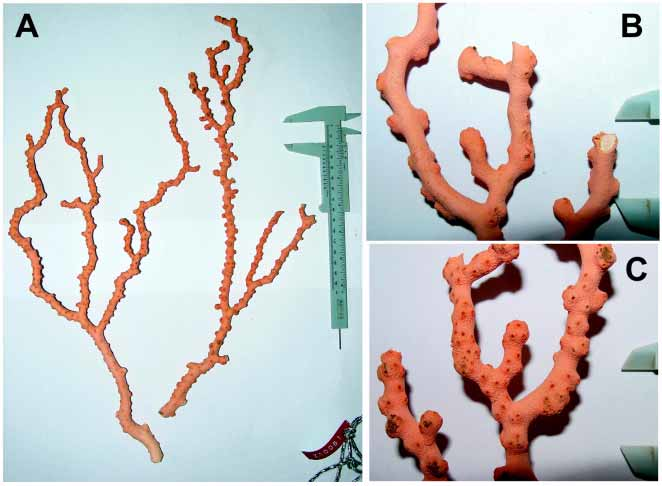
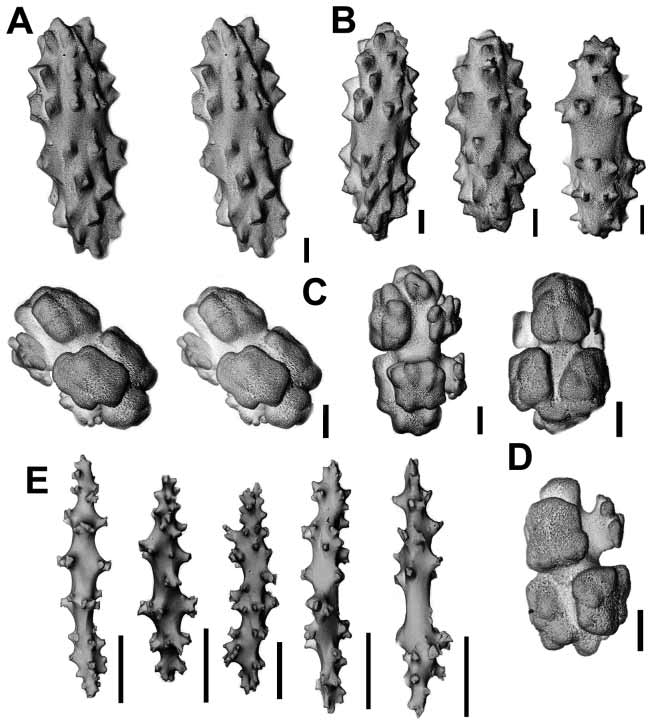
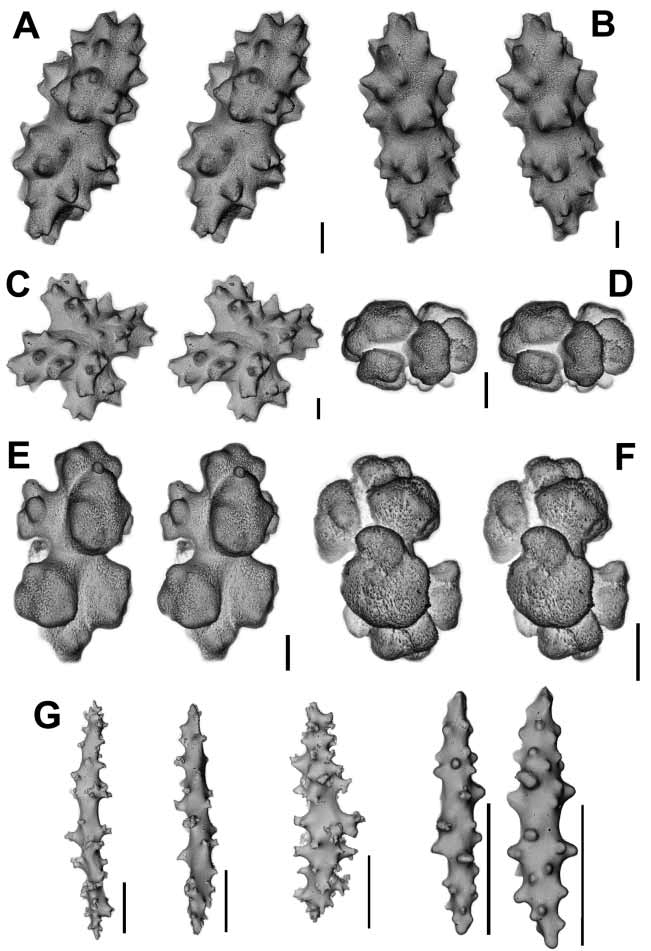
Description. Branching colonies, pseudodichotomous, uniplanar, up to 40 cm in height (holotype 30 cm: Fig. 22). Slim terminal branches 4 – 6 mm in diameter (Figs. 22 – 23). Autozooids usually clustered in groups of 2 – 7 polyps, towards one face of the colony, as alternately distributed hemispheric nodules on the branches (Figs. 22 – 23). Surface cortex with numerous tiny granular siphonozooid apertures present on both sides of the colony. Colonies pale red in alcohol and pink when dried, medulla predominately white. Autozooid polyps often retracted but occasionally extended in preserved samples exhibiting pale yellow tentacles. Medulla in the terminal branches perforated by 4 – 6 main canals and usually including red sclerites. Subsurface exhibiting 18 – 22 clearly discernable canals around the medulla. Tentacles with common Paragorgia sclerites: ornate blunt ovals up to 0.1 mm in length, usually with conelike prominences and a smooth waist (Figs. 24 A – B, 25 A – B), and with occasional twinned forms producing crosses (Fig. 25 C). Surface of the cortex, including autozooid aperture, with small, radiate sclerites less than 0.05 mm in length averaging 0.04 mm (0.0028 SD, n = 10, NIWA 3319; 0.0038 SD, n = 10, NIWA 3318) (Figs. 24 C – D; 25 D – F). Surface radiates between 1.65 – 1.7 times longer than wide, averaging 0.02 mm in width (0.0028 SD, n = 10, NIWA 3319; 0.0035 SD, n = 10, NIWA 3318). They show a loss of the radial symmetry by an asymmetrical enlargement of most radial ornaments (Figs. 24 C – D; 25 D – F); the uneven and irregular form and contours of the enlarged radial ornaments include considerably larger amounts of calcite than shorter ray ornaments. Subsurface sclerites include the same radiates as the surface with the occasional presence of larger forms with similar shapes and short, smooth but ornate, spindles up to 0.25 mm. Medulla with long, slim, mostly straight but occasionally bent, ornate, spindles less than 0.4 mm in length usually up to 0.35 mm (Figs. 24 E, 25 G). Morphological variation. Owing to the irregular ornamentation of the diagnostic cortex surface sclerites, there was quite a lot of individuality in the form of the radiates among and within specimens (e. g., Figs. 24 C – D, 25 D – F).
Common Names
No common names available.
Taxonomic Hierarchy
Kingdom: Animalia
Phylum: Cnidaria
Class: Anthozoa
Order: Scleralcyonacea
Family: Coralliidae
Genus: Paragorgia
Species: Paragorgia kaupeka Sánchez, 2005
Paragorgia kaupeka Sánchez, 2005