Caranx heberi (Bennett, 1830)




Description
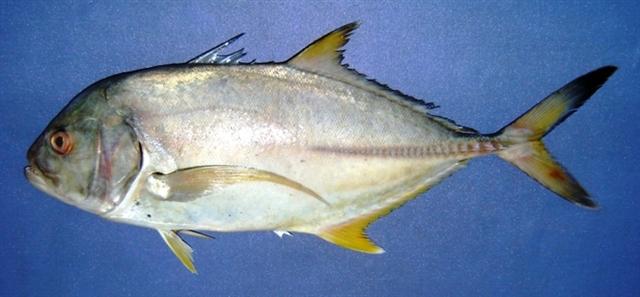
Dorsal spines (total): 9; Dorsal soft rays (total): 19 - 21; Anal spines: 3; Anal soft rays: 15 - 17. Dark bronze to yellow-green dorsally, shading to silvery bronze to yellowish or yellow green ventrally (Ref. 48635, 90102), yellow to dusky caudal fin and usually outer half of upper caudal lobe black (especially in juvenile) (Ref. 90102). Identified by black-tipped caudal fin (Ref. 48635). Body oblong and compressed, dorsal profile strongly convex to second dorsal fin, ventral profile slightly convex. Breast scalation variable, completely scaly (uncommon) to scaleless ventrally (Ref. 90102). LL with 30-40 strong scutes (Ref. 48635, 90102). Adipose eyelid moderately developed, small anteriorly and extending forward to rear edge of pupil o posterior part of eye. (Ref. 90102)
Common Names
Taxonomic Hierarchy
Kingdom: Animalia
Phylum: Chordata
Class: Teleostei
Order: Carangiformes
Family: Carangidae
Genus: Caranx
Species: Caranx heberi (Bennett, 1830)
Climate Zone
Location
Biology
Adults inhabit clear coastal waters, over rocky reefs in small aggregations (Ref. 5213). Seldom found in turbid or estuarine waters. May be found solitary (Ref. 90102). They feed on fishes and crustaceans (Ref. 5213). Sold fresh and dried salted in markets. Excellent food fish if cooked properly (Ref. 12484).
Habitat
brackish
Conservation Status
Least Concern
Threat to Humans
Harmless