Squatina formosa Shen & Ting, 1972
Description
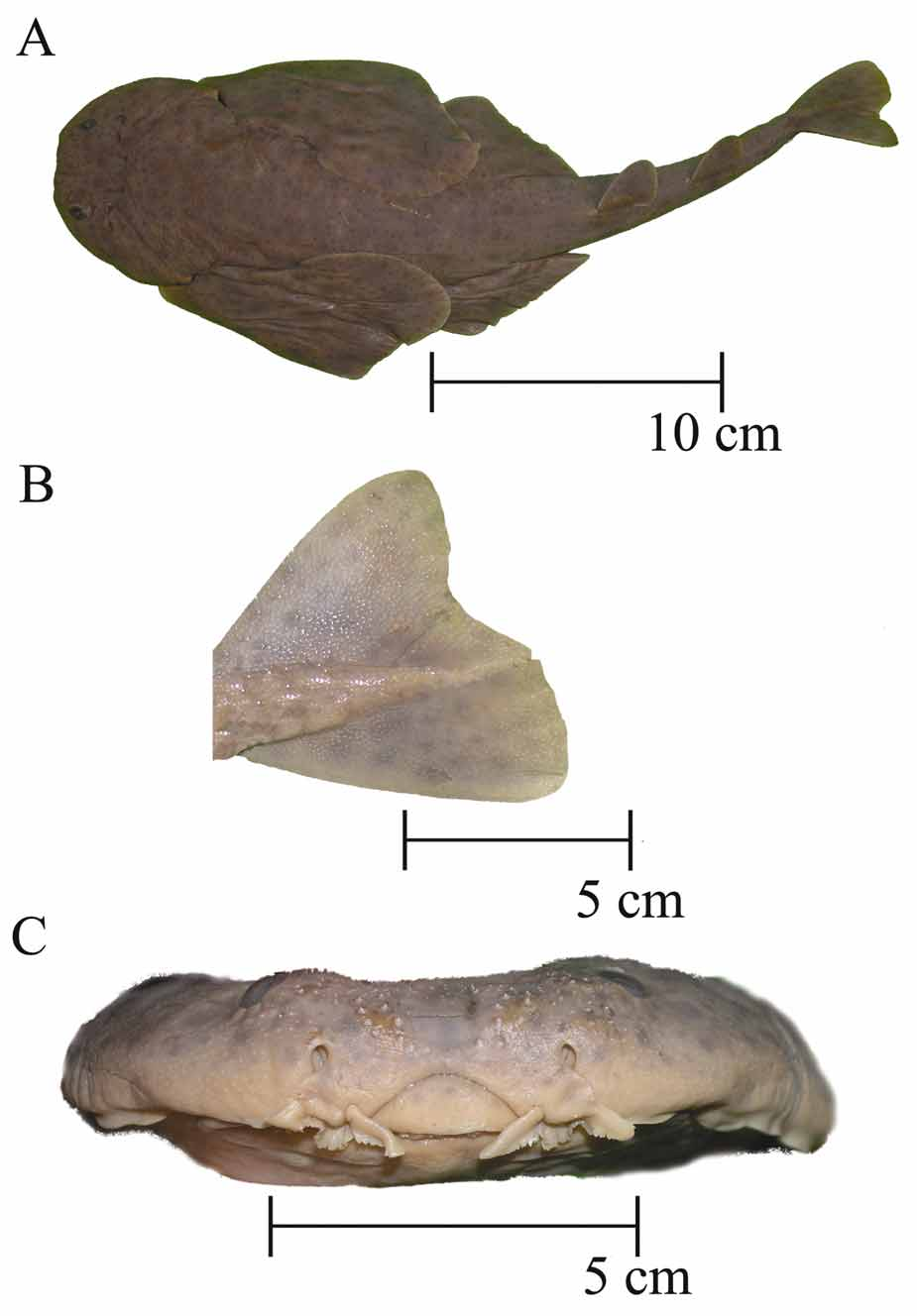
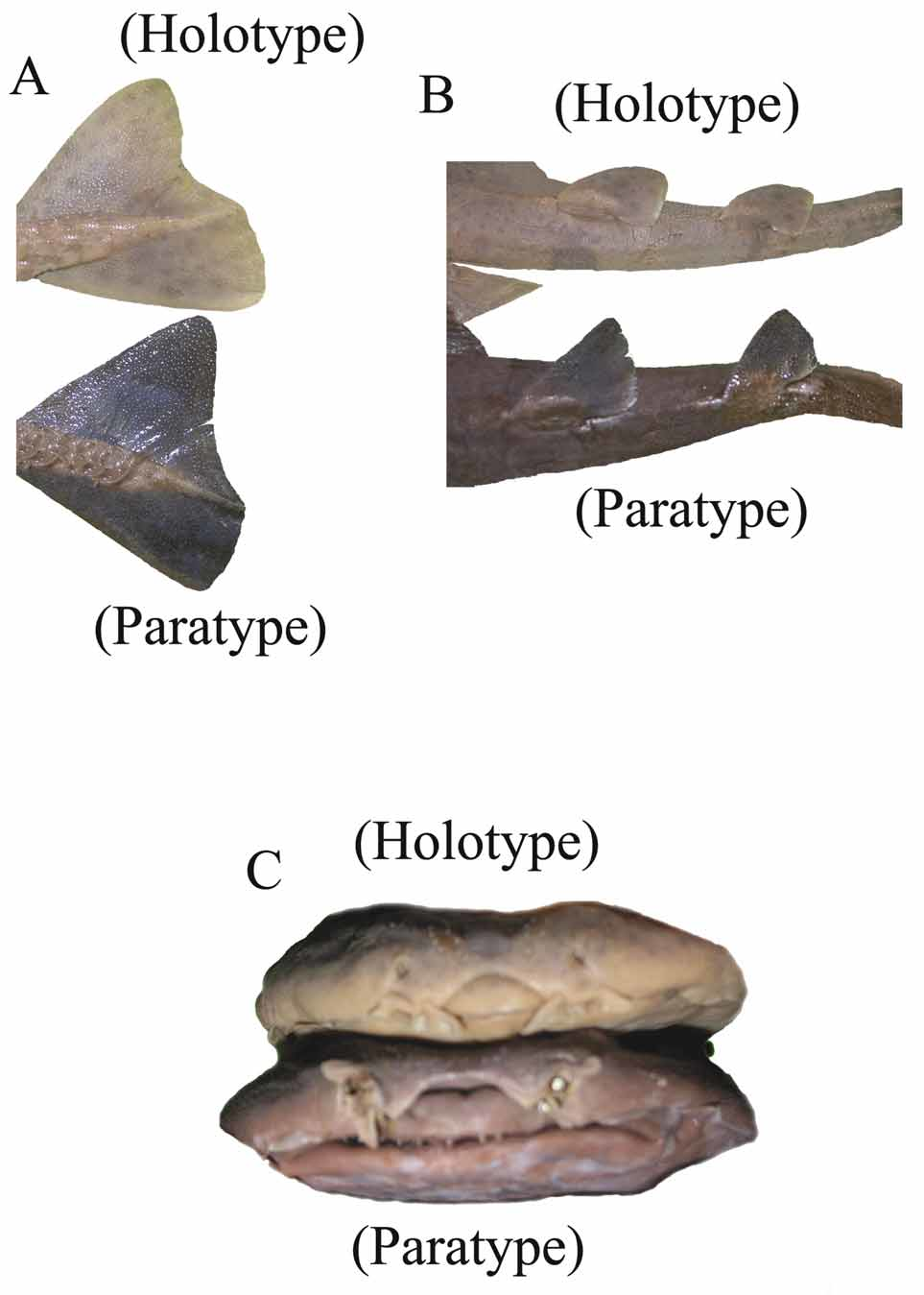
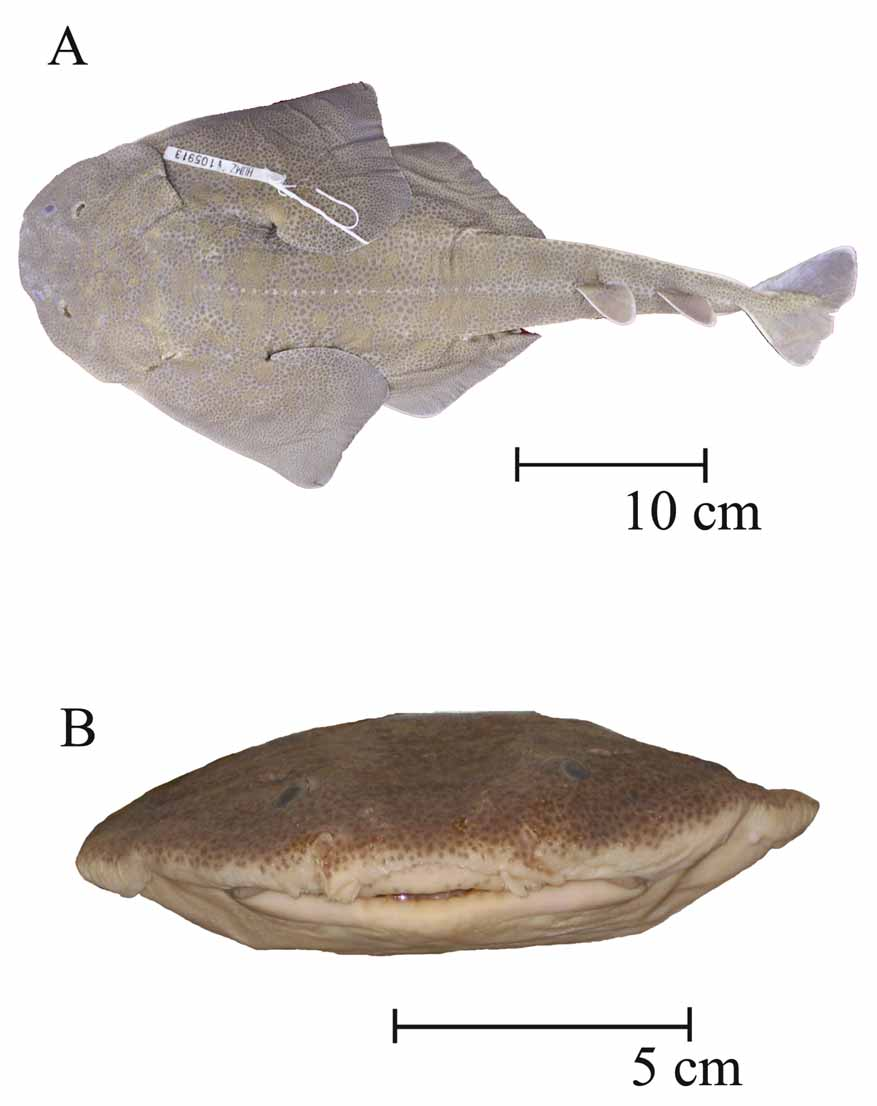
Description. Dorsal surface, except for posterior portion of caudal fin, covered with denticles of moderate roughness. Ventral surface smooth except for narrow bands of denticles on the pectoral and pelvic fins anterior margins. Head rounded, length about 0.2 times total length, maximum width occurring just anterior of gill openings. Moderately rough tubercles interspersed above mouth and eye crests. Eyes almond-shaped, widely set, interorbital space 8.2 (7.7 - 8.9). Eye-spiracle space short. Spiracles are crescent shaped without large papillae. Interspiracle space (7.8 - 8.2) slightly less than interorbital space. Center of upper lip exposed at midpoint of upper jaw, exposure semi-circular in shape, extending dorsally approximately 0.6 - 0.7 of upper jaw space, upper lip height (1.2 - 2.1), upper lip arch width (3.8 - 5.1). Labial furrows conspicuous, roughly equal in length, extending from corners of mouth medially, with upper labial furrow partially covered with dermal folds. Distinct nasal flaps protruding from dermal folds above mouth, two barbels protruding from each flap. Inner nasal barbel rod-like with a spatulate tip, inner basal portion contains little if any fringe. Outer nasal barbel narrow. Nostrils large, slightly protruding. Dermal folds along exterior of head, one small lobe present at corners of mouth extending ventrally. Mouth length about 0.3 times as long as mouth width. Dentition consisting of small, dagger-like teeth, conical without cusplets on a broad base, in 3 orderly longitudinal rows, no teeth at symphysis, teeth by row 9 - 10 - 9 - 10 / 10 - 10. Pectoral fins large, broadly rounded, originating just behind gills. Anterior margin of pectoral fin slightly convex and about three quarters as long as pectoral length, extending to a lateral apex. Angle of lateral apex slightly more obtuse than 120 °. Margin from lateral apex to most posterior lobe slightly concave. Posterior lobe broadly convex. Pectoral inner margin convex, about one half of pectoral length. Overall pelvic fin shape somewhat triangular with rounded fintips. Pelvics originating anterior to pectoral fin free rear tips. Pelvic fin length approximately two thirds as long as pectoral fin length. Pelvic fin base approximately 1.2 times broader than pectoral base. Anterior margin slightly curvilinear, extending at roughly a 45 ° angle from trunk to rounded apex lateral of body, anterior margin 0.5 times as long as pelvic fin length. Pelvic girdle width (26.3 - 29.8) between pelvic fin apexes moderately broad, about 1.4 times head length. Posterior margin of pelvic fin, approximately 0.8 times pelvic fin length, straight to posterior free tip. Pelvic inner margin concave and short, only about 0.4 times as long as pectoral fin length. Pelvic insertion furrows on ventral extend in a narrow ellipse to anterior apogee of vent in most specimens, vent is within ellipse. Pelvic fin tips reach origin of first dorsal. Dorsal fins lobed and nearly equal in size, with denticles covering the whole of fins. Interdorsal space about 0.8 times as long as dorsal caudal finspace. Anterior margin of dorsals slightly convex, nearly equidistant. First dorsal base slightly shorter than second, first dorsal base 15.2 (10.0 - 11.8), second dorsal base 17.4 (13.0 - 15.0). Apex of dorsals lobed. Posterior margins slightly convex, about 0.7 times as long as anterior margins. Inner margins of dorsals slightly convex, approximately 0.7 times as long as anterior margins. Caudal peduncle compressed dorso-ventrally with lateral longitudinal ridges, tapering posteriorly. Caudal fin lobe-like, markedly at dorsal apex. Caudal dorsal margin broadly rounded, about 0.8 times as long as preventral caudal fin margin. Subterminal caudal fin margin approximately half as long as caudal upper post ventral margin. Caudal lower postventral margin convex, approximately 0.8 times as long as caudal upper post ventral margin. Total vertebrae 137 - 139; total precaudal vertebrae 107 - 110; monospondylous vertebrae 48 - 52; diplospondylous vertebrae 58 - 59; caudal vertebrae 29 - 30. Coloration. Dorsal surface of specimens prior to preservation are light to dark brown throughout with numerous black and white spots of varying sizes. Black blotches laterally at origin of dorsals. Ventral surface pale white with some black mottling on abdomen, pectoral and pelvic fin ventral margins with denticles colored similar to dorsal. Color after preservation tends to fade to a lighter brown or pale yellow with spots becoming indistinct.
Common Names
Taxonomic Hierarchy
Kingdom: Animalia
Phylum: Chordata
Class: Elasmobranchii
Order: Squatiniformes
Family: Squatinidae
Genus: Squatina
Species: Squatina formosa Shen & Ting, 1972
Squatina formosa Shen & Ting, 1972