Pseudostichopus langeae Thandar, 2009
Description
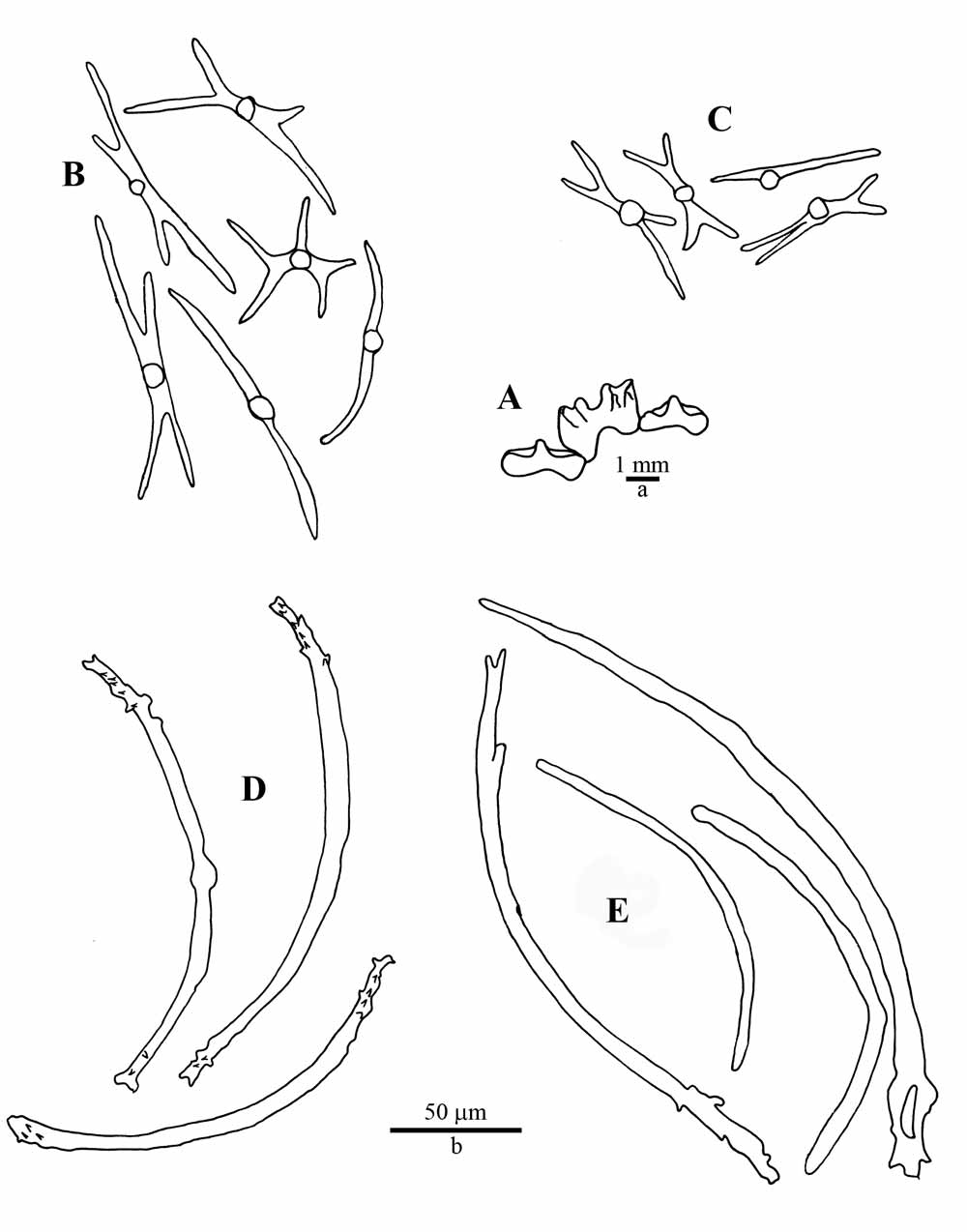
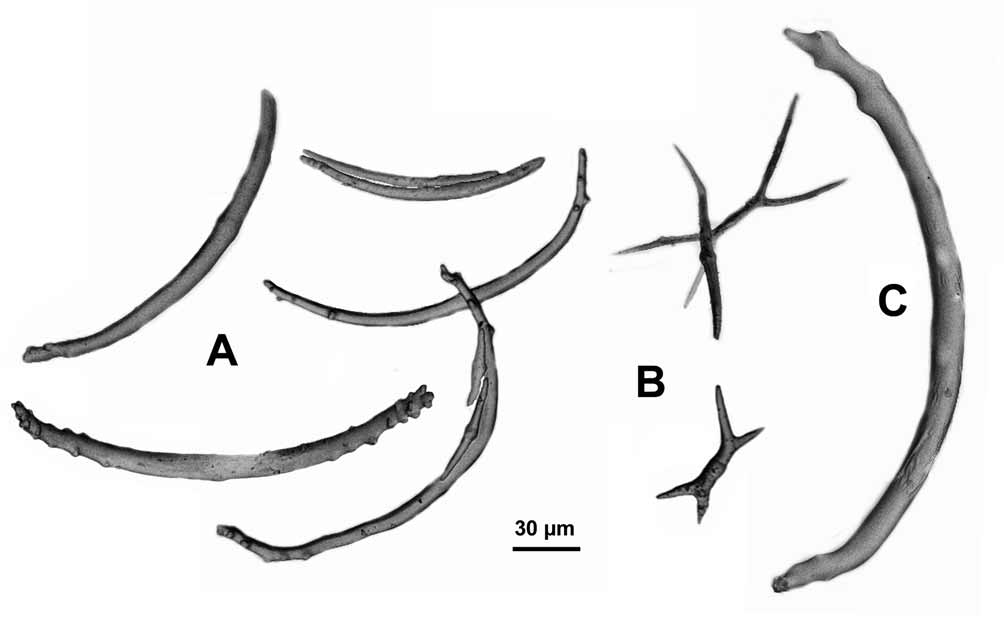
Description of holotype. Specimen partially eviscerated, one respiratory tree and part of another projecting out from anus. Length 42 mm, breadth in mid-body 6 mm, anterior and posterior ends of approximately same diameter. Colour, in alcohol, uniformly off-white. Body form sub-cylindrical but ventral surface only slightly flattened and dorsal only slightly arched, with longitudinal ridges and depressions throughout length, perhaps due to preservation. Mouth ventral, encircled by a narrow collar, tentacles approximately 20, distinctly peltate, protruding through mouth, each tentacle about 1 mm long and disc about 1 mm in diameter. Anus sub-ventral, pygal furrow conspicuous from both dorsal and ventral surfaces. Body wall encrusted with sand grains, small stones, broken shells, coral debris, echinoid spines, foraminifera, all easily rubbed off; pteropod shells and sponge spicules absent. Body wall thick, leathery. Podia thin, non-retractile, microscopic, numerous, mostly developed in the paired radii, especially dorsolaterally, none in ventral radius. Each podium slightly expanded terminally but sucker and end-plate absent, largest podium 2 mm long. Calcareous ring (Figure 1 A) delicate, radial plates sculptured, each with an anterior notch and a concave posterior margin; interradial plates also slightly sculptured with a shallow posterior concavity and an anterior tooth-like projection with the tooth lying in the middle of paired ridges. Polian vesicle single, sac-like; stone canal not detected. Gonad (testis) as tuft of unbranched tubules arranged serially along entire length of stolon. Longitudinal muscles thick, partially paired, folded, appearing cylindrical. Respiratory trees well branched, yellowish, one longer than the other, but reaching only anterior third of body. Stomach filled with foraminifera, sand grains, coral debris, etc. Ossicles present only in tentacles, podia, respiratory trees and gonad. Tentacle ossicles as slender curved rods (up to 300 µm long), ends rarely branched, mostly spinulated, sometimes perforated once or twice (Figures 1 E, 2 A). Podial ossicles of same form (up to 200 µm) (Figures 1 D, 2 C), arranged concentrically along length of podium, end- plates absent. Gonad ossicles (up to 120 µm) (Figures 1 B, 2 B) mostly branched, in the form of smooth x- or y-shaped rods with a central thickening, with each branch always tapering to a point, rods rarely branched more than once or not at all, then appearing as straight or as c- or s-shaped bodies, always with central thickening. Respiratory trees with similar but smaller and sparser deposits (up to 70 µm) (Figures 1 C, 2 B). Pygal lobes and longitudinal muscles without deposits. Description of paratypes (SAM-A 28043). Body form as in holotype but one specimen with longitudinal folds forming ridges and furrows all along length, perhaps an artefact of preservation. Colour dull-greyish to creamish-white, length 50 – 60 mm, width in mid-body 8 – 10 mm. Tentacles 17 – 19. Encrustations as in holotype, but scarce in one individual. Podia mostly in the ventro-lateral radii, in double rows, none dorsally or mid-ventrally, filiform, 1.5 – 2.0 mm in length, suckers and end-plates absent. Both dissected specimens without most of the internal organs except for some remains of the gut, part of the respiratory trees and in one specimen, a small portion of the gonad. Ossicles as in holotype. SAM-A 28043 (spec 1): tentacle rods 100 – 360 µm (mean 192 µm, SD ± 78.4, n = 25), podial rods 50 – 150 µm (mean 117 µm, SD ± 19.5, n = 25). SAM-A 28043 (spec 2): tentacle rods 120 – 450 µm (mean 251 µm, SD ± 93.3, n = 25), podial rods 120 – 200 µm (mean 152 µm, SD ± 17.9, n = 25).
Common Names
No common names available.
Taxonomic Hierarchy
Kingdom: Animalia
Phylum: Echinodermata
Class: Holothuroidea
Order: Persiculida
Family: Pseudostichopodidae
Genus: Pseudostichopus
Species: Pseudostichopus langeae Thandar, 2009
Pseudostichopus langeae Thandar, 2009