Brachionichthys hirsutus (Lacepède, 1804)
Description
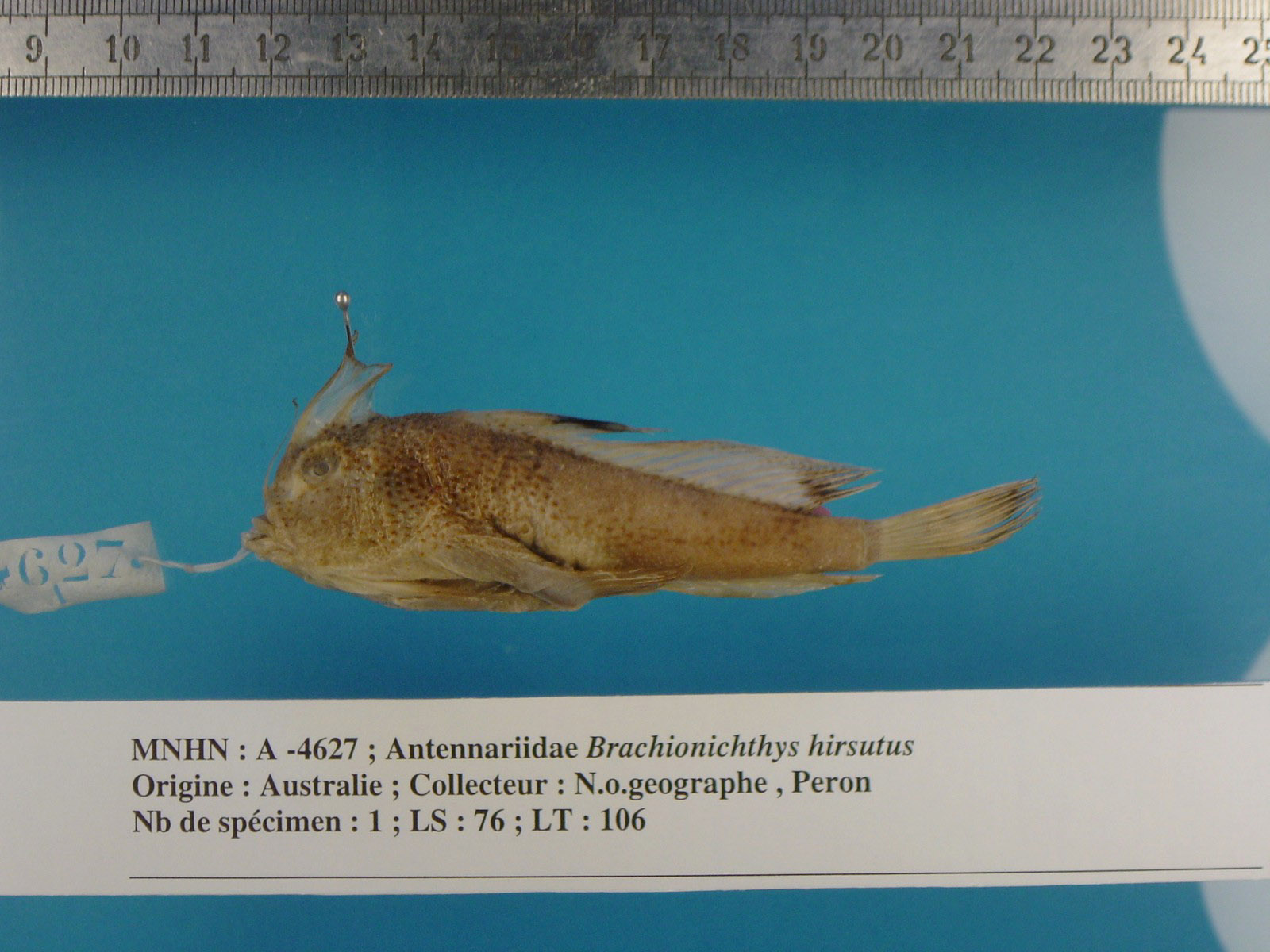
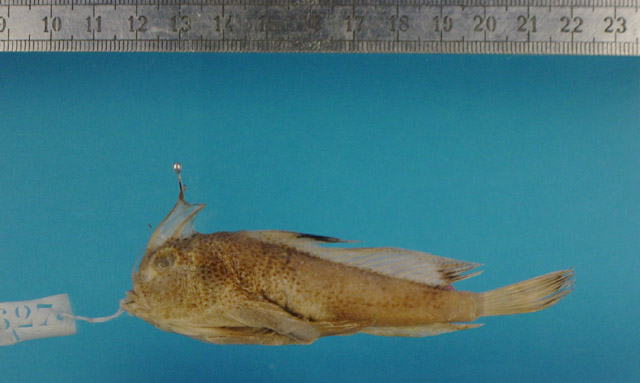
Dorsal soft rays (total): 19 - 21; Anal soft rays: 8 - 10. This species is unique in having the following set of characters: esca small, 15-26% (mean 20%) of illicium length (including esca); illicium very slender, no dermal spinules, length 19-20% SL (mean 20%), 2.3-2.4 times in head length; eye moderate, exceeding 5.4 times in head; body entirely covered with close-set, non-imbricate scales; scale bases subcircular with long unicuspid spinules (except for those closely-associated with pores of the acoustico-lateralis system); spinules originating from middle of scale base, variable in length over body; second dorsal-fin rays 17-19 (mean 18), fin base 61-64 (mean 62%) SL; first ray of first dorsal fin length 0.7-1.0 times length of longest ray of second dorsal fin; anal-fin rays 8-10; pectoral-fin rays usually 7 ; upper body usually covered with fine dark spots or short streaks (rarely with long streaks on head); caudal fin with dense coverage of fine spots, forming a dark submarginal bar in juveniles (Ref. 72490).
Common Names
Taxonomic Hierarchy
Kingdom: Animalia
Phylum: Chordata
Class: Teleostei
Order: Lophiiformes
Family: Brachionichthyidae
Genus: Brachionichthys
Species: Brachionichthys hirsutus (Lacepède, 1804)
Climate Zone
Location
- Southwest Pacific: Endemic to Tasmania, Australia. Has been nearly wiped out by an introduced starfish which preys on its egg clusters (Ref. 27438).
Biology
Occurs in the continental shelf and inshore waters (Ref. 7300). Occurs in coarse to fine sand habitats in depths of 5-40 m (most commonly 5-10 m). Often found in shallow, shell-filled depressions or near rocks of low relief projecting from the substrate (Ref. 30684). Length only preliminary, replace with better value (RF). Egg masses contain about 80-250 eggs, about 1.8-2 mm in diameter; egg capsules about 3-4 mm diameter. Newly hatched juveniles are about 6-7 mm SL, attaining at least 9.0 cm SL (about 13.0 cm TL), with adults commonly about 6.0-7.5 cm SL (Ref. 72490).
Habitat
demersal
Conservation Status
Critically Endangered
Threat to Humans
Harmless
Brachionichthys hirsutus (Lacepède, 1804)