Bodianus cylindriatus (Tanaka, 1930)
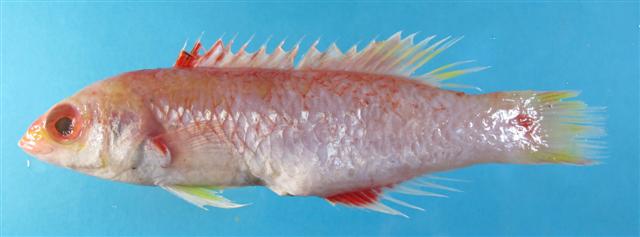
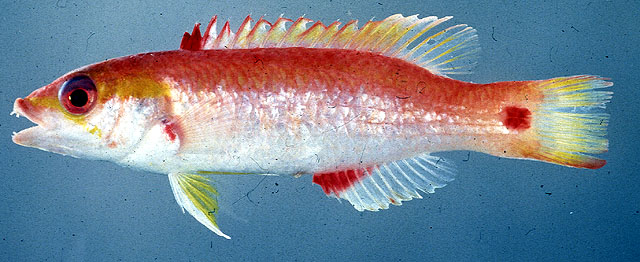
Description
Dorsal spines (total): 12; Dorsal soft rays (total): 10. This species has the following characters: D XII, 10; caudal fin rays 10 + 12 + 10; pectoral-fin rays ii, 14-15; lateral line scales 30-31 (rarely 31); scales above lateral line 2-3; scales below lateral line 8½-10½; predorsal scales 25-27; total gill rakers 13-17; upper jaw have prominent anterior canines of similar size; dental ridge is low, 2 consecutive rows of shorter canines, the first with 4 teeth slightly longer than 4-5 in second row; posterior end of upper jaw with moderately large canine; lower jaw with first prominent anterior canine ca ½ - 2/3 size of second, directed anterodorsally and slightly laterally; dental ridge low with 2 series of smaller caniniform teeth laterally, the first with about 4 teeth slightly longer than 6-7 in second; similar sized lateral teeth in both jaws; shallow body, 21.3-25.5% SL; snout, 7.6-10.4% SL; short head, 31.8-34.2% SL; first soft ray of pelvic fin not prolonged as filament, at most reaching just beyond anus (Ref. 75973).
Taxonomic Hierarchy
Kingdom: Animalia
Phylum: Chordata
Class: Teleostei
Order: Eupercaria/misc
Family: Labridae
Genus: Bodianus
Species: Bodianus cylindriatus (Tanaka, 1930)
Climate Zone
Location
- Western Pacific: Japan. More recently reported from the Chesterfield Islands (Ref. 11897). Reported from the Hawaiian Islands (Ref. 58302).
Biology
Benthopelagic over hard substrates (Ref. 58302). Oviparous, distinct pairing during breeding (Ref. 205).
Habitat
associated
Conservation Status
Least Concern
Threat to Humans
Harmless
Bodianus cylindriatus (Tanaka, 1930)