Sargocentron melanospilos (Bleeker, 1858)
Description
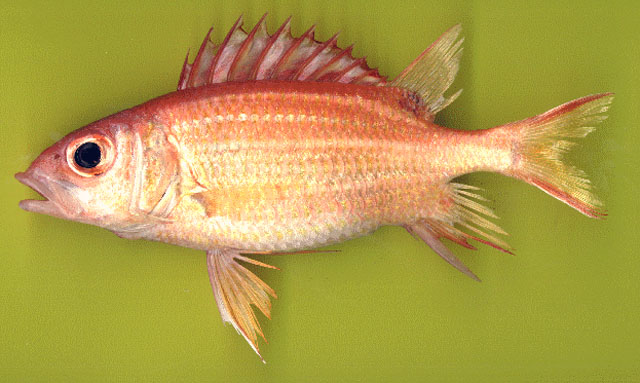
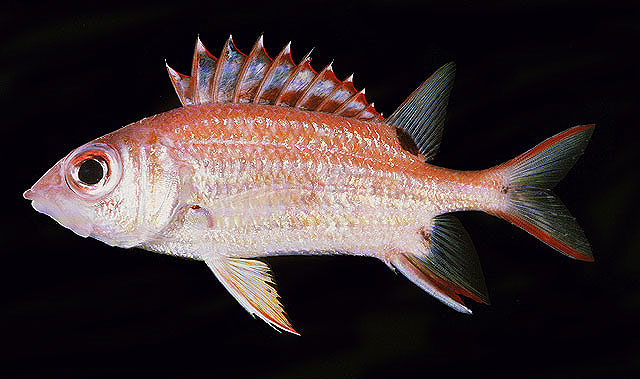
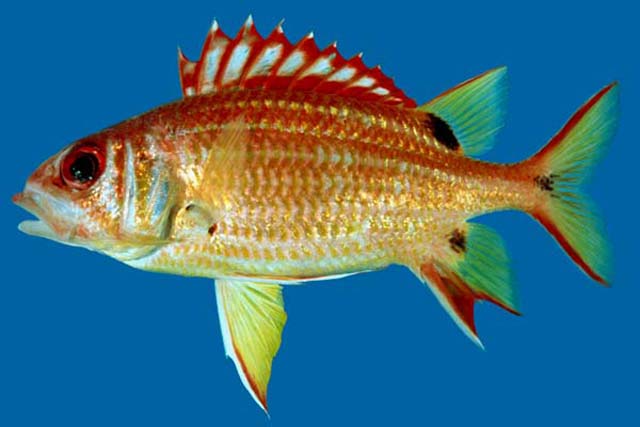
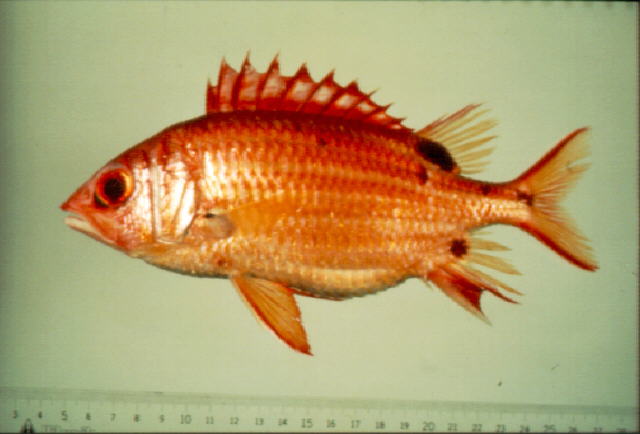
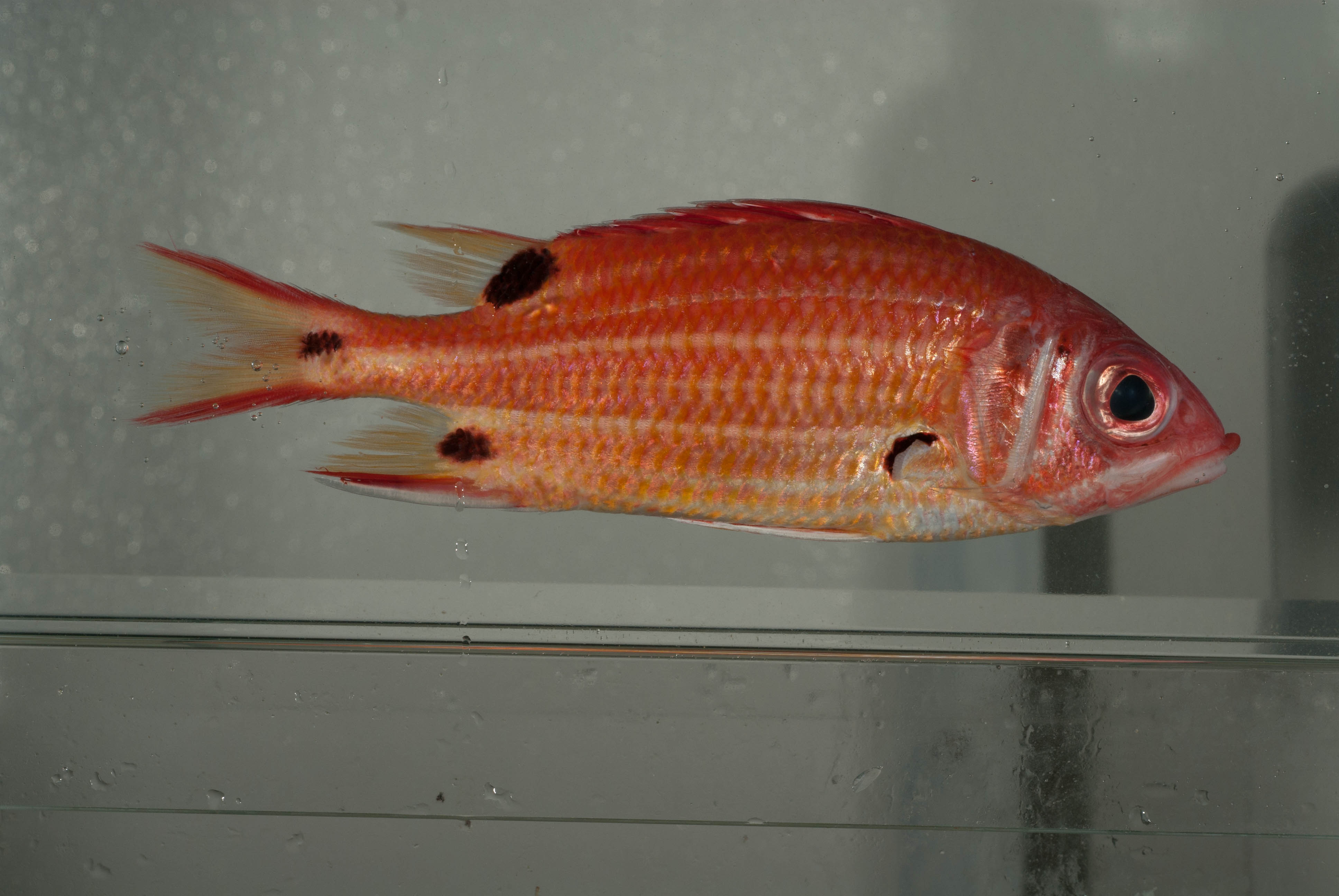
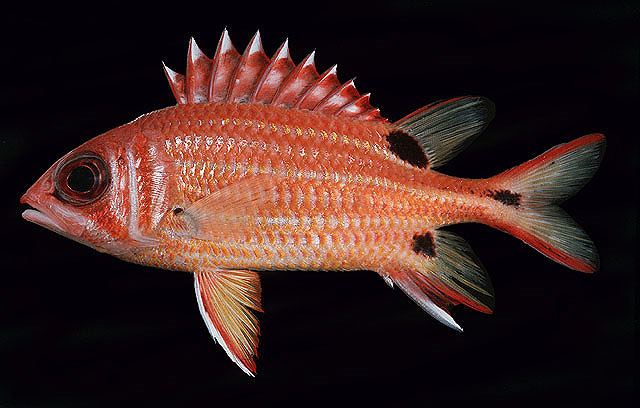
Dorsal spines (total): 11; Dorsal soft rays (total): 12 - 14; Anal spines: 4; Anal soft rays: 9 - 10. Body with red and white stripes following the scale rows; black blotch at base of soft dorsal, anal, and caudal fins, but may be faint or absent in caudal and anal fins (Ref. 4201, 48635). Uniformly small ctenii on posterior margin of scales of body. Inferior mouth due to hypertrophy of median part of upper lip (front of upper lip thickened and slightly protruding) (Ref. 3079). Five oblique scale rows on cheek; body depth 2.7-2.95 in SL; head length (HL) 2.6-2.9 in SL; snout length 3.6-4.4 in HL; interorbital width 4.4-5.25 in HL; slender caudal peduncle, depth 3.9-4.65 in HL; maxilla extending from below center of the eye to a vertical at rear edge of pupil, upper jaw length 2.25-2.4 in HL; premaxillary groove ending above or slightly posterior to a vertical at the front edge of orbit; anterior end of nasal bone ending with a small spine; surface or medial edge of nasal bone spineless; nasal fossa with 1 to 4 spinules on posterior edge; preopercular spine 3.45-3.65 in HL; longest dorsal spine 1.95-2.4 in HL; 3rd anal spine 1.5-1.75 in HL (Ref. 27370).
Common Names
Taxonomic Hierarchy
Kingdom: Animalia
Phylum: Chordata
Class: Teleostei
Order: Holocentriformes
Family: Holocentridae
Genus: Sargocentron
Species: Sargocentron melanospilos (Bleeker, 1858)
Climate Zone
Biology
A relatively uncommon inhabitant of rocky reefs and coral-rich areas. Spine of preopercle venomous. Usually seen solitary , but sometimes forms schools in deep water in oceanic locations (Ref. 48635). Found in seaward slopes in 5-90 m (Ref. 90102).
Habitat
associated
Conservation Status
Least Concern
Threat to Humans
Venomous
Sargocentron melanospilos (Bleeker, 1858)