Upeneus spottocaudalis Uiblein & Gledhill, 2017
Description
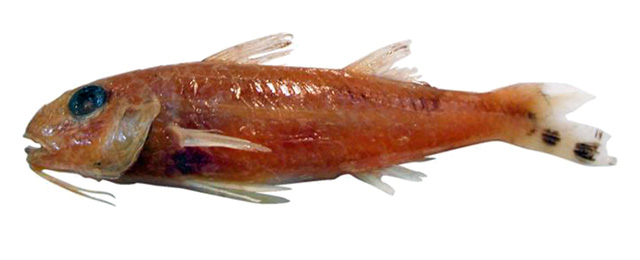
Dorsal spines (total): 7; Dorsal soft rays (total): 9; Anal spines: 1; Anal soft rays: 6. This species is distinguished by the following characters: D VII + 9; pectoral fins 12-13; gill rakers 5-6 + 15-18 = 22-23; adult measurements in % SL (when different for subadults, values in parentheses): body depth at first dorsal-fin origin 22-25 (22-24); body depth at anus 19-22 (18-20); caudal-peduncle depth 8.6-10; maximum head depth 19-22 (19-21); head depth through eye 15-18 (16-18); interorbital length 7.3-8.9 (7.7-8.1); head length 30-32; snout length 9.7-12 (10-11); postorbital length 11-13 (12-14); orbit length 6.9-8.2 (7.2-8.9); upper jaw length 10-13 (11-13); barbel length 19-22 (21-23); caudal-peduncle length 21-24 (23-25); caudal-fin length 28-32 (30-33); anal-fin height 16-19 (18-19); pelvic-fin length 22-24 (24-26); pectoral-fin length 19-22 (20-23); first dorsal-fin height 19-22 (21-23); second dorsal-fin height 18-21. Colour of body and head red, with dark dots along the lateral line, a saddle behind second dorsal fin; 3-5 red or pale brown bars on each caudal-fin lobe with the bars on the lower lobe interrupted or replaced by 3-4 dark-brown rounded or triangular spots at mid-lobe; dorsal, anal and pelvic fins with red pigment forming patches or stripes; barbels yellow; preserved fish with pale-brown head and body, sometimes with remaining pigmentation dorsally and on dorsal fins, bars on upper-caudal fin lobe are mostly retained; spots on lower caudal-fin lobe are always retained in both adults and subadults (Ref. 116177).
Taxonomic Hierarchy
Kingdom: Animalia
Phylum: Chordata
Class: Teleostei
Order: Mulliformes
Family: Mullidae
Genus: Upeneus
Species: Upeneus spottocaudalis Uiblein & Gledhill, 2017
Climate Zone
Biology
Life cycle and mating behavior
Habitat
oceanic
Conservation Status
Not Evaluated
Threat to Humans
Harmless
Upeneus spottocaudalis Uiblein & Gledhill, 2017