Arctoraja parmifera (Bean, 1881)
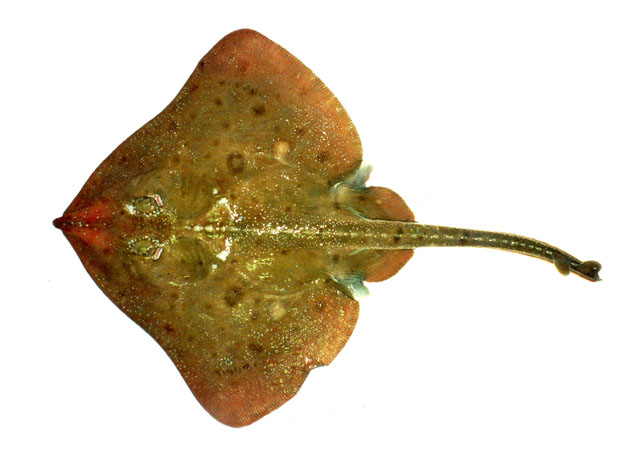
Description
This species is distinguished from all other members of the subgenus Arctoraja by having a complete or, uncommonly, an incomplete row of dorsal thorns extending from the nuchal region to the interdorsal; dorsum nearly uniform brown, often with vague dark spotting and a yellowish blotch at pectoral-fin base; and two unique COI haplotypes. It is further distinguished from B. panthera by having fewer total thorns 19-36 (vs. 31-42), fewer tail thorns 15-23 (vs.19-28), internal carotid foramina widely separated (vs. foramina in a single median pit), distal portion of ventral marginal cartilage distolaterally directed and straight (vs. sinusoidal), accessory terminal 2 broadly triangular with short spike (vs. elongate with long spike), distal tip of axial cartilage bluntly rounded (vs. pointed), anterior portion of body short and narrow (vs. longer and wider); tail short (vs. longer); from B. simoterus by its wider interdorsal space 1.0-3.9% TL (vs. 0.5-1.0% TL), fewer precaudal and caudal vertebrae 32-40 and 82-89 (vs. 41 and 90), fewer tail thorns 15-23 (vs. 22-28), larger orbit 4.3-5.3% TL (vs. 2.6-4.8% TL), anterior- and posterior-most postdorsal and postventral foramina of the scapulacoracoid larger than three intervening foramina (vs. three postdorsal foramina slightly smaller posteriorly, posteriormost postventral foramina four times larger than preceding six foramina), distal projection of the ventral marginal directed distolaterally (vs. distally), ventral terminal tear-drop shaped (vs. lanceolate), and dorsal and ventral marginals extend to about a quarter the length of dorsal terminal 2 (vs. extending farther distally to distal tip of dorsal terminal 3); from B. smirnovi by its typically complete dorsal row of thorns (vs. always broadly interrupted between the nuchal and tail thorns), wider interdorsal space (1.0-3.9% TL (vs. 0.1-1.4% TL), distal projection of the ventral marginal projecting distolaterally (vs. distally), ventral terminal tear-drop shaped (vs. lanceolate), and dorsal and ventral marginals extending to about a quarter the length of dorsal terminal 2 (vs. extending farther distally to distal tip of dorsal terminal 3) (Ref. 89865).
Common Names
Taxonomic Hierarchy
Kingdom: Animalia
Phylum: Chordata
Class: Elasmobranchii
Order: Rajiformes
Family: Arhynchobatidae
Genus: Arctoraja
Species: Arctoraja parmifera (Bean, 1881)
Climate Zone
Location
- North Pacific: Bering Sea to southeastern Alaska.
Biology
An epi- to mesobenthic species (Ref. 89865). Large individuals are reported to feed on Pleurogrammus monopterygius and miscellaneous other fishes, while the smaller ones feed on crabs and amphipods; in the eastern Bering Sea, mature individuals feed primarily on Theragra chalcogramma, miscellaneous fishes, and Chionocetescrabs (Ref. 89865). Oviparous. Distinct pairing with embrace. Young may tend to follow large objects, such as their mother (Ref. 205). Eggs are oblong capsules with stiff pointed horns at the corners deposited in sandy or muddy flats (Ref. 205). Egg capsules are 12.9-15.0 cm long and 8.9-9.1 cm wide (Ref. 41249, 41298).
Habitat
demersal
Conservation Status
Least Concern
Threat to Humans
Harmless
Arctoraja parmifera (Bean, 1881)