Pliotrema warreni Regan, 1906
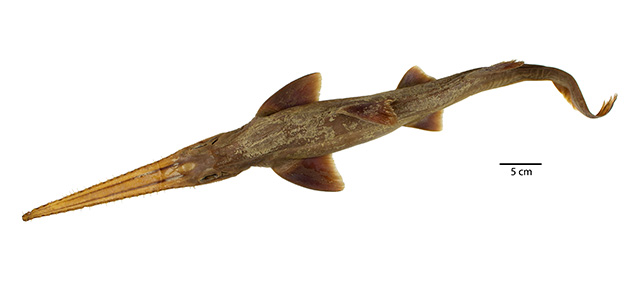
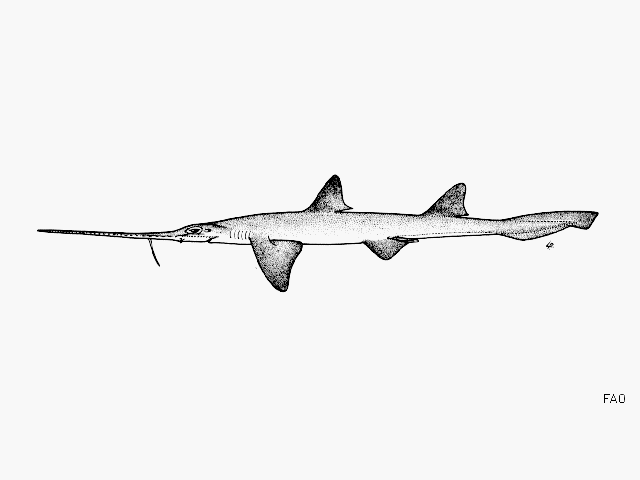

Description
This large six-gilled sawshark is distinguished by the following characters: barbel origin to anterior nostrils 1.4-1.6 times anterior nostrils to symphysis upper jaw; prenarial length 1.3-1.4 times prebarbel length; preoral length 1.8-2.3 times interdorsal space; pectoral-fin anterior margin 1.4-1.5 times dorsal-caudal space; mouth width 3.1-3.9 times spiracle length; the first dorsal fin originates about opposite pectoral-fin free rear tips; lateral trunk dermal denticles tricuspidate, rather flat and imbricated. monospondylous centra 53-56; precaudal diplospondylous centra 4-51; total vertebral centra 154-158; rostrum not constricted between barbel origin and nostrils and barbels that are situated about two thirds way from rostral tip to mouth, with prebarbel length about twice, i.e. 1.7-2.1 times, distance from barbel origin to symphysis of upper jaw (vs. barbels situated about half way from rostral tip to mouth, with prebarbel length about equal, i.e. 1.0-1.1 times, distance from barbel origin to symphysis of upper jaw), prebarbel length 60.2-68.0% (vs. 49.4-52.9% of preoral length), preoral length 1.5-1.7 (vs. 1.9-2.0 times prebarbel length), prenarial length 1.3-1.4 (vs. 1.5-1.7 times prebarbel length). Colouration: medium to dark brown dorsally with a pronounced yellowish longitudinal stripe; uniform white ventrally; the dorsal rostrum surface with two distinct longitudinal dark stripes, lateral rostral teeth dark-edged (Ref. 122027).
Common Names
Taxonomic Hierarchy
Kingdom: Animalia
Phylum: Chordata
Class: Elasmobranchii
Order: Pristiophoriformes
Family: Pristiophoridae
Genus: Pliotrema
Species: Pliotrema warreni Regan, 1906
Climate Zone
Biology
Found on the continental shelf and upper slope to at least 430 m (Ref. 247). Feeds on bony fish, also shrimp, mysids and squid (Ref. 5578). Ovoviviparous (Ref. 50449), with 5 to 7 young in a litter (Ref. 247). Probably uses its saw to stun and kill prey (Ref. 5578). Sometimes caught by sports anglers (Ref. 5578).
Habitat
demersal
Conservation Status
Least Concern
Threat to Humans
Harmless
Pliotrema warreni Regan, 1906