Pegasus laternarius Cuvier, 1816
Description
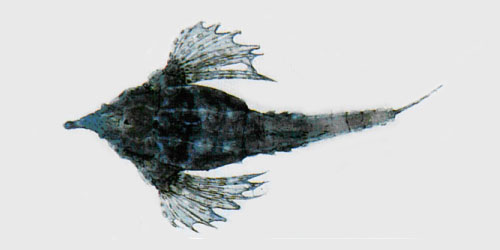
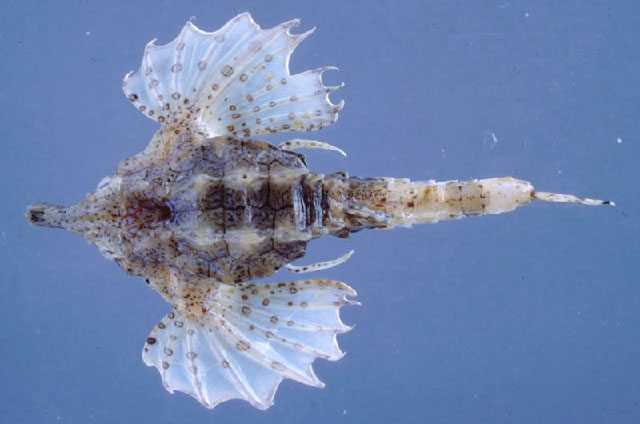
Dorsal spines (total): 0; Dorsal soft rays (total): 5; Anal spines: 0; Anal soft rays: 5; Vertebrae: 20. It has a variety of colors and can be dull to bright yellow or blue (Ref. 48635). Preserved body dark brown dorsally and laterally; lighter ventrally. Species with 4 pairs of dorsolateral body plates; 5 pairs ventrolateral body plates; deep pits on dorsal surface of head and within interorbital depression absent; 11 or more tail rings with 9th and 10th fused; suborbital shelf convex, obscuring eye from ventral view; last tail ring without spine on dorsal surface. 5th rays of pectorals stout, much thicker than other rays. No scales on orbit. Distal margin of dorsal and anal fins oblique to horizontal axis of body. Readily identified by its rather short rostrum when juvenile or female; it is more developed in males (Ref. 48635).
Common Names
Taxonomic Hierarchy
Kingdom: Animalia
Phylum: Chordata
Class: Teleostei
Order: Dactylopteriformes
Family: Pegasidae
Genus: Pegasus
Species: Pegasus laternarius Cuvier, 1816
Climate Zone
Biology
Adults lives on muddy bottoms, often collected at depths of about 50 m; larvae are planktonic. Rarely seen diving, except a few localities in Japan where they occur in sheltered muddy habitats (Ref. 48635).
Habitat
demersal
Conservation Status
Data deficient
Threat to Humans
Harmless
Pegasus laternarius Cuvier, 1816