Parupeneus williamsi Shibuya & Motomura, 2020

Description
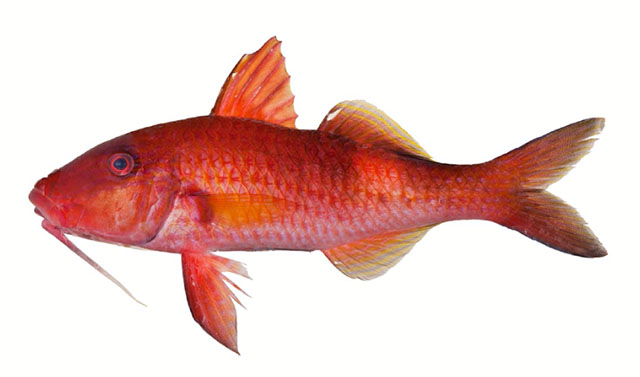
Dorsal spines (total): 8; Dorsal soft rays (total): 9; Anal soft rays: 7. This species is distinguishec by the following characters: barbels are white to yellowish distally, with the tips usually extending beyond posterior margin of preopercle; upper jaw somewhat slender and shorter in specimens that are greater than 5.0 cm SL (upper-jaw length times maxillary depth 60.5-96.9%, mean 74.4% of SL]; second anal-fn soft ray is long, its length 47.2-55.2% (51.3%) of caudal-fn length; 2-3 very indistinct blackish vertical bands on trunk, the frst located under frst dorsal fin (most indistinct, sometimes absent), the second below inter-dorsal-fin space and the third below anterior part of second dorsal fin; a very indistinct blackish saddle on upper caudal peduncle; dense melanophores uniformly distributed on the anal-fin membranes in most preserved specimens (Ref. 123210).
Taxonomic Hierarchy
Kingdom: Animalia
Phylum: Chordata
Class: Teleostei
Order: Mulliformes
Family: Mullidae
Genus: Parupeneus
Species: Parupeneus williamsi Shibuya & Motomura, 2020
Climate Zone
Biology
Life cycle and mating behavior
Habitat
associated
Conservation Status
Not Evaluated
Threat to Humans
Harmless
Parupeneus williamsi Shibuya & Motomura, 2020