Parupeneus porphyreus (Jenkins, 1903)
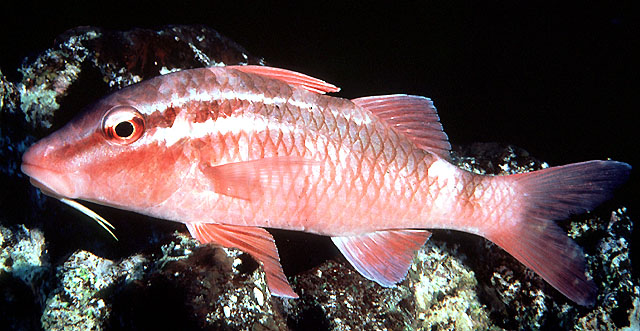
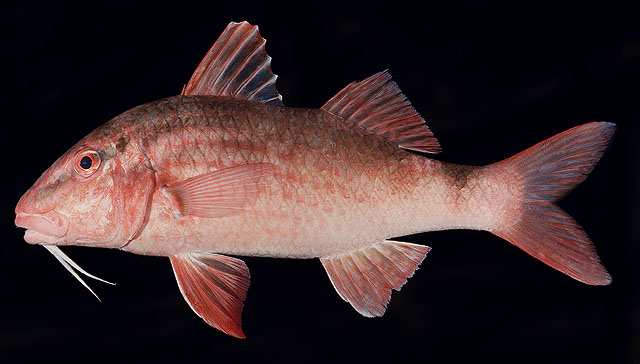

Description
Dorsal spines (total): 8; Dorsal soft rays (total): 9; Anal soft rays: 7; Vertebrae: 24. Diagnosis: Pectoral rays 15 (rarely 14 or 16). Gill rakers 6-7 + 24-27 (total 30-34). Body depth 2.85-3.25 in SL; head length (HL) 2.85-3.1 in SL; snout length 1.85-2.2 in HL; barbels short, 1.65-1.95 in HL; longest dorsal spine 1.55-1.85 in HL; last dorsal ray slightly longer than penultimate ray; posterior margin of each caudal lobe convex; pectoral-fin length 1.3-1.5 in HL; pelvic-fin length 1.2-1.4 in HL. Body red to reddish brown dorsally, light red ventrally, with a white saddle-like spot on caudal peduncle flanked anteriorly and posteriorly by a dusky spot, the posterior one darkest; a reddish brown band from front of snout through eye and along body to above lateral line, fading and broadening below second dorsal fin, dark band behind eye and anteriorly on body bordered by a white band; fins mainly red; barbels white (Ref. 54393).
Common Names
Taxonomic Hierarchy
Kingdom: Animalia
Phylum: Chordata
Class: Teleostei
Order: Mulliformes
Family: Mullidae
Genus: Parupeneus
Species: Parupeneus porphyreus (Jenkins, 1903)
Climate Zone
Biology
Inhabits lagoon and seaward reefs; in small groups under ledges or among corals by day, dispersing at night to feed among rocks and corals on benthic crustaceans (Ref. 9710). It is a nocturnal predator that feeds mostly on benthic crustaceans (Ref. 13550). Spawning appears to be year-round with the peak from December to July; females may spawn more than once a year (Ref. 54393).
Habitat
associated
Conservation Status
Near Threatened
Threat to Humans
Harmless
Parupeneus porphyreus (Jenkins, 1903)