Parupeneus orientalis (Fowler, 1933)

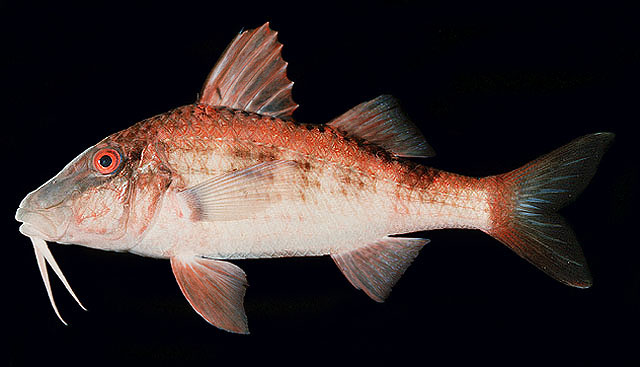
Description
Dorsal spines (total): 8; Dorsal soft rays (total): 9; Anal soft rays: 7; Vertebrae: 24. Diagnosis: Pectoral rays 16-17 (three of four with 16). Gill rakers 7-8 + 27-29 (total 35-37). Body depth 2.95-3.3 in SL; head length (HL) 2.7-2.95 in SL; snout length 1.7-1.75 in HL; barbel length 1.45-1.7 in HL; third dorsal spine longest, 1.55-2.0 in HL; penultimate dorsal ray at most 1.1 in length of last dorsal ray; pectoral-fin length 1.4-1.5 in HL; pelvic-fin length 1.35-1.55 in HL. Body in life with a broad white stripe just above lateral line, bordered dorsally by a series of close-set black spots along uppermost row of scales; side of body below lateral line light brown with five large square blackish bars (each scale in bars with a black spot), the last anteriorly on caudal peduncle continuing dorsally across white stripe; head bluish gray dorsally with transverse rows of black spots on nape and interorbital; fins dusky to reddish (Ref. 54393).
Taxonomic Hierarchy
Kingdom: Animalia
Phylum: Chordata
Class: Teleostei
Order: Mulliformes
Family: Mullidae
Genus: Parupeneus
Species: Parupeneus orientalis (Fowler, 1933)
Climate Zone
Biology
Stomach contents include a juvenile spiny lobster (Panulirus pascuensis) and small crabs (Ref. 54393).
Habitat
demersal
Conservation Status
Not Evaluated
Threat to Humans
Harmless
Parupeneus orientalis (Fowler, 1933)