Parupeneus fraserorum Randall & King, 2009

Description
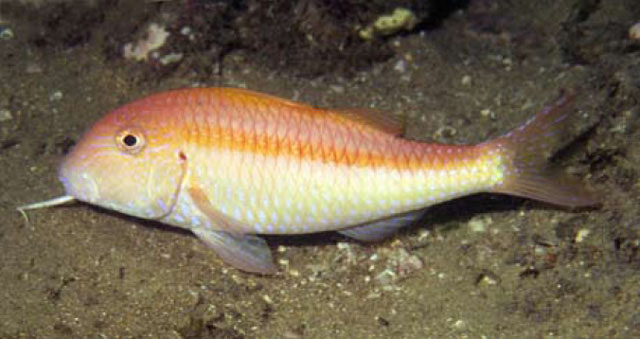
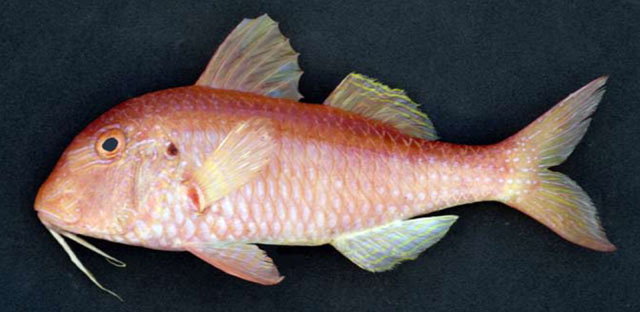
Dorsal spines (total): 8; Dorsal soft rays (total): 9; Anal spines: 1; Anal soft rays: 7; Vertebrae: 24. This species is distinguished by the following characters: 16 or 17 pectoral-fin rays; 6 + 21 or 22 gill rakers; body depth 2.8-2.9 in SL; head length 2.8-2.9 in SL; snout length 1.8-1.85 in HL; posterior margin of maxilla symmetrically convex; barbels 1.3-1.35 in HL; third dorsal spine longest, 1.8-2.0 in HL; longest dorsal ray 3.15-3.3 in HL; penultimate dorsal-fin ray only slightly shorter than last ray; pectoral-fin length 1.2-1.25 in HL; pelvic-fin length 1.35-1.5 in HL; in life, has an orange-yellow stripe following lateral line with body above the stripe pale brown and below stripe white with light blue iridescence centrally in each scale, posteriorly becoming a smaller, more defined spot; scale edges narrowly dark; upper end of gill opening with a dark brown spot about half pupil diameter in height; faint oblique blue lines anterior and posterior to eye; second dorsal and anal fins with wavy blue lines; caudal fin with iridescent blue longitudinal streaks; pectoral fins with a light red bar at base; white barbels (Ref. 82839).
Taxonomic Hierarchy
Kingdom: Animalia
Phylum: Chordata
Class: Teleostei
Order: Mulliformes
Family: Mullidae
Genus: Parupeneus
Species: Parupeneus fraserorum Randall & King, 2009
Climate Zone
Biology
Inhabits sand bottom areas near edge of low profile reefs, usually solitary, occasionally in loose pairs (Ref. 82839).
Habitat
associated
Conservation Status
Least Concern
Threat to Humans
Harmless
Parupeneus fraserorum Randall & King, 2009