Lipogenys gillii Goode & Bean, 1895

Description
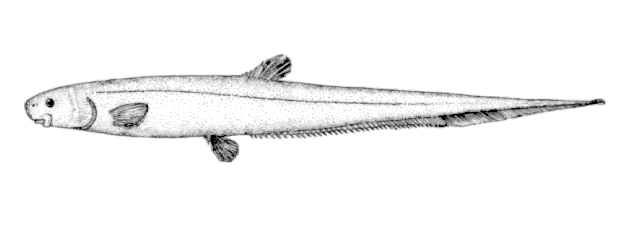
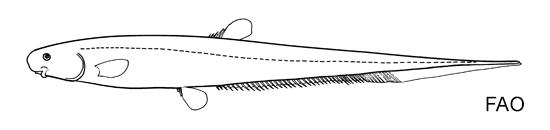
Dorsal spines (total): 6 - 8; Dorsal soft rays (total): 4 - 5; Anal spines: 44 - 58; Anal soft rays: 67 - 88; Vertebrae: 228 - 234. Tail slender and tapering to a point. Mouth inferior, small and sucker-like; upper lip with thick, pleated folds; posterior end of maxilla bent sharply downward, forming a flap-like structure; fleshy papillae on snout bordering upper lip. Teeth absent. Dorsal fin short-based, located above anus, the first 4-6 rays hard and spinous, increasing in length from front to back, the remainder soft and segmented, membrane connecting all rays except for first I-III spines. Anal fin long, extending from just behind anus to tip of tail, anterior rays spinous, posterior rays segmented, the transition gradual. Caudal fin absent (Ref. 11041). Light brown, lining of gill chamber and rim of opercular branchiostegal flap dark brown, mouth and lining of buccal cavity light yellowish tan (Ref. 37108).
Common Names
Taxonomic Hierarchy
Kingdom: Animalia
Phylum: Chordata
Class: Teleostei
Order: Notacanthiformes
Family: Notacanthidae
Genus: Lipogenys
Species: Lipogenys gillii Goode & Bean, 1895
Climate Zone
Biology
Feed mostly on organic material contained in bottom sediment drawn up by the sucker-like mouth [RF doubts this is a detritus feeder; the elaborate mouth without teeth looks like a specialization for extracting soft-bodied benthic invertebrates out of the ground; also, there are no gill rakers to filter detritus (Ref. 50674)]. No obvious sexual dimorphism; a female of 37.5 cm SL was still immature (Ref. 50674).
Habitat
bathydemersal
Conservation Status
Not Evaluated
Threat to Humans
Harmless
Lipogenys gillii Goode & Bean, 1895