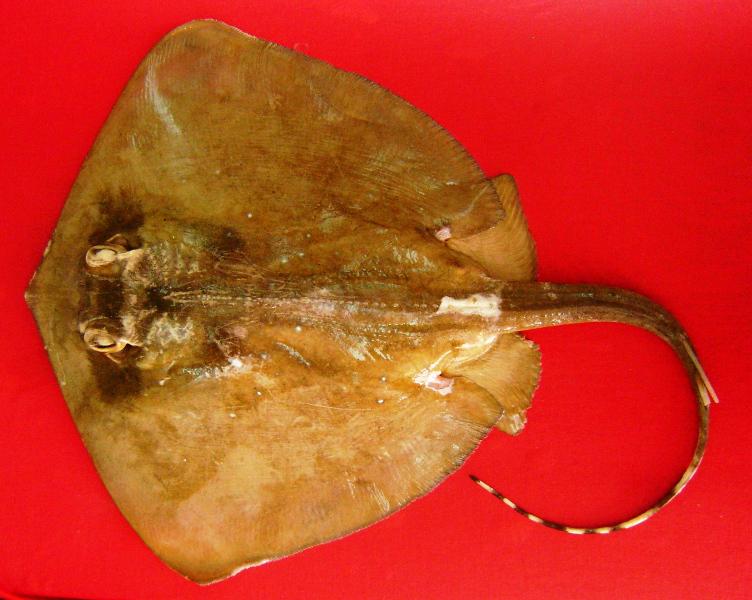
Neotrygon kuhlii (Müller & Henle, 1841)

Description


This medium-sized Neotrygon of the kuhlii-complex (reaching at least 30 cm DW) is distinguished by the following set of characters: disc is broader than long, its width ca. 1.2 times length; pectoral apices are narrowly rounded; snout rather fleshy, broadly angular, its angle ca. 107°, its length 1.7-2.1 times interorbital width; maximum width is relatively well back on disc, the length from snout tip to pectoral-fin insertion 1.8-1.9 times and disc width 2.5-2.6 times horizontal distance from snout tip to maximum disc width; preoral length is 2.4-2.8 times mouth width; internasal distance is 1.5-1.8 in prenasal length; interspiracular distance is 13-15% DW; nostril length is 2.8-4.1% DW; nasal curtain width is 8-8.3% DW; mouth small, its width 6.4-6.8% DW; horizontal distance from cloaca to caudal sting base ca. 55% of disc length; nuchal region with thornlets, none from tail in all sizes; no dermal denticles; 113 pectoral-fin radials (based on new specimen); 133 total vertebral centra (including synarcual), 39 trunk centra (including synarcual); presence of blue spots that are very small and sparse, largest spot on disc 0.3-0.5 times eye width; median belt with 0-6 (mean 3.0) blue spots, largest ~2.1% DW; pronounced mask-like marking, not covered with dark peppery spots; ventral surface of disc and pelvic fins with broad dark greyish submarginal bands; when fresh, ventral tail fold and adjacent tail bluish grey (Ref. 116741).

Common Names


  • Bloukol-pylstert , Afrikaans , South Africa
  • Lukhmah , Arabic , Oman
  • Ali , Bahasa Indonesia , Indonesia
  • Anin , Bahasa Indonesia , Indonesia
  • Pari kodok , Bahasa Indonesia , Indonesia
  • Pasa-pasa , Banton , Philippines
  • Dahunan , Bikol , Philippines
  • Daragon , Bikol , Philippines
  • Kuyampao , Bikol , Philippines
  • Kuyampo , Bikol , Philippines
  • Pagi , Bikol , Philippines
  • Leik-kyauh sun-maung-shin , Burmese , Myanmar
  • Faiyemeet , Carolinian , Micronesia
  • Ntsara , Comorian , Comoros
  • Kuhls pigrokke , Danish , Denmark
  • Page , Davawenyo , Philippines
  • Grijze pijlstaartrog , Dutch , Netherlands
  • Ble-spotted stingaree , English , Malaysia
  • Ble-spotted stingray , English , Malaysia
  • Blue spotted stingray , English , Micronesia
  • Blue spotted stingray , English , Viet Nam
  • Blue-spotted maskray , English , Australia
  • Blue-spotted maskray , English , Malaysia
  • Blue-spotted maskray , English , Philippines
  • Blue-spotted stingaree , English , Australia
  • Blue-spotted stingray , English , Australia
  • Blue-spotted stingray , English , Papua New Guinea
  • Blue-spotted stingray , English , Philippines
  • Blue-spotted stingray , English , Global
  • Bluespotted maskray , English , Australia
  • Bluespotted maskray , English , Malaysia
  • Bluespotted stingray , English , India
  • Bluespotted stingray , English , Malaysia
  • Bluespotted stingray , English , Micronesia
  • Bluespotted stingray , English , South Africa
  • Bluespotted stingray , English , Global
  • Kuhl's stingray , English , Australia
  • Kuhl's stingray , English , Solomon Is.
  • Spotted stingray , English , Malaysia
  • Sinitäpp-maskrai , Estonian , Estonia
  • Vai , Fijian , Fiji
  • Vai dina , Fijian , Fiji
  • Pastenague à points bleus , French , France
  • Pastenague à points bleus , French , Global
  • Raie à points bleus , French , New Caledonia
  • Requin raie , French , New Caledonia
  • Vali , Gela , Solomon Is.
  • Pagi , Hiligaynon , Philippines
  • Pagi , Ilokano , Philippines
  • Yakko ei , Japanese , Japan
  • Yakko-ei , Japanese , Japan
  • Pari blentik , Javanese , Indonesia
  • 꽁지가오리 , Korean , Korea (South)
  • Nek pa , Kumak (Nenema) , New Caledonia
  • Kalbog , Kuyunon , Philippines
  • Page , Kuyunon , Philippines
  • Ketuka , Malay , Malaysia
  • Kiampau , Malay , Malaysia
  • Pari lalat , Malay , Malaysia
  • Pari lanyau , Malay , Malaysia
  • Pari macan , Malay , Indonesia
  • Pari minyak , Malay , Malaysia
  • Pari renyau , Malay , Malaysia
  • Pari riman , Malay , Malaysia
  • Pari rimau , Malay , Malaysia
  • Pari tanjung , Malay , Malaysia
  • 古氏土魟 , Mandarin Chinese , China
  • 古氏土魟 , Mandarin Chinese , Taiwan/Ch Taipei
  • 古氏魟 , Mandarin Chinese , China
  • 鲂仔 , Mandarin Chinese , China
  • Pakat , Marathi , India
  • Palwa , Marathi , India
  • पकात , Marathi , India
  • पळवा , Marathi , India
  • Vé , Numee (Nââ Kwênyi) , New Caledonia
  • Rrull , Palauan , Palau
  • Page , Pangasinan , Philippines
  • Uge ponteado , Portuguese , Mozambique
  • хвостокол японский , Russian , Russia
  • Fai-malie , Samoan , Samoa
  • Fai-tala , Samoan , Samoa
  • Chittipi-tan , Sindhi , Pakistan
  • Pague , Surigaonon , Philippines
  • Dahunan , Tagalog , Philippines
  • Pagi , Tagalog , Philippines
  • Kunnoo-tirike , Tamil , Sri Lanka
  • Kunoo-tirike , Tamil , India
  • Pulli-thirukhai , Tamil , Sri Lanka
  • Pulli-thirukhai , Tamil , India
  • குன்னு தீருக்கை , Tamil , India
  • குன்னு தீருக்கை , Tamil , India
  • கூனுத் திருக்‍கை , Tamil , India
  • புள்ளி திருக்‍கை , Tamil , India
  • புள்ளீதீருக்கை , Tamil , India
  • Shemen-tenkee , Telugu , India
  • షిమెన్ టెంకీ , Telugu , India
  • షిమెన్ టెంకీ , Telugu , India
  • Krabane Jamoog-woa , Thai , Thailand
  • Fai kili , Tokelauan , Tokelau
  • Cá Duôi Bông , Vietnamese , Viet Nam
  • Cá Đuối bồng đuôi vằn , Vietnamese , Viet Nam
  • Cá Đuối bông đuôi vằn , Vietnamese , Viet Nam
  • Pagi , Visayan , Philippines
  • Pasa-pasa , Visayan , Philippines
  • Taxonomic Hierarchy


    Kingdom: Animalia

    Phylum: Chordata

    Class: Elasmobranchii

    Order: Myliobatiformes

    Family: Dasyatidae

    Genus: Neotrygon

    Species: Neotrygon kuhlii (Müller & Henle, 1841)

    Climate Zone


  • Tropical
  • Biology


    A solitary species found on sandy bottoms near rocky or coral reefs (Ref. 12951). Usually found in deeper water but moves onto the reef flat and into shallow lagoons at high tide (Ref. 12951). Occasionally covers itself with sand, leaving only its eyes and tail visible (Ref. 37816). Feeds on crabs and shrimps (Ref. 5578). Ovoviviparous (Ref. 50449). The venomous spine can inflict a painful wound (Ref.4690). Caught in very large quantities in the bottom trawl, trammel and fish trap fisheries. Utilized for its meat but of limited value due to its small size (Ref. 58048). It is parasitised by the monogenean Dendromonocotyle kuhlii on the dorsal skin surface (Ref. 124051).

    Habitat


    associated

    Conservation Status


    Data deficient

    Threat to Humans


    Venomous