Hypanus americanus (Hildebrand & Schroeder, 1928)






Description
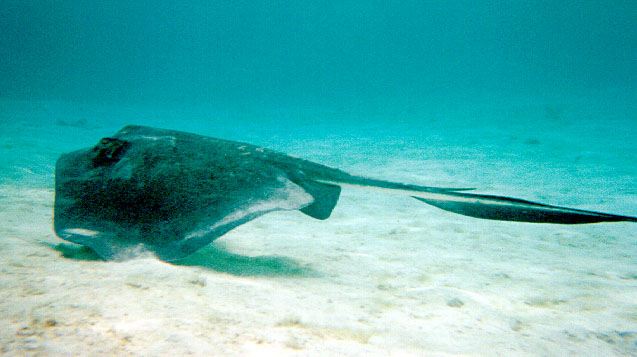
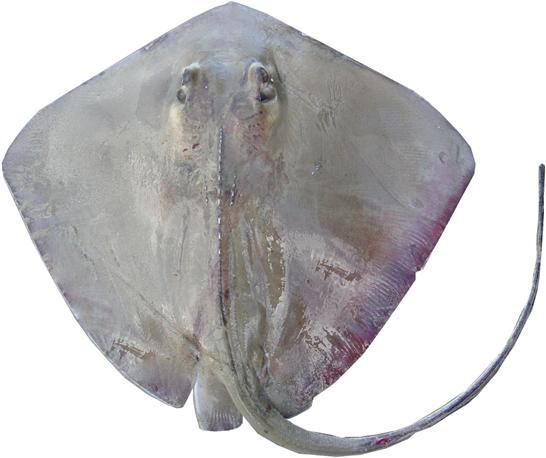
Disk has sharp outer corners and irregular row of short spines on upper surface (Ref. 26938). Disk usually uniform dark brown above, grayer in young. Ventral finfold on tail long and high, dorsal finfold absent (Ref. 7251). Upper surface of disc gray, dark or olivaceous brown or olive green. Lower surface of disc white or whitish with an edging of gray or brown (Ref. 6902).
Common Names
Taxonomic Hierarchy
Kingdom: Animalia
Phylum: Chordata
Class: Elasmobranchii
Order: Myliobatiformes
Family: Dasyatidae
Genus: Hypanus
Species: Hypanus americanus (Hildebrand & Schroeder, 1928)
Climate Zone
Biology
Found on sandy bottoms, seagrass beds, lagoons and the reef face (Ref. 12951). Common in bays and estuaries (Ref. 7251). Observed singly, in pairs and in aggregations (Ref. 12951). Buries in the sand during the day and forages at night, usually in seagrass beds (Ref. 12951). Feeds mainly on bivalves and worms and also takes shrimps, crabs and small fishes (Ref. 3168). Feeds by creating depressions in the sand to expose invertebrates and small fishes (Ref. 9710). Ovoviviparous, with 3-4 in a litter (Ref. 12951). May be found in cleaning stations where they are attended to by the bluehead wrasse and Spanish hogfish (Ref. 12951). Equipped with a well-developed serrated spine and capable of inflicting a painful laceration. Easily approached by divers (Ref. 9710).
Habitat
brackish
Conservation Status
Near Threatened
Threat to Humans
Traumatogenic