Cryptocellus chimaera Botero-Trujillo & Valdez-Mondragón, 2016
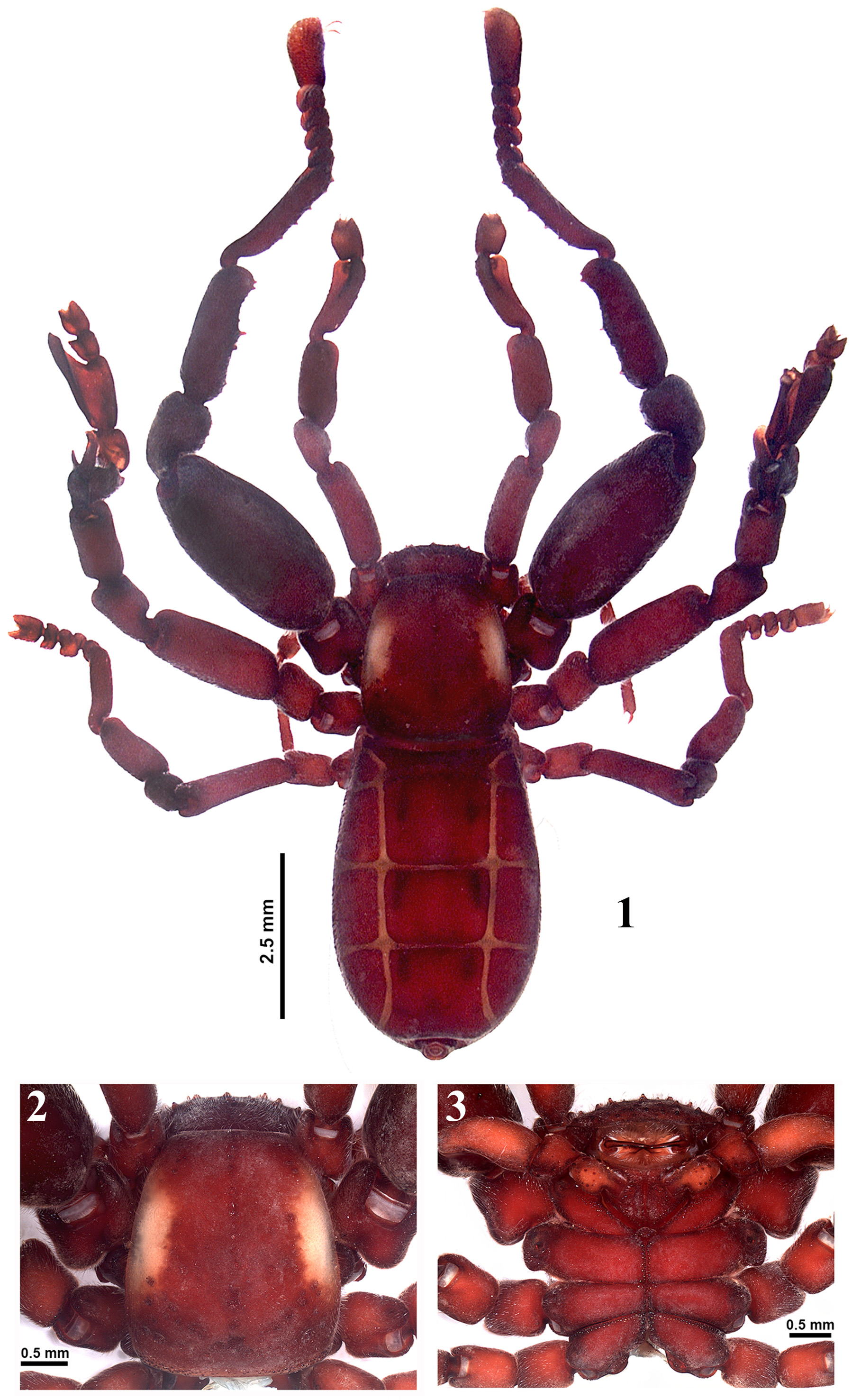
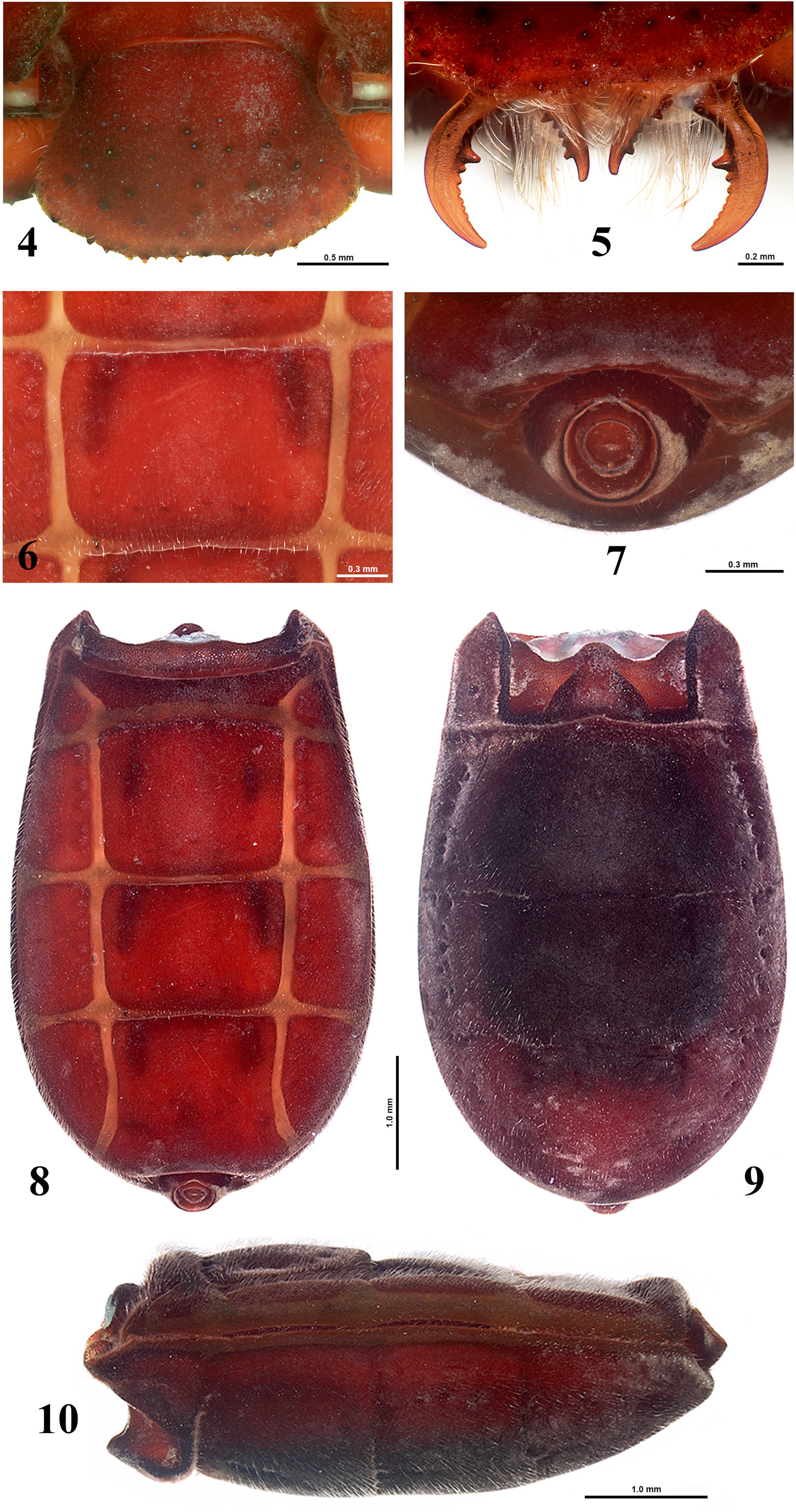
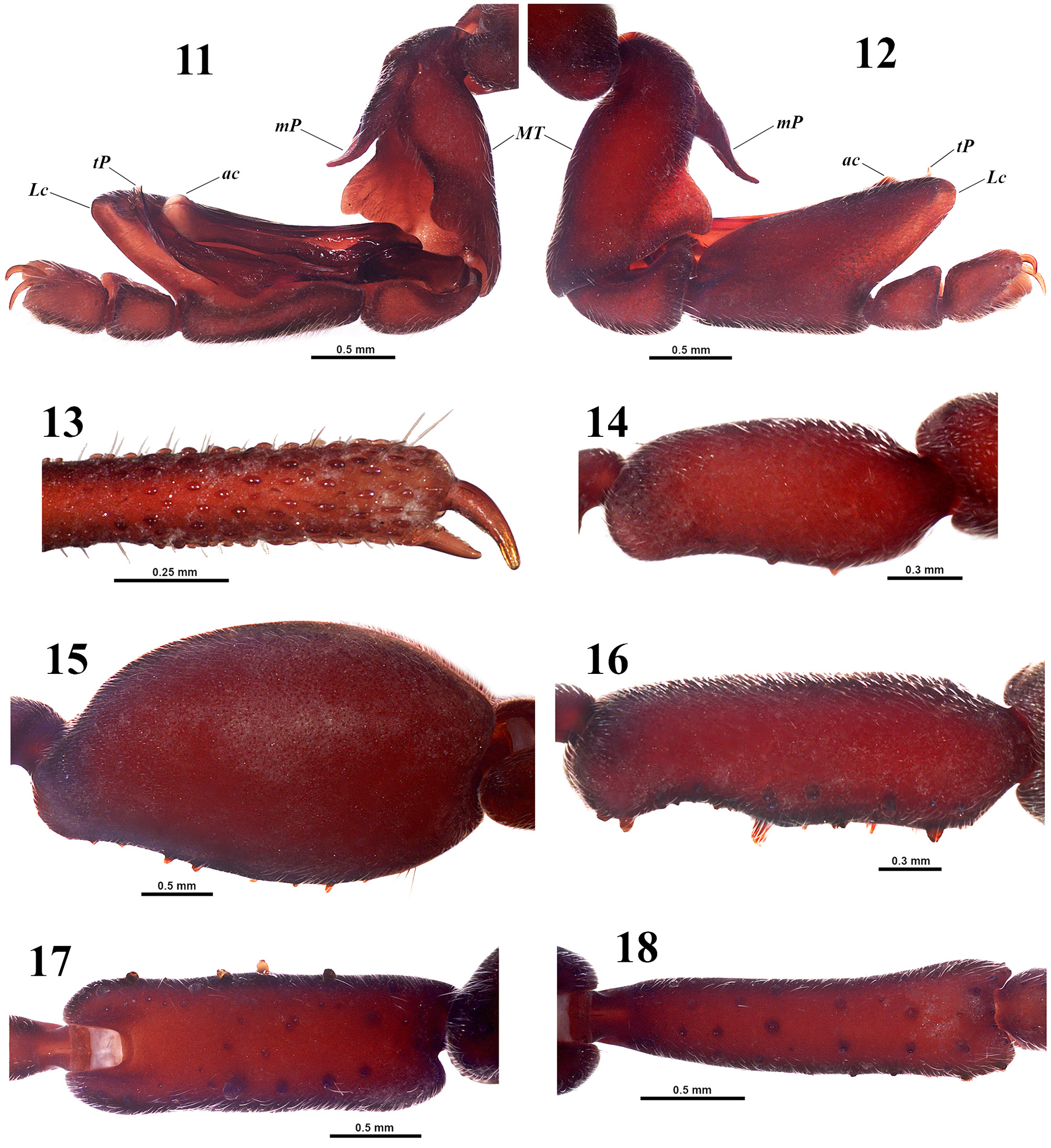
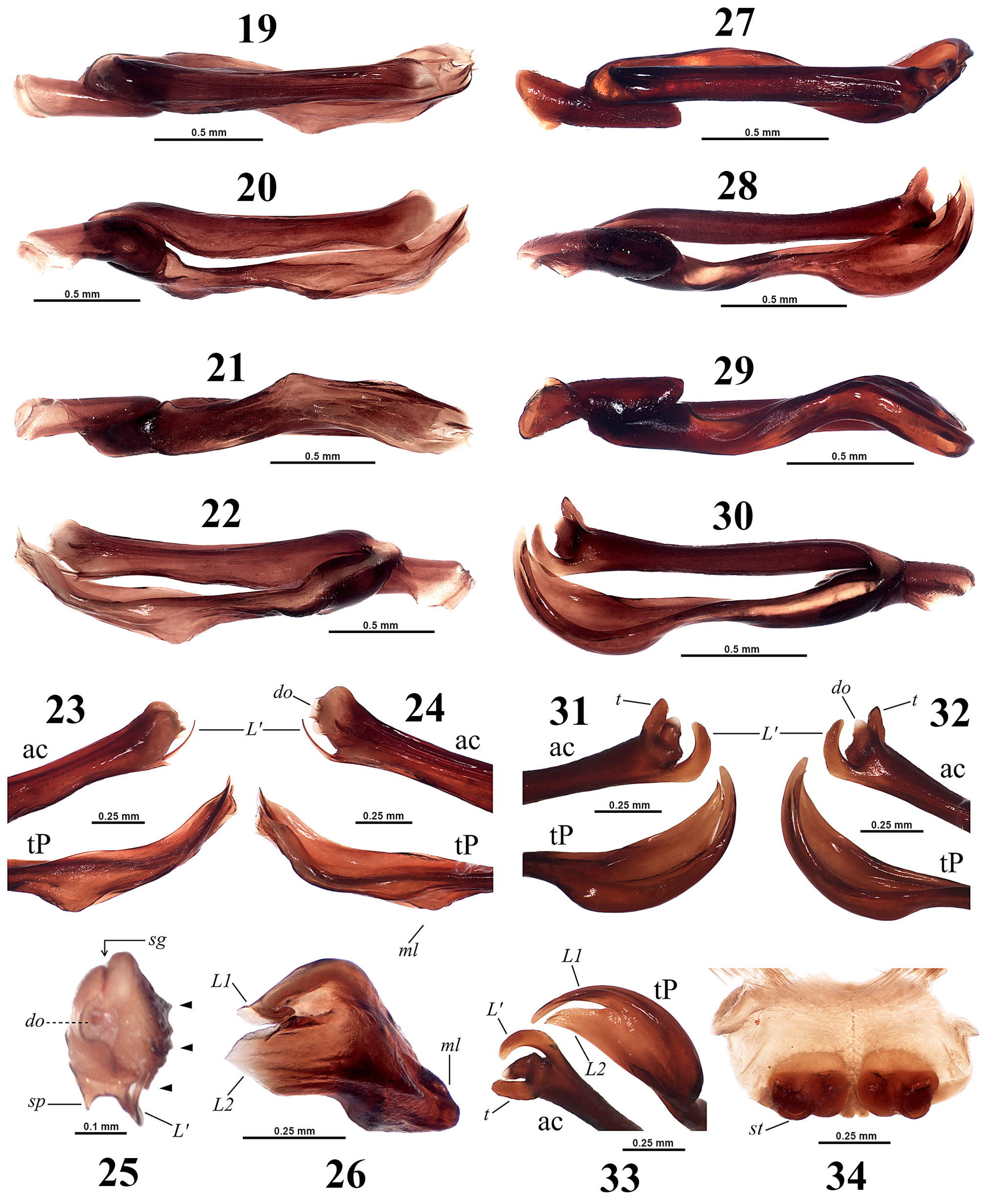
Description
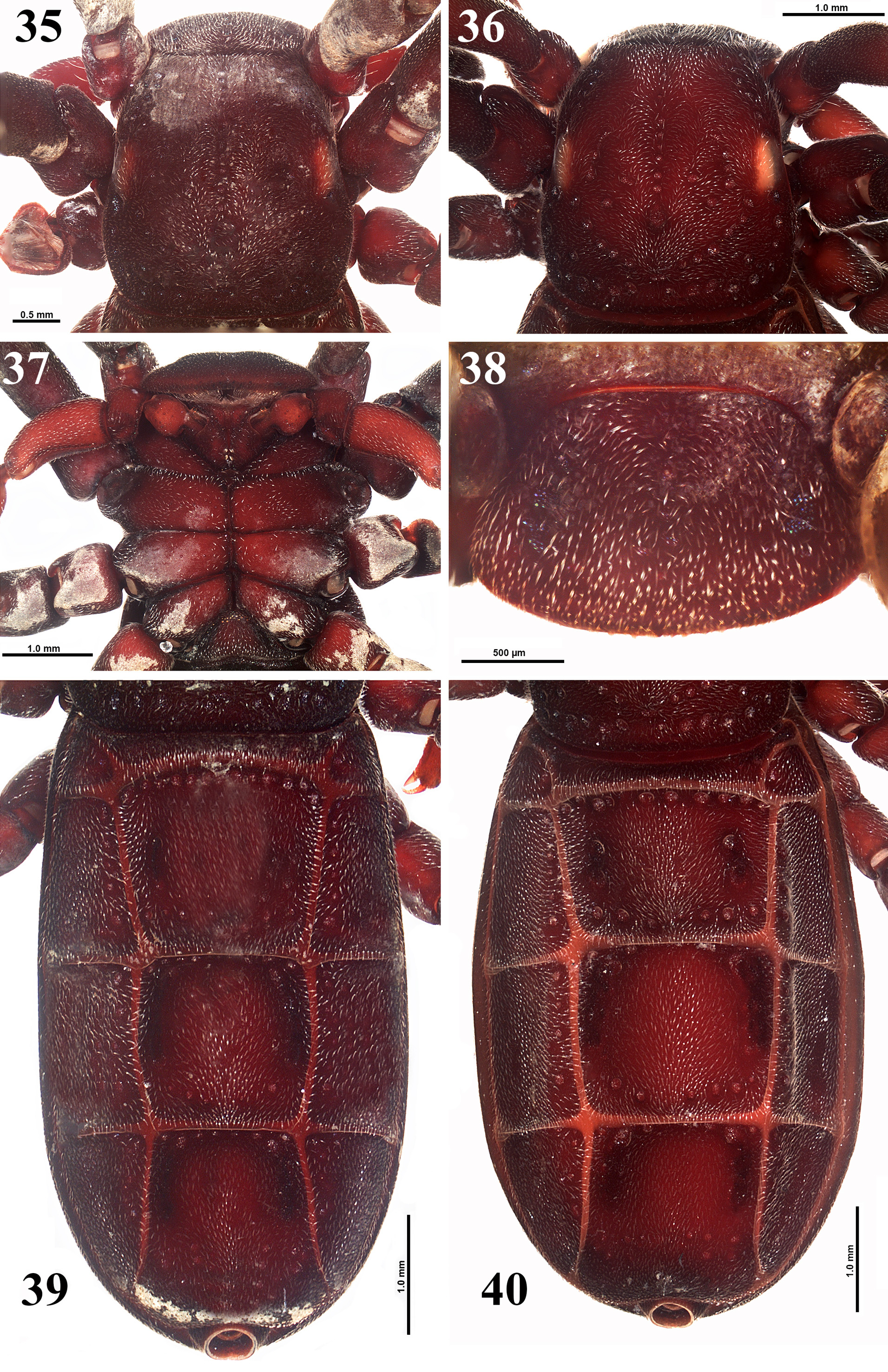
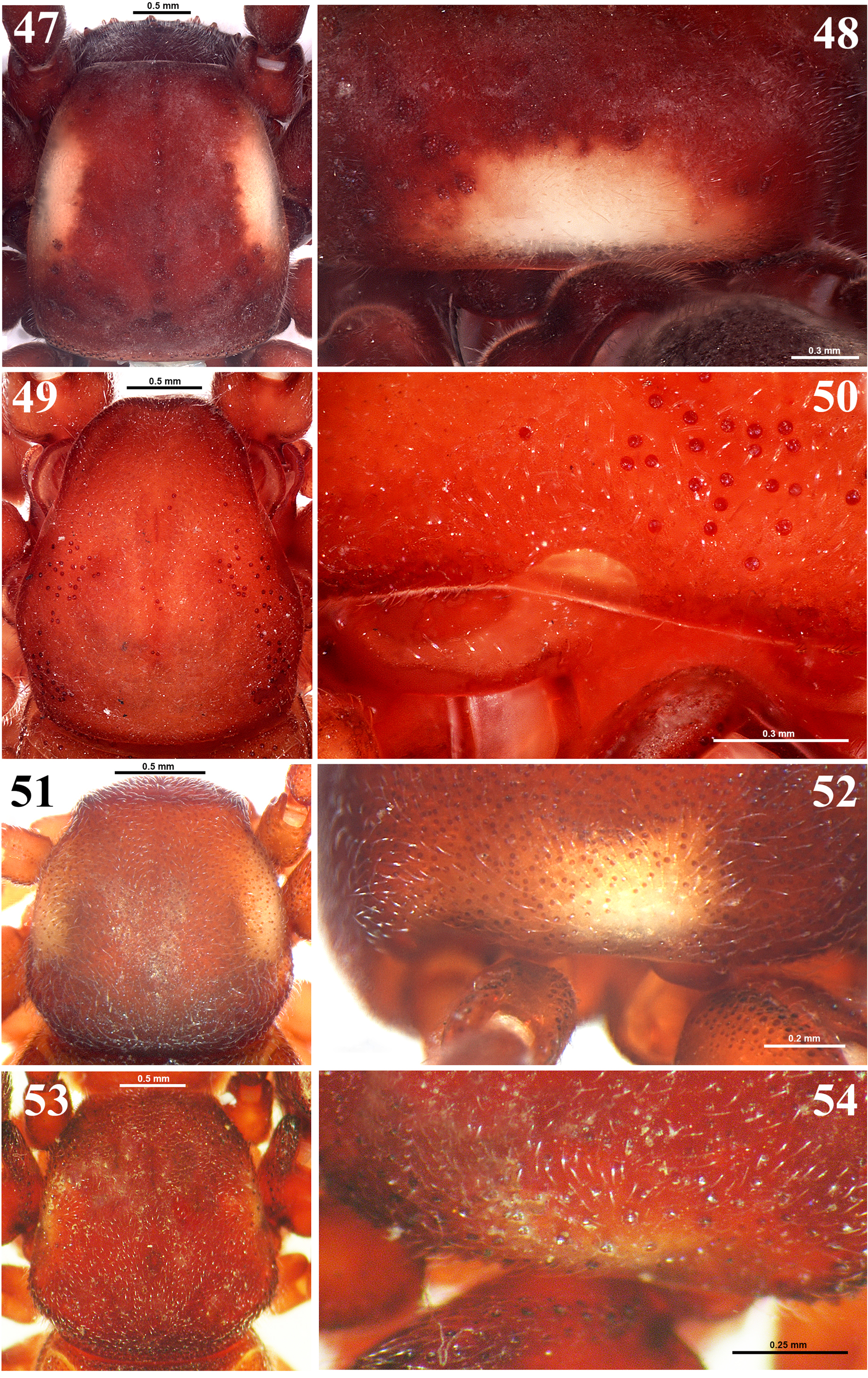
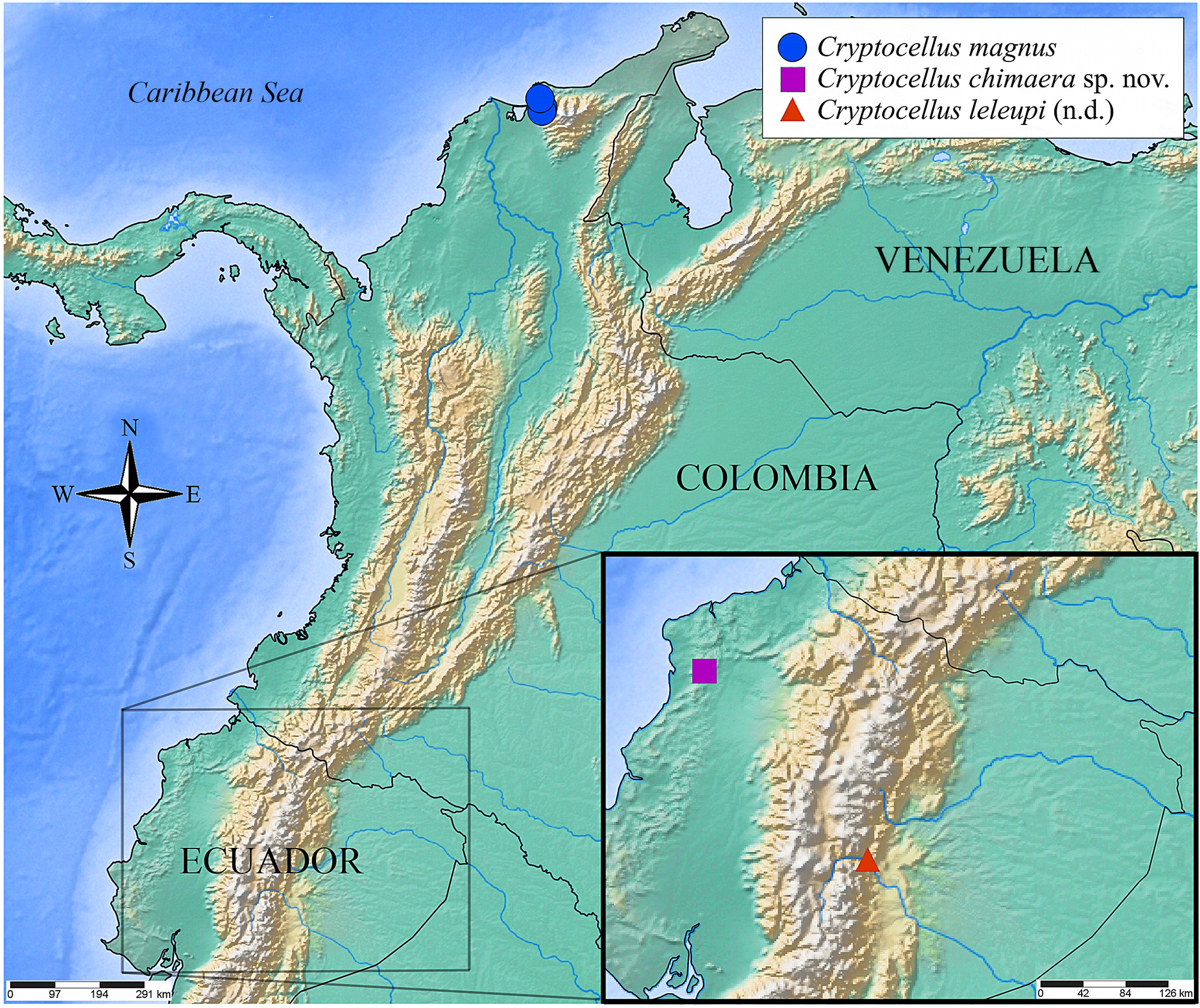
Description. Male (holotype). Coloration: Figs 1 – 3. Cucullus, carapace, sternal region and legs II reddish brown; pedipalps, legs I, III, IV, and dorsal surface of opisthosoma reddish; opisthosoma ventrally with a darkened rounded area, covering the central part of sternites XI, XII, and XIII anteriorly. Longitudinal carapacial translucent areas yellow, contrasting with the background color. Setation: Figs. 1 – 18. Body and appendages entirely covered with fine, bristle-like, translucent setae, which are sparse in sternal region. Carapace: Figs. 1 – 2, 47 – 48. Trapezoidal in shape, with lateral margins not parallel (narrowing anteriorly); anterior margin straight in dorsal aspect, slightly re-curved in frontal aspect; posterior margin gently re-curved; carapace longer than wide, widest at level between coxae II and III. Longitudinal translucent areas dorsallydirected in the lateral edges of carapace, without well-defined borders, covering between one third and half the length of the lateral margins, from level of coxae I to level between coxae II and III; translucent areas mostly covered with setae as rest of carapace, glabrous regions as narrow areas at the margin of carapace at level of coxae II. Carapace with symmetrical arrangement of tubercle-containing cuticular pits, as follows: about 17 pits along median longitudinal axis (posterior-most three pits larger); posterior margin with about six pits on each side of the midline (lateral two pairs wider); short oblique rows posterior to the translucent areas, each with about eight pits, the anteriormost pit which penetrates into the translucent areas; few additional isolated pits found between the translucent areas and anterior to these. Carapace without any other pronounced depressions. Granules (apart from those of pits) only found in a row along posterior margin. Cucullus: Fig. 4. Wider than long, noticeably widest anteriorly; with abundant strong surface tubercles on distal two thirds; with few tubercle-containing cuticular pits and devoid of furrows. Chelicerae: Fig. 5. Movable finger twice the length of fixed finger and more robust; movable finger armed with one noticeably large sub-basal tooth and six small teeth progressively decreasing in size; fixed finger with five teeth, basal and distal ones slightly larger than three middle ones. Sternal region: Fig. 3. Coxae I meeting tritosternum; coxae II – IV meeting entirely, progressively decreasing in length; II and III sub-rectangular, IV pear-shaped; coxae II with anterior and posterior margins parallel, each forming a straight line perpendicular to the median axis; suture lines of coxae III and IV each about half the length of that of coxae II (coxae II are larger). Cuticle with minute tubercles along coxal margins (more abundant on pedipalp coxae) and without cuticular pits. Opisthosoma: Figs. 1, 8 – 10. Oblong truncate, longer than wide, widest at level of tergite XII. Median plates of tergites XI – XIII with paired antero-lateral depressions and lateral margins approximately parallel; median plate of tergites XI and XIII approximately as wide as long, that of XII clearly wider than long, that of X slit-like trapezoidal. Central region of tergite XI median plate only slightly elevated; tergite XIII median plate with rear corners pointy, protruding laterally. Dorsal and ventral surfaces with symmetrical arrangement of tuberclecontaining cuticular pits, as follows: tergite XI median plate with eleven along anterior margin, five on posterior margin, four – five on lateral margins; tergite XII median plate with seven on anterior margin, five on posterior margin, four on each lateral margin; tergite XIII median plate with seven on anterior margin, three on each lateral margin. Internal margin of lateral plates of tergites X to XIII with one – two, six – seven, six – seven and five – seven pits, respectively. Lateral margins of ventral surface with a longitudinal row of pits consisting of one on each side of sternite X, six – seven on XI, seven – eight on XII, and ten on each side of XIII. Ventral pits also present on paired antero-lateral depressions of XI – XIII. Outside of the pits, minute tubercles only found on median plate of tergite X. Basal segment of pygidium with shallow notch on dorsal posterior border; ventral border without notch. Pedipalps: Fig. 13. Without cuticular pits; with few tubercles on ventral surface of trochanters I and II. Femur dorsally convex, widened in basal half. Tibia longer than femur, with dorsal surface straight, slightly widened ventrally in basal third, and with array of shallow elongated tubercles [= ' elevated tubercles' of Salvatierra & Tourinho (2016)] on all surfaces in distal half. Movable claw about twice the length of fixed claw and more robust; fixed claw armed with minute teeth, movable claw toothless or feebly serrate (any teeth might have worn down). Legs: Figs. 1, 11 – 12, 14 – 18. Without cuticular pits; leg segments with minute, inconspicuous granules in the very basal and distal boundaries facing the neighbouring segments. Leg II noticeably long and widened, especially on femur which very incrassate; other legs decrease in width in the order III, I, IV. Tibia of legs I and II with ventral notch, shallow on tibia I, more pronounced on tibia II. Legs I and II with ventral tubercles on femur, patella (on I only basally), tibia, and metatarsus, sparse and moderate in leg I, more abundant and sharp-tipped in leg II; the larger tubercles, found in femur and tibia of leg II, are mostly arranged in pro- and retroventral rows; legs III and IV devoid of tubercles. Leg I tarsus elevated, dorsally rounded, with claws sheltered in a cavity with disto-ventral opening; leg II distal tarsomere at least three times longer than the preceding tarsomeres, which are small and subequal in size and shape, with claws sheltered in a cavity with elongated ventral opening [like that of Pseudocellus boneti (Bolívar y Pieltain, 1942) see Talarico et al. 2006: fig. 3 b]; leg III unmodified two tarsomeres sub-equal, slightly longer than the small tarsomeres of leg II; leg IV tarsomeres similar to those of leg II, except for terminal tarsomere which is at least twice longer than the preceding tarsomeres; terminal tarsomere of legs III and IV with distal dorsal and ventral V-shaped invaginations so the claws are exposed on either aspect. Leg III metatarsus not inflated, moderately excavated, with pro- and retrolateral subapical lobes; lamina cyathiformis longer than high, obtuse. Trochanter IV unmodified. Copulatory apparatus: Figs. 11 – 12, 19 – 26. Tarsal process S-shaped on dorsal aspect, with moderate ipsilateral rotation; somewhat canoe-shaped on lateral aspect, with pronounced pro-ventral median ledge and array of distinct ventral longitudinal keels; dorsal pro- and retrolateral margins sinuous; apex shallowly bifid forming pro- (L 2) and retrolateral (L 1) lobes; L 1 lobe rather horn-like, with irregular margins, shorter than L 2. Accessory piece massive from base to apex, predominantly straight except for pronounced ventral sub-basal widening; apex with thin, dorsally-curved, retro-ventral hook-like lobe (L ′), and spiniform pro-ventral process; L′ ′ lobe not differentiated; dorsal aspect of the accessory piece with longitudinal sperm transfer groove ending in distal opening, retrolateral aspect with series of longitudinal carinae, one of which is especially protruding. Measurements of male (in mm). Body length, excluding pygidium 7.85; cucullus 1.13 long, greatest width 1.80; carapace 2.60 long, 2.33 wide at level between coxae II and III (where widest); opisthosoma 4.33 long (excluding pygidium), 3.07 wide at level of tergite XII (where widest); median plate of tergite XI 1.33 long, 1.60 wide (where widest); median plate of tergite XII 1.13 long, 1.60 wide; median plate of tergite XIII 1.33 long, 1.67 wide; suture line of coxae II 0.57 long, of coxae III 0.31 long; pedipalp femur 1.27 long, greatest depth 0.54; pedipalp tibia 1.87 long, greatest depth 0.26; femur I 1.47 long, greatest width 0.60; femur II 2.93 long, 1.47 greatest width, 1.87 greatest depth; femur III 0.80 width; femur IV 0.47 width. Female. Unknown.
Common Names
No common names available.
Taxonomic Hierarchy
Kingdom: Animalia
Phylum: Arthropoda
Class: Arachnida
Order: Ricinulei
Family: Ricinoididae
Genus: Cryptocellus
Species: Cryptocellus chimaera Botero-Trujillo & Valdez-Mondragón, 2016
Cryptocellus chimaera Botero-Trujillo & Valdez-Mondragón, 2016