Macrognathus albus Plamoottil & Abraham, 2014
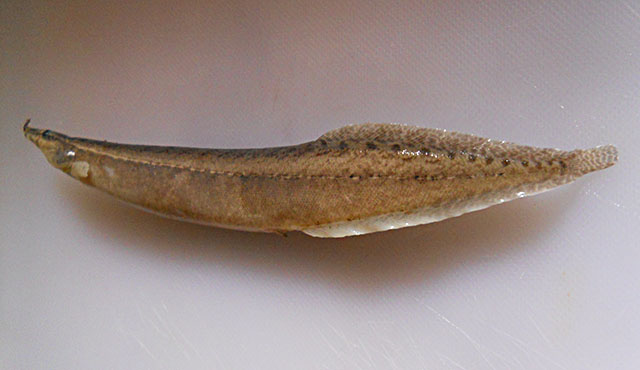

Description
Dorsal spines (total): 26 - 30; Dorsal soft rays (total): 62 - 65; Anal spines: 3; Anal soft rays: 56 - 62. Macrognathus albus can be distinguished by the following characters: absence of any bands or bars on body; 26- 29 irregular blotches on mid dorsal line from top of operculum to base of caudal; absence of pre-orbital spine; spinous part of dorsal fin originating considerably behind the end of pectoral fin; head longer and deeper, eyes located closely, body width lesser, pre dorsal and pre anal distances greater (Ref. 97143).
Taxonomic Hierarchy
Kingdom: Animalia
Phylum: Chordata
Class: Teleostei
Order: Synbranchiformes
Family: Mastacembelidae
Genus: Macrognathus
Species: Macrognathus albus Plamoottil & Abraham, 2014
Climate Zone
Biology
The type locality, Manimala River, is highly sinuous and generally rocky with deep pools at certain locations and sand deposit occurring as sporadic patches or fillings in the pools. It has more or less scanty riparian vegetation. The river has bed materials generally of coarser grade and very low sand content. The width of the river channel ranges from 45-110 m and water depth in the active channel during summer seasons ranges from 0.5 m-3 m. This species occurs together with the following fish species: Anguilla bengalensis, Salmostoma boopis, Danio malabaricus, Barilius bakeri, Gonoproktopterus kurali, Rasbora daniconius, Puntius mahecola, Haludaria fasciatus, Pethia ticto, Dawkinsia filamentosa, Systomus subnasutus, Batasio travancoria, Ompok malabaricus, Clarias dussumieri, Heteropneustes fossilis, Mesonoemacheilus triangularis, Bhavania australis, Xenentodon cancila, Aplocheilus lineatus, Parambassis thomassi, Etroplus maculatus, Etroplus suratensis, Anabas testudineus, Pristolepis malabaricus, Mastacembelus armatus, Macrognathus guentheri, etc. (Ref. 97143).
Habitat
benthopelagic
Conservation Status
Not Evaluated
Threat to Humans
Harmless
Macrognathus albus Plamoottil & Abraham, 2014