Agnezia orthenteron (Redikorzev, 1941)
Description
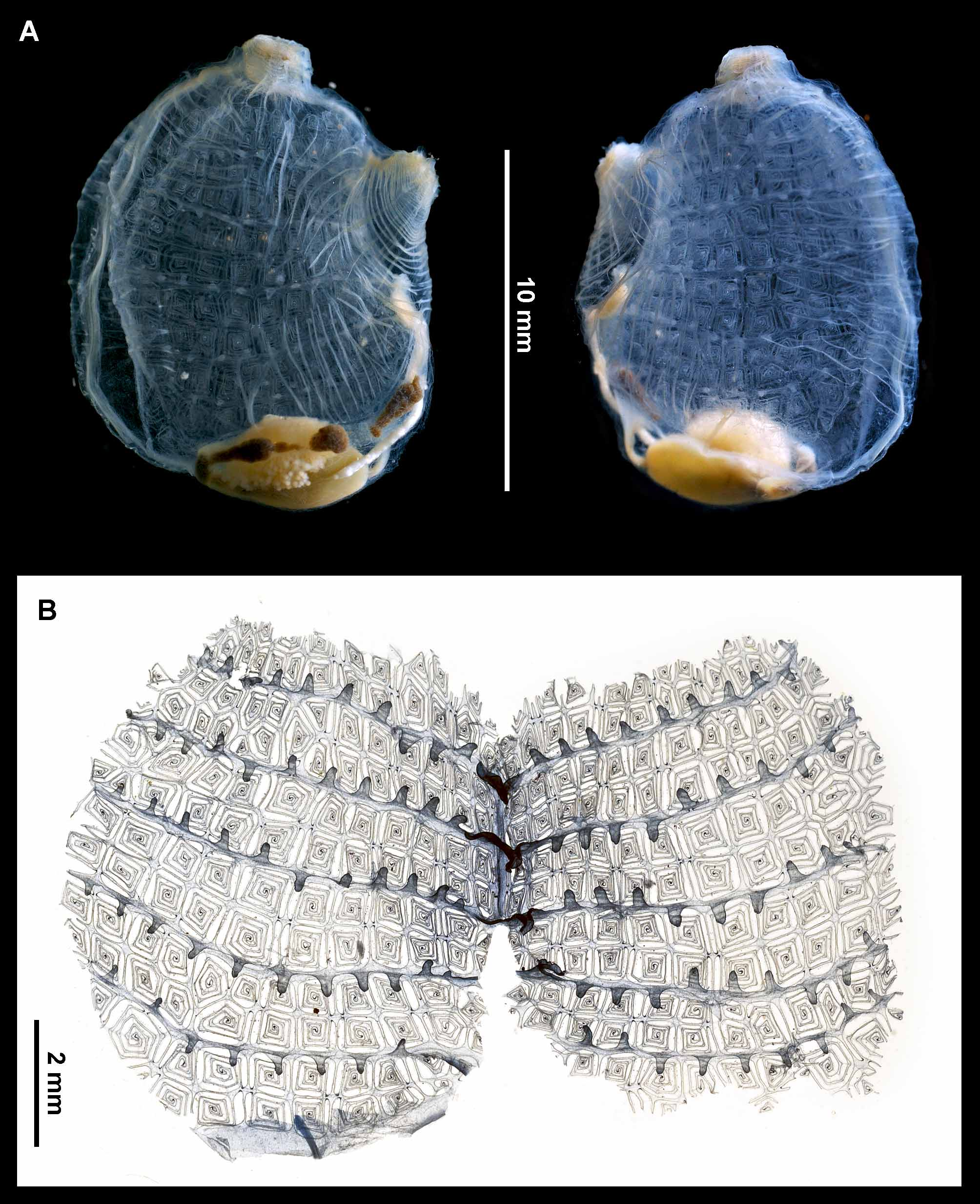
Description. The specimens are oval in outline and laterally flattened. The largest is about 15 mm diameter. The test is colourless, clear and transparent. Few fine test processes may present on the posterior end of the body along with sparse spicules of sponges attached to them, otherwise the surface of the test is smooth. Most specimens have epibionts (probably bryozoans) on the test around siphons. Siphons short, the branchial is terminal and the atrial one third down along mid dorsal line of the body. Body wall, as in most species of the genus, is very thin and transparent (Fig. 1 A). Muscles almost equally developed on both sides of the body. Thick circular muscle fibers are on the body wall around the atrial siphon, and circular muscles on the branchial siphon are limited to the wall of the siphon and do not extend beyond the branchial velum. Eight to ten thin short radial muscles radiating from the branchial siphon, the same number of longer and thicker muscles radiate from the atrial siphon. No muscles crossing intersiphonal area. Rather long parallel transverse muscles form a band on each side of the endostyle and cross the dorsal surface posterior to the atrial siphon. Numerous branchial tentacles of different lengths are arranged in several cycles and situated halfway between the branchial aperture and strong muscular branchial velum. Prepharyngeal band runs close to the velum without any noticeable undulations and makes a prominent dorsal V around the long ganglion. The dorsal tubercle was not detected. Each side of the branchial sac has six double rows of ten or eleven spiral stigmata (Fig. 1 B). The stigmata are not interrupted, mostly with four coils, and form perfectly rectangular meshes, although several polygonal figures are also present. Typically four, occasionally more radial parastigmatic vessels present on each mesh. Double rows of stigmata are separated by five transverse vessels. Each vessel has 10 or 11 simple papillae on the right side of the body and 9 or 10 on the left, and a dorsal languet displaced slightly to the left from mid-dorsal line. The gut forms slightly curved loop at posterior part of the left side of the body. The gonads consisting of ramified testis and the ovary are in the gut loop and male and female ducts run along the rectum to open together near the anus.
Common Names
No common names available.
Taxonomic Hierarchy
Kingdom: Animalia
Phylum: Chordata
Class: Ascidiacea
Order: Phlebobranchia
Family: Agneziidae
Genus: Agnezia
Species: Agnezia orthenteron (Redikorzev, 1941)