Four-banded Sandgrouse Pterocles quadricinctus
Description
Description from View on Wikipedia →

The four-banded sandgrouse (Pterocles quadricinctus) is a medium-sized bird in the sandgrouse family.
Description
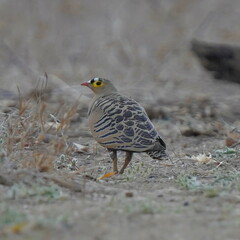
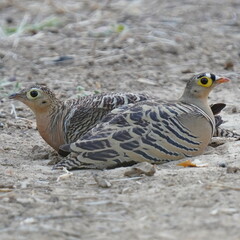
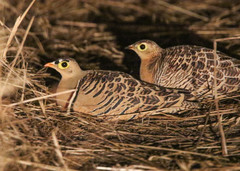
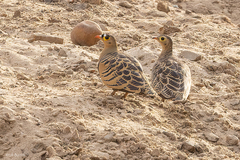
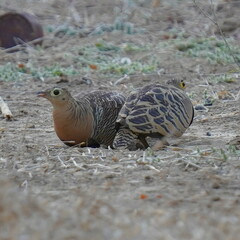
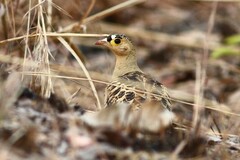
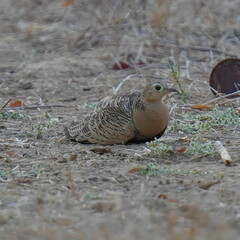
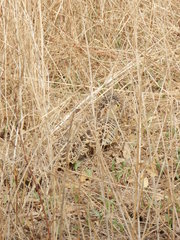
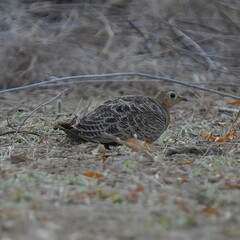
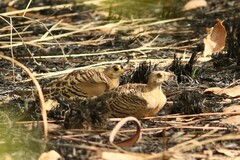
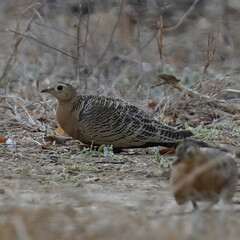
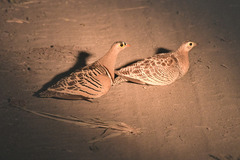
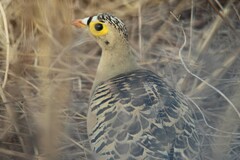
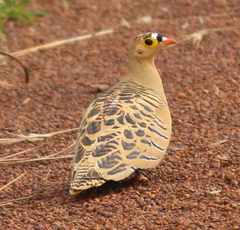
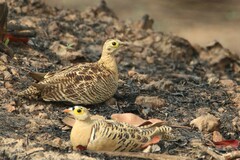
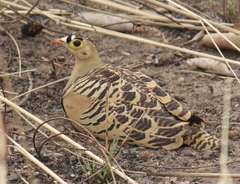
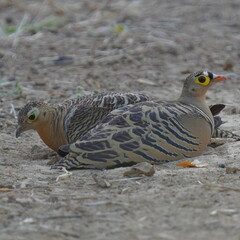
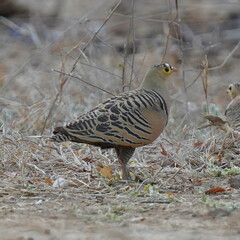
The four-banded sandgrouse is 25–28 cm long. Its head, neck and upperparts are yellowish-green, with the back heavily marked with brown. The male has black and white bands on its forehead as well as black and white bands separating the breast from the heavily barred belly. The female lacks the head and breast bands and is heavily barred on the back and flanks. It has a small, pigeon-like head and neck, but a sturdy compact body. It has long pointed wings, which are grey underneath, a short tail and a fast direct flight.
Distribution and habitat
This gregarious species occurs in a belt across Africa from Mauritania and Cameroon east to Sudan and Uganda. It is much more common in the west of its range. It is a partial seasonal migrant, with some birds moving further north in the rainy season. It breeds on open areas with some trees, including savanna, scrubland and similar habitats.
Behaviour
Flocks fly to watering holes in the evening to drink and are largely nocturnal. The call is a loud wulli-wulli, and there is much twittering at the drinking holes. The nest is a ground scrape into which 2 or 3 buff eggs with brown markings are laid. Both sexes incubate.
References
- ^ BirdLife International (2016). "Pterocles quadricinctus". IUCN Red List of Threatened Species. 2016: e.T22693021A93379066. doi:10.2305/IUCN.UK.2016-3.RLTS.T22693021A93379066.en. Retrieved 12 November 2021.
- Pheasants, Partridges and Grouse by Madge and McGowan, ISBN 0-7136-3966-0
This article uses material from the Wikipedia article "Four-banded sandgrouse", which is released under the Creative Commons Attribution-Share-Alike License 3.0. Content may have been omitted from the original, but no content has been changed or extended.
Common Names
Taxonomic Hierarchy
Kingdom: Animalia
Phylum: Chordata
Class: Aves
Order: Pterocliformes
Family: Pteroclidae
Genus: Pterocles
Species: Four-banded Sandgrouse Pterocles quadricinctus
Conservation Status
least concern (LC)
Four-banded Sandgrouse Pterocles quadricinctus